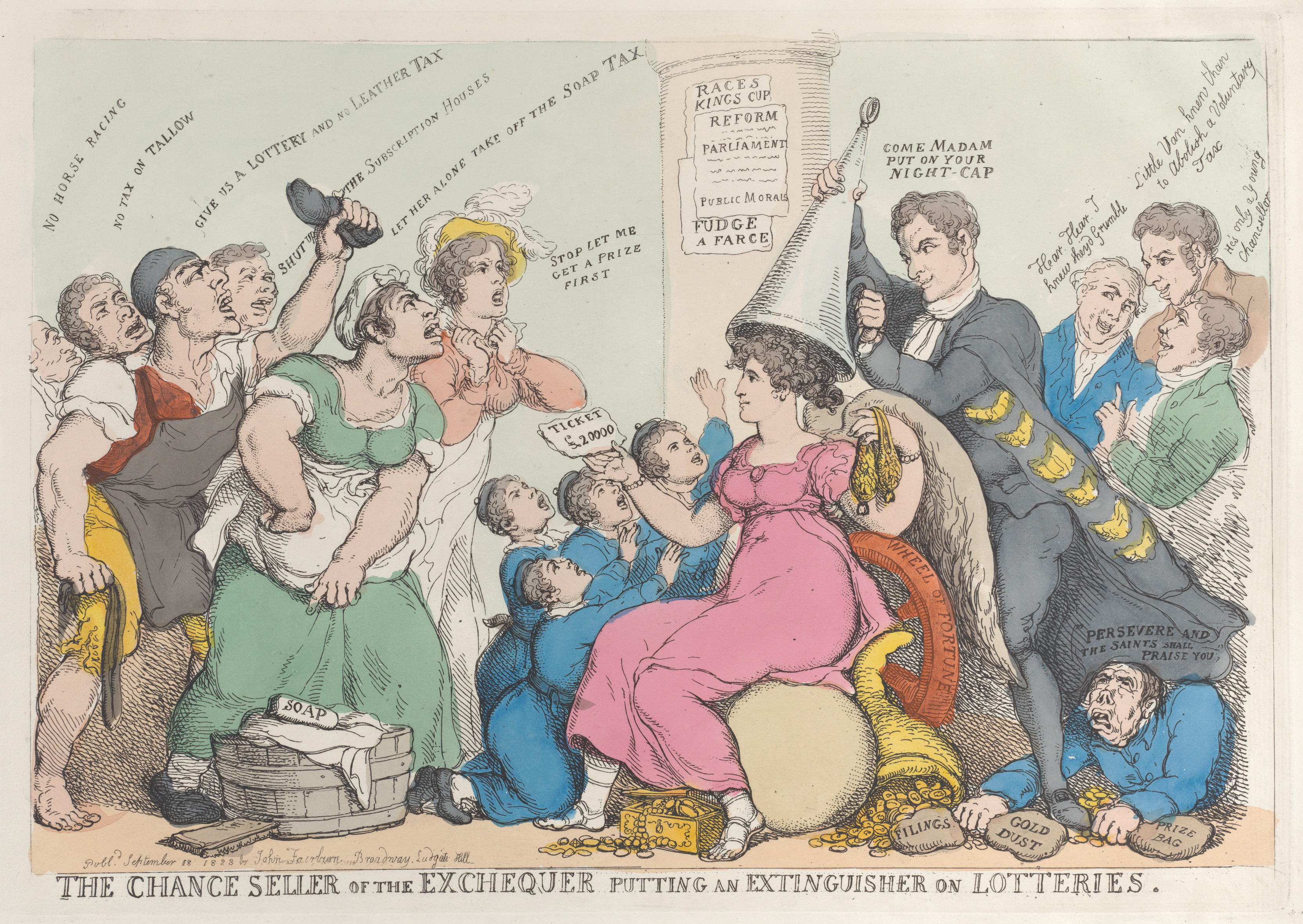
The Chance Seller of the Exchequer: A Study in Draped Authority
The isolated aesthetic archaeology of the 18th-century hand-colored etching, The Chance Seller of the Exchequer Putting an Extinguisher on Lotteries, presents a paradox of classical elegance. At first glance, the composition is a political satire—a moment of fiscal restraint. Yet, for the discerning eye of the Haute Couture curator, the etching reveals a profound lexicon of drapery, proportion, and symbolic weight. The figures, rendered in meticulous line and wash, are not merely characters in a historical anecdote; they are archetypes of sartorial power. The extinguisher itself, a conical, volumetric form, becomes a primary motif. The interplay between the rigid, authoritative structure of the Exchequer’s robes and the fluid, almost chaotic fall of the lottery seller’s garments offers a masterclass in tension. This tension, between control and release, between the architectural and the organic, is the foundational principle for the 2026 luxury silhouette at Natalie Fashion Atelier.
Deconstructing the Etching: The Language of Line and Volume
The etching’s power resides in its linear economy. The artist uses a sparse, yet decisive, hand to define the folds of the Exchequer’s coat. These are not soft, romantic drapes; they are structural pleats, carved with the precision of a stonecutter. The fabric appears heavy, almost metallic—a wool broadcloth or a stiffened silk. The collar, a high, standing band, creates a visual fulcrum, anchoring the entire silhouette. This is a garment of vertical authority. Conversely, the lottery seller’s attire is a study in horizontal dispersal. The sleeves are full, the waistcoat unbuttoned, the cravat a cloud of white linen. The etching captures a moment of kinetic dishevelment, a counterpoint to the Exchequer’s static monumentality. For the 2026 silhouette, this dichotomy translates into a new principle: asymmetric volume control. The left shoulder of a gown may be sculpted into a sharp, architectural peak (the Exchequer’s authority), while the right side cascades into a liquid, unconstructed drape (the seller’s entropy). The hand-coloring—a wash of pale ochre and muted crimson—adds a layer of chromatic restraint, a palette that will define the Atelier’s autumn-winter collection.
From Satirical Symbol to Silhouette Architecture: The Extinguisher as Motif
The extinguisher, the central prop of the etching, is a triumph of negative space. Its conical form is both a tool of suppression and a sculptural object of beauty. In the 2026 context, this form is deconstructed and reimagined as a structural boning element within the bodice. The cone is not worn literally; rather, its geometry informs the internal architecture of the garment. We see this in the development of a new corset, the Éteignoir corset. It features a series of graduated, petal-like panels that radiate from the sternum, creating a funnel-shaped torso that narrows at the waist and flares subtly at the hips. This is not a Victorian wasp waist; it is a modernist volume, a controlled explosion of form. The “extinguishing” action is translated into a draped closure—a single, long sash of duchesse satin that wraps from the left hip, crosses the front, and is secured at the right shoulder, effectively “putting out” the visual heat of the silhouette. The etching’s satirical edge is thus preserved: the 2026 woman does not suppress chance; she architects it.
Materiality and Craft: The Hand-Colored Imperative
The hand-colored nature of the etching is not a decorative afterthought; it is a process-driven directive. Each print is unique, the color applied by an artisan’s hand. This principle of artisanal intervention is the core of the Atelier’s 2026 haute couture approach. The fabrics for the collection will be treated as a blank canvas for pigment. We are developing a technique of hand-painted silk gazar, where a master colorist applies washes of muted chartreuse, oxidized silver, and deep aubergine—directly translating the etching’s ochre and crimson into a modern, nocturnal palette. The application is not uniform; it is gradated and layered, mimicking the wash of the original print. The silhouette itself becomes a three-dimensional etching. The seams are not hidden; they are emphasized with a fine, hand-stitched line of metallic thread, echoing the etching’s defining strokes. The construction of a ball gown, for instance, will begin with a paper pattern that is itself a drawing, a blueprint of line and volume, before a single piece of silk is cut. This is aesthetic archaeology in action: the 18th-century print is not a reference; it is a methodology.
The 2026 Silhouette: A Synthesis of Draped Authority and Sculpted Chance
The final silhouette for 2026 emerges as a synthesis of these elements. It is a silhouette of controlled asymmetry and volumetric dialogue. The daywear silhouette, the Exchequer, is a tailored coat-dress with a single, exaggerated shoulder—a rigid, architectural peak that references the Exchequer’s collar. The opposite side falls in a clean, unbroken line to the floor. The fabric is a double-faced wool, one side a deep charcoal, the other a flash of hand-painted crimson. The evening silhouette, the Lottery Seller, is a study in liquid volume. A gown of hand-painted silk gazar features a bodice that is a sculpted cone (the extinguisher), while the skirt is a cascade of asymmetrical, knife-pleated panels that seem to be in a state of perpetual motion. The closure is a single, dramatic sash—the extinguisher’s handle—that is tied in a complex, non-repeating knot. The 2026 Natalie Fashion Atelier woman is not wearing a costume; she is wearing a constructed argument. She embodies the etching’s central tension: the authority to control and the grace to embrace the unpredictable. The silhouette is a dialogue between the classical and the contemporary, a hand-colored moment of pure, architectural elegance. The chance seller has been extinguished, but only to make way for a new, more deliberate form of couture chance.