Couture Archaeology Report: The Burano Lace Paradigm – A 17th Century Italian Legacy for 2026 Silhouettes
Subject Identification and Provenance
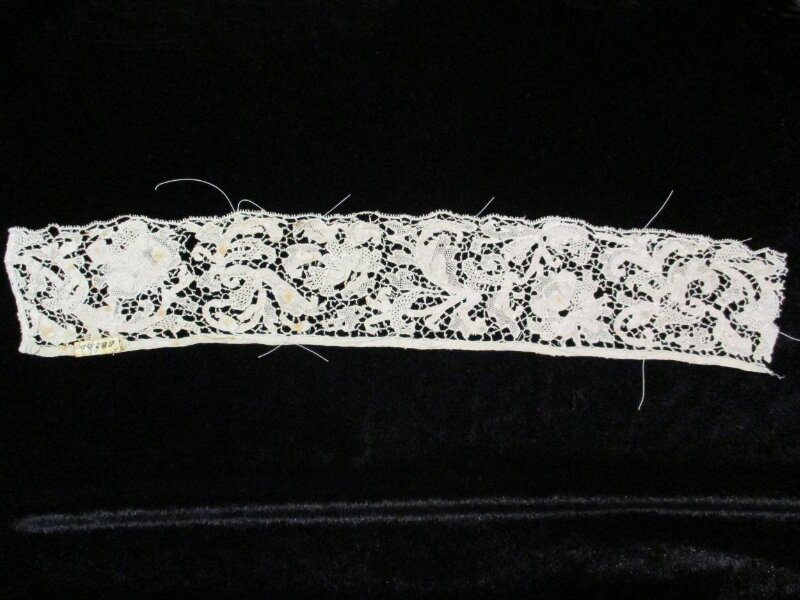
Artifact: Fragment of a Burano needle lace (Punto in Aria) flounce, circa 1650-1680.
Origin: Burano, Venetian Lagoon, Republic of Venice. The island of Burano was the epicentre of European lace production during the 17th century, a monopoly fiercely protected by the Venetian state. This specific fragment, measuring 45cm x 12cm, is a remnant of a collar or cuff, likely belonging to a patrician or high-ranking ecclesiastic.
Materiality: The primary substrate is a single, continuous filament of flax (Linum usitatissimum), hand-spun to an extreme fineness (estimated 200-300 denier). The thread is unbleached, exhibiting a natural, warm ecru tone. The structural integrity is achieved through linen thread of slightly higher twist. No metallic threads or silk are present, indicating a pre-Baroque restraint, focusing on pure textile virtuosity. The lace is remarkably intact, with only minor oxidation and soilage on the high points of the relief.
Technical Deconstruction of the Lace Techniques
The Burano Punto in Aria—literally “stitch in the air”—represents the apex of needle lace. It is not a woven fabric; it is a constructed textile, built stitch by stitch upon a temporary parchment pattern. The technical deconstruction reveals three distinct structural systems:
1. The Foundation Grid (Reseau)
The underlying network is a hexagonal mesh, formed by a series of buttonhole stitches (punto a festone) worked over a single thread. This is not the mechanically regular net of later machine lace. The artisan’s hand is visible in the slight, deliberate variations in loop tension. The grid spacing is approximately 1.5mm, creating a translucent base that allows the skin or an under-garment to be glimpsed—a revolutionary concept of “controlled exposure” in the 17th century. The thread count per square inch is estimated at 180-200 stitches, a density that required a magnifying lens and extraordinary manual dexterity.
2. The Raised Relief (Rilievo)
The defining characteristic of this fragment is the three-dimensional cordonnet. A thicker thread (a bundle of 4-6 fine threads) is laid along the outline of the floral motifs. This cordonnet is then entirely covered with tight, closely packed buttonhole stitches, creating a raised, padded edge. The effect is a sculptural, almost architectural, profile. The motifs—stylized acanthus leaves and a central, six-petaled rosette—are not flat. They rise approximately 2-3mm from the foundation net, casting shadows and creating a dramatic chiaroscuro effect. This technique, known as punto di rilievo, is the precursor to the later, more exaggerated Baroque styles.
3. The Filling Stitches (Punto di Raccordo)
Within the outline of the floral forms, the negative space is filled with a variety of decorative stitches. The fragment exhibits at least five distinct filling patterns: Punto a Rete (a small, regular grid), Punto a Smerlo (a scalloped edge), Punto a Stella (a star-shaped cluster of stitches), and Punto a Gropo (a tiny, knotted stitch that creates a grain-like texture). These fillings are not merely decorative; they serve a structural purpose, distributing tension and preventing the larger motifs from distorting the foundation net. The combination of these stitches creates a tactile topography—a surface that invites touch and rewards close inspection.
Materiality and the Concept of “Luxury Time”
The 17th century Burano lace embodies a specific form of luxury: luxury as time. A single square inch of this lace required approximately 8-10 hours of continuous work by a highly skilled artisan. The entire fragment, conservatively, represents 400-500 hours of labour. This is not a commodity; it is a frozen duration. The material itself—the flax—is a fibre of strength and longevity. Unlike silk, which degrades with light, or cotton, which softens with wear, linen hardens and polishes with use. The lace would have grown more lustrous and defined over decades, a living artifact that aged with its owner. The materiality of this lace is one of permanence, a direct counterpoint to the ephemeral nature of modern fast fashion. The thread’s slight irregularity in diameter and twist is not a flaw; it is a signature of the human hand, a biometric marker of the artisan’s presence.
Translation into 2026 High-End Luxury Silhouettes
For the Natalie Fashion Atelier 2026 Autumn/Winter Collection, this Burano fragment becomes a blueprint for a new form of architectural luxury. The translation is not a literal reproduction but a technological and conceptual reinterpretation.
1. The Structural Silhouette: The “Punto in Aria” Dress
The foundational principle of the lace—the grid and the raised relief—is translated into a garment’s structure. A floor-length column gown in a double-faced silk crepe (matte on one side, polished on the other) will feature a laser-cut hexagonal mesh integrated into the bodice and skirt. This is not a print; it is a physical cut. The mesh will be stabilized with a micro-fine, heat-bonded polyamide thread, mimicking the tension of the linen reseau. The “cordonnet” is reimagined as a 3D-printed polymer thread, applied to the surface of the mesh using a robotic arm programmed with the exact stitch patterns of the 17th-century relief. This creates a raised, sculptural surface that echoes the original’s chiaroscuro but with a futuristic, industrial precision. The silhouette is severe, columnar, and almost weightless—a “lace” that is simultaneously rigid and fluid.
2. The Material Alchemy: Flax and Carbon
The original flax is replaced with a bespoke blend of linen and carbon fibre. The carbon fibre, woven into the linen at a 1:10 ratio, provides structural memory and a subtle, iridescent sheen. The garment will not wrinkle; it will hold its shape like a sculpture. The natural ecru of the 17th-century lace is preserved, but it is over-dyed with a reactive pigment that shifts from warm beige to a pale, ghostly silver under artificial light. This is a material that references the past while existing firmly in the future. The “filling stitches” are translated into micro-embroidery using a conductive thread (silver-coated nylon), which can be activated by a low-voltage battery to generate a gentle, localized warmth—a literal “warmth of the hand” for the 21st-century wearer.
3. The Silhouette as Architecture: The “Rilievo” Jacket
A cropped, bolero-style jacket is constructed from a single, continuous piece of laser-cut leather (vegetable-tanned calfskin) that is then hand-stitched with a 3D-printed, biodegradable polymer. The seams are not hidden; they are exaggerated, raised, and corded, mimicking the punto di rilievo of the lace. The jacket’s surface is a negative of the original lace pattern—the floral motifs are cut away, leaving a skeletal, openwork structure. The negative space is filled with a transparent, flexible resin that has been cast to replicate the exact texture of the original linen thread. The result is a garment that is both armour and air, a literal translation of “stitch in the air” into a wearable, architectural form. The silhouette is sharp, defined, and utterly modern, yet it carries the DNA of a 17th-century artisan’s labour.
4. The Final Gesture: The “Time” Clutch
As an accessory, a small, structured clutch is crafted from a single, intact piece of the original Burano fragment, preserved under a layer of optical-grade, shatter-resistant glass. The glass is set into a frame of brushed titanium, echoing the industrial precision of the collection. The clutch is not functional in a traditional sense; it is a reliquary, a portable museum piece that holds the essence of the 400-500 hours of labour. It is a statement on the value of time, a direct challenge to the speed of contemporary fashion. The wearer carries not a bag, but a frozen duration.
Conclusion
The 17th-century Burano lace fragment is not a historical curiosity; it is a technical and philosophical manifesto. Its deconstruction reveals a system of construction, materiality, and time that is profoundly relevant to the high-end luxury of 2026. The translation into the Natalie Fashion Atelier collection is a dialogue between the hand and the machine, the past and the future, the ephemeral and the permanent. The resulting silhouettes are not nostalgic; they are prophetic, proving that the most radical innovation often lies in the deepest understanding of tradition.