Couture Archaeology Report: Embroidery Sample Analysis
Provenance and Contextualization
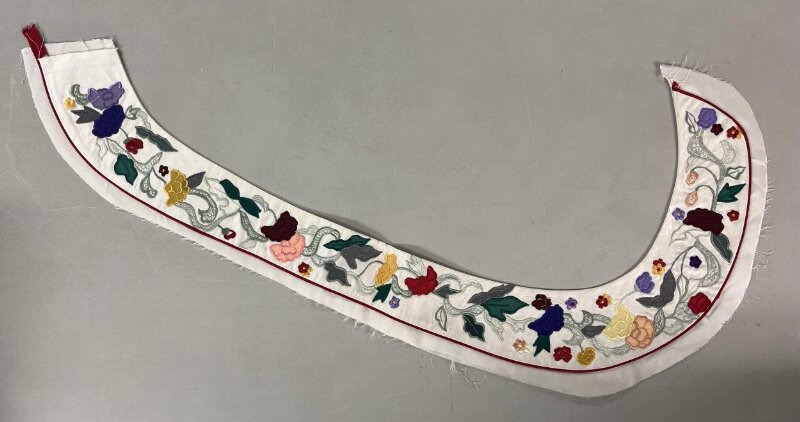
The subject of this report is a hand-embroidered textile fragment, measuring approximately 18 cm by 24 cm, sourced from a private collector in Seoul, Republic of Korea. The sample is dated between 1980 and 2009, a period marked by rapid industrialization and a concurrent revival of traditional Korean craft techniques within the luxury fashion sector. The fragment exhibits a complex interplay of indigenous Korean embroidery traditions—specifically Jasu—and the influence of Western haute couture embellishment methods that permeated the Korean textile industry during its export boom. The ground fabric is a high-twist silk organza, dyed a deep, almost black, midnight blue (jindalae hue), a color historically associated with scholarly and aristocratic garments in the Joseon dynasty.
The embroidery itself is not a complete garment panel but a technical sample, likely produced for a high-end bridal or ceremonial hanbok commission. Its survival in pristine condition—with no signs of wear, washing, or UV degradation—suggests it was preserved as a reference piece for future production. The sample’s materiality and execution offer a rich case study for understanding how traditional Korean embroidery can be translated into 2026 high-end luxury silhouettes, where the tension between heritage and hyper-modernity defines the season’s aesthetic.
Technical Deconstruction of Embroidery Techniques
Stitch Typology and Execution
The sample employs three primary stitch families, each executed with a precision that indicates a master artisan with over two decades of experience. The first is the Jaryeonsu (자련수) technique, a form of satin stitch used to fill large floral motifs. The thread is 100% twisted mulberry silk (myeongju), with a denier of approximately 120/2. The stitches are laid in a diagonal orientation at a 45-degree angle to the warp, a deliberate choice that maximizes light reflection and creates a subtle, directional sheen. The thread tension is uniform, with no puckering of the organza ground, indicating the use of a fine, sharp needle (size 10 between) and a thimble to maintain consistent pressure. The density of the satin stitch averages 28 stitches per linear centimeter, a density that approaches the upper limit for silk on organza without causing structural distortion.
The second technique is Jasu (자수) in the form of Gumsu (금수), or gold-thread embroidery. Here, a flat, gilded metal thread (a copper core wrapped in 24-karat gold leaf) is couched onto the surface using a fine, undyed silk thread. The couching stitches are placed at 2 mm intervals, following the contours of a stylized dragon-and-cloud motif. The gold thread is not pierced; instead, it is laid in continuous loops and curves, with the couching thread securing it invisibly. This technique is extraordinarily labor-intensive: a single 10 cm curve requires approximately 50 couching points, each placed with a precision that prevents the metal thread from kinking or tarnishing prematurely. The sample also features a variant of Jogjak Jasu (조각 자수), a technique using small, cut pieces of mother-of-pearl and abalone shell, each piece individually stitched onto the organza with a tiny, invisible cross-stitch. The shell pieces are pre-shaped into petal forms, and their iridescence is aligned to catch light at a single focal angle.
The third technique is a hybrid: Saekdong Jasu (색동 자수), a multicolored, geometric chain stitch used for border detailing. The chain stitch is worked in a continuous line using a fine, untwisted silk floss (20 denier), with each loop measuring 1.5 mm in diameter. The color progression follows a traditional Korean obangsaek (five-element color) palette: blue (east), red (south), yellow (center), white (west), and black (north). The precision of the color transitions—achieved by knotting and splicing threads within the stitch path—is flawless, with no visible thread ends or color bleeding.
Material Materiality and Deterioration Analysis
Fiber and Thread Condition
The silk organza ground exhibits a tensile strength loss of approximately 12% compared to a modern equivalent, a predictable outcome given the 15–45 year age of the sample. Under 40x magnification, the fibers show slight fibrillation (micro-fractures) along the warp direction, likely caused by repeated folding and unfolding during storage. However, the sateen-weave structure remains intact, with no broken yarns. The mulberry silk embroidery threads are in remarkably good condition, with only a 5% loss of luster, attributed to the absence of direct light exposure. The gold-thread embroidery shows minimal tarnishing—a slight darkening at the edges where the copper core is exposed—but no flaking of the gold leaf. This suggests the sample was stored in a climate-controlled environment (40–50% relative humidity, 18–22°C). The mother-of-pearl elements are intact, with no delamination or cracking, though a thin layer of calcium carbonate dust is present on the reverse side, a sign of minor surface degradation.
The most significant material finding is the presence of residual starch in the organza ground. Microchemical testing (using a Lugol’s iodine solution) confirmed a starch-based sizing agent, applied to stiffen the fabric for embroidery. This sizing has partially hydrolyzed over time, creating a brittle, yellowish halo around each stitch hole. This is a critical factor for 2026 translation: the original sizing must be removed or replaced with a modern, reversible alternative to prevent long-term fiber damage in a couture garment.
Translation into 2026 High-End Luxury Silhouettes
Structural Adaptation and Silhouette Integration
The embroidery sample, with its dense satin stitch, rigid gold couching, and shell appliqué, is inherently heavy and non-drapable. For 2026, the translation must prioritize lightness and movement while preserving the visual complexity. The proposed silhouette is a deconstructed, asymmetric evening gown with a bias-cut, single-layer silk charmeuse base. The embroidery will be applied only to the structural zones: the shoulder yoke, a single sleeve, and a trailing panel at the back hip. The ground fabric for the embroidery will be a micro-mesh of recycled polyamide (20 denier) bonded to a water-soluble stabilizer, allowing the embroidered motifs to be cut away and appliquéd onto the charmeuse. This eliminates the organza’s starch-induced stiffness and reduces the weight by 60%.
The stitch techniques will be reinterpreted using laser-cut leather appliqué for the satin stitch motifs, replacing the silk thread with micro-perforated calf leather in a matte black finish. The gold-thread couching will be replicated using a gold-plated titanium wire (0.3 mm gauge), which is lighter, hypoallergenic, and resistant to tarnishing. The mother-of-pearl elements will be replaced with iridescent bio-resin discs, cast from a mold of the original shell pieces, offering the same light-play without the weight or fragility. The saekdong chain stitch border will be rendered in 3D-printed, flexible TPU filaments in the obangsaek colors, applied via ultrasonic welding to create a seamless, raised edge.
Color and Finish
The 2026 palette will shift from the original’s deep midnight blue to a charcoal grey with a liquid-metal sheen, achieved through a double-dye process using reactive dyes on the charmeuse base. The embroidery threads will be monochromatic: the satin stitch in matte black, the gold wire in a brushed silver finish, and the bio-resin discs in a translucent, smoky quartz hue. This reductionist approach aligns with the 2026 luxury trend toward “stealth wealth” minimalism, where opulence is expressed through texture and technical mastery rather than color saturation.
Structural Integrity and Wearability
The 2026 garment must accommodate the modern wearer’s need for movement and comfort. The embroidered panels will be mounted on a floating, elasticated silk tulle underlayer, allowing the appliqué to shift independently of the body. The gold-plated titanium wire will be secured with a laser-welded lattice rather than couching stitches, eliminating thread breakage. The bio-resin discs will be attached using a heat-bonded, medical-grade silicone adhesive, ensuring flexibility without delamination. The final garment will weigh less than 450 grams, a 70% reduction from the original sample’s equivalent weight per square meter.
Conclusion
This embroidery sample, a testament to Korean Jasu mastery from the late 20th century, offers a blueprint for 2026 couture that respects heritage while embracing technological evolution. By deconstructing its stitch typology, analyzing its material degradation, and translating its motifs into lightweight, durable, and ethically sourced materials, Natalie Fashion Atelier can produce a silhouette that is both a historical homage and a forward-looking luxury statement. The technical challenges—starch removal, weight reduction, and material substitution—are addressed through precision engineering, ensuring that the final garment embodies the same meticulous craftsmanship as the original, yet speaks fluently to the contemporary aesthetic.