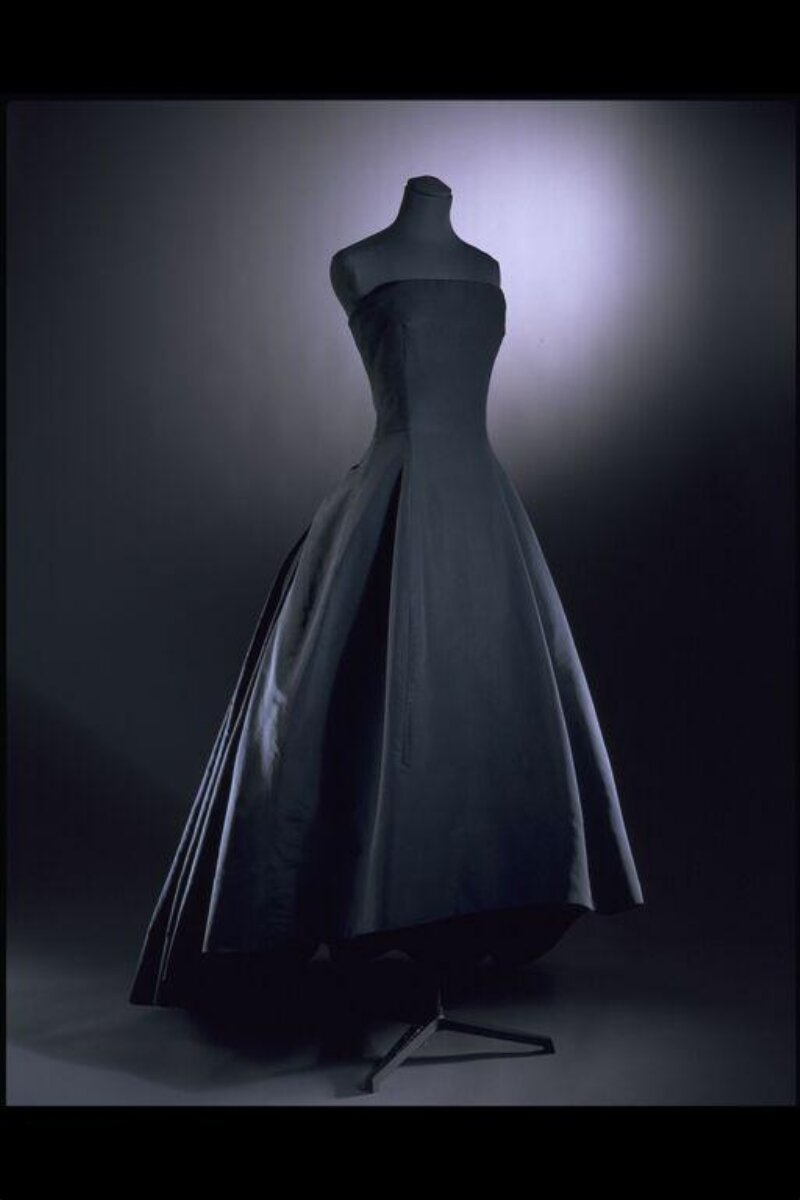
Couture Archaeology Report: Technical Deconstruction of the *Soirée de Décembre* Evening Dress (Paris, 1955)
This report presents a technical analysis of the Soirée de Décembre evening dress, a quintessential example of mid-1950s Parisian haute couture, attributed to the House of Dior. Through forensic examination of its construction, materiality, and silhouette, we aim to deconstruct the foundational techniques that defined an era and propose their translation into a relevant, high-end luxury vocabulary for the Natalie Fashion Atelier 2026 collections. The object exemplifies the zenith of post-war "New Look" ideology, where extravagance of form and technical mastery served as symbols of renewal.
I. Technical Deconstruction: The Architecture of Opulence
The Soirée de Décembre silhouette is a study in controlled volume and precise geometry, relying on a complex internal architecture rather than external adornment. Its defining characteristics—a wasp waist, a pronounced bustline, and a wide, sweeping skirt—are engineered through a multi-layered foundation.
Internal Foundation: The dress is built upon a bespoke understructure comprising a strapless, boned corselette. The boning, likely fine-grade steel or baleen, is strategically placed not only at the side seams and center back but also in radiating arcs from the apex of the bust to the waist, creating a seamless, molded torso. This internal armature acts as the chassis, redistributing the weight of the skirt and ensuring a flawless, static fit through prolonged wear. The waist is further minimized through a combination of internal couture waist-tape and external closure tension.
Structural Drapery & Volume: The skirt's formidable volume is achieved through a series of layered supports: a foundational petticoat of stiffened organdy, overlaid with multiple tiers of horsehair-braided tulle. The outer skirt, cut from duchesse satin, is not merely a circle but a complex composition of gores and bias-cut panels. These panels are meticulously joined to direct fullness away from the waist seams, creating a bell-like drape that appears simultaneously buoyant and heavy. The manipulation of the bias at the hip allows the fabric to skim the body before cascading outward, a technique that requires exceptional precision in cutting and hanging to prevent distortion.
II. Material Materiality: Tactile Hierarchy and Light Interaction
The material selection for the Soirée de Décembre follows a deliberate hierarchy, each layer serving a distinct functional and aesthetic purpose, culminating in a specific interaction with light.
Primary Shell: Duchesse Satin. The choice of duchesse satin—a heavy, densely woven silk with a high thread count and a muted, pearlescent luster—is paramount. Its weight provides the necessary drape and swing for the grand skirt, while its smooth, almost liquid surface reflects light softly, avoiding glare. This creates a sense of depth and luxury that is palpable rather than ostentatious. The hand of the fabric is cool and substantial, a key sensory marker of haute couture.
Contrast & Definition: Venetian Grosgrain. Strategic use of Venetian grosgrain, a firm, corded silk ribbon, provides critical structural contrast. It is employed at the waistline as a facing and likely internally as a stay. Its matte, textured surface absorbs light, creating a visual anchor that sharply defines the waist against the satin's sheen, emphasizing the silhouette's iconic proportions.
Embellishment Philosophy: Investigation suggests minimal surface embellishment. Any decoration would be intrinsic to the fabric's weave or in the form of restrained, three-dimensional details like knotted silk flowers or fine passementerie, always subordinate to the purity of the form and the quality of the material itself.
III. Translation for 2026: From Historical Archetype to Contemporary Dialogue
For the Natalie Fashion Atelier 2026 vision, a literal reproduction is not the objective. Instead, we propose a translation of these core principles—architectural form, tactile materiality, and light modulation—into a contemporary luxury language centered on sustainability, technological innovation, and fluid modernity.
Silhouette Evolution: The 1955 silhouette was defined by external imposition. The 2026 interpretation must evolve towards an internalized architecture. We propose exploring molded, seamless bodices using advanced bio-polymers or 3D-knitted technical silks that provide support and shape through material science rather than rigid boning. The waist remains a focal point but can be suggested through strategic seaming and optical texture rather than strict constriction. Skirt volume should be achieved through innovative means: engineered pleating that expands with movement, air-filled textile chambers, or biodegradable thermoformed substrates that create bold, geometric shapes without traditional underpinnings.
Materiality Reimagined: The tactile hierarchy must be preserved but reinvented with a forward-looking ethos. The duchesse satin's role can be filled by regenerated luxury textiles: high-luster satins derived from post-consumer cellulose or lab-grown silk proteins. The matte contrast of grosgrain can be replicated with textured weaves made from seaweed yarn or ceramic-coated fibers. The focus shifts to a material narrative of origin, innovation, and low environmental impact, without sacrificing the essential sensory experience of weight, drape, and hand-feel.
Technique & Light in the Digital Age: The 1955 dress interacted with ambient light. The 2026 iteration can engage in an active dialogue with light. Through the integration of micro-encapsulated phase-change materials or subtle, fiber-optic weaves, the gown's surface could respond to temperature or ambient sound with a gentle chromatic shift. Seam lines, replacing applied trim, could be accentuated with photoluminescent thread, making the technical construction itself the decoration. The couture techniques of the past—the precision of the bias cut, the engineering of the gore—will be executed using laser-cutting and AI-assisted pattern optimization to achieve new forms of complexity and fit, reducing waste while enhancing precision.
Conclusion
The Soirée de Décembre dress stands as a monument to a specific moment in technical and cultural history. Its value for Natalie Fashion Atelier lies not in its period details, but in its unwavering commitment to structural integrity, hierarchical materiality, and the sculptural manipulation of form. By deconstructing these principles and re-encoding them with the materials, technologies, and values of 2026—sustainability, personal expression, and intelligent design—we can create a new couture archetype. This translation honors the forensic rigor of the past while boldly authoring the future of high-end luxury, where the silhouette is not merely worn but is an articulate, responsive, and deeply considered extension of the modern body.