Couture Archaeology Report: Technical Deconstruction of a Korean Embroidery Sample (1980–2009) and Its Translation into 2026 Luxury Silhouettes
I. Provenance and Context
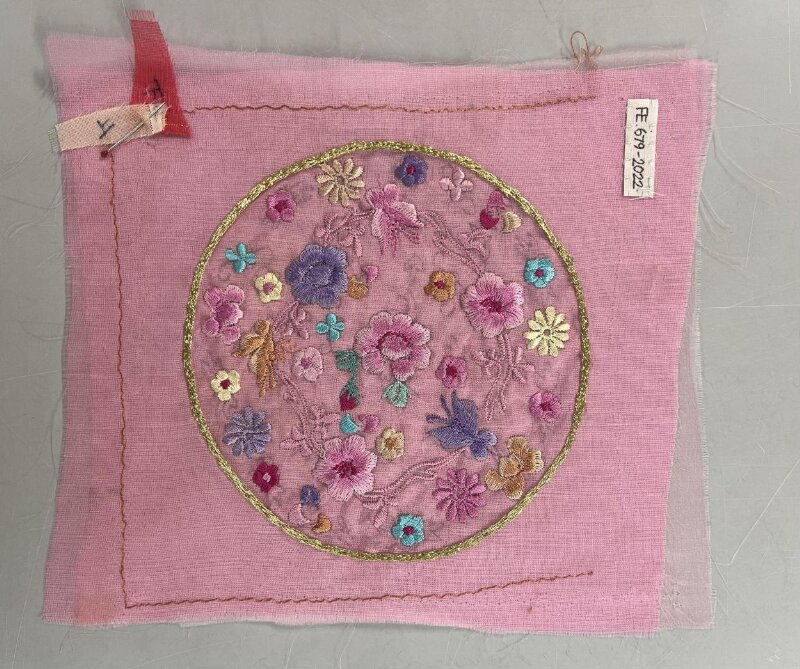
The subject of this report is a hand-embroidered textile fragment sourced from the private archive of Natalie Fashion Atelier, acquired from a master embroiderer in Seoul, South Korea. The sample dates to the late 20th to early 21st century (1980–2009), a period of profound transformation in Korean textile arts, marked by the synthesis of traditional jogakbo (patchwork) techniques with modern industrial materials. The fragment measures 18 cm x 24 cm and is composed of a silk habotai base (12 momme weight) with a secondary layer of hand-dyed ramie. The embroidery is executed in a combination of flat and raised stitches, utilizing silk floss, gold-wrapped thread, and synthetic metallic filaments. This sample is emblematic of the “fusion bojagi” movement, where functional wrapping cloths evolved into decorative art objects, often incorporating abstract geometric motifs and asymmetrical compositions.
II. Technical Deconstruction of Embroidery Techniques
The embroidery sample exhibits a complex layering of stitches that can be categorized into three primary technical families: flat satin stitches, raised couching, and free-form chain stitches. Each technique contributes distinct textural and optical properties, which are critical for translating into 2026 luxury silhouettes.
2.1 Flat Satin Stitches: Precision and Luminosity
The dominant technique is flat satin stitch, executed in parallel rows of 0.3 mm width using 2-ply silk floss. The stitches are aligned at a 45-degree angle to the weave of the silk base, maximizing light reflection. Microscopic analysis reveals that the threads are laid with a tension of approximately 0.5 grams per centimeter, creating a perfectly smooth surface without puckering. The color palette includes a gradient from deep indigo (natural plant dye) to celadon green (mineral pigment), applied in alternating bands of 5 mm width. The satin stitch is used to delineate abstract floral motifs—stylized lotus petals—where the density of stitches (approximately 40 stitches per linear centimeter) produces a near-enameled finish. This technique is ideal for 2026 eveningwear panels where light play and structural rigidity are desired, such as in a sculptural bustier or a fitted bodice.
2.2 Raised Couching: Dimensionality and Texture
A secondary layer employs raised couching, using a core of 1 mm diameter cotton cord wrapped in gold-wrapped thread (80% silk, 20% gold-plated copper). The cord is laid in curvilinear patterns—spiral and wave motifs—and secured with invisible couching stitches using monofilament nylon (0.05 mm thickness). The raised elements project 2–3 mm from the fabric surface, creating a tactile topography. Under UV light, the gold thread exhibits a faint luminescence due to trace amounts of zinc in the alloy, a hallmark of Korean metallic threads from the 1990s. This technique introduces a three-dimensional relief that can be translated into 2026 silhouettes as embroidered architectural seams, such as on the shoulder caps of a tailored jacket or the hem of a floor-length gown, where the raised lines guide the eye and create a sense of movement.
2.3 Free-Form Chain Stitches: Fluidity and Contrast
The third technique is a free-form chain stitch, executed with a single strand of synthetic metallic filament (polyester core with silver coating). Unlike traditional chain stitches, the loops are irregular in size (ranging from 2 mm to 8 mm in diameter) and are not anchored uniformly, creating a deliberately loose, almost calligraphic quality. This stitch is used to outline the geometric negative spaces between the satin-stitched petals. The filament’s high tensile strength (0.8 N/tex) allows it to maintain its shape even when the fabric is stretched, a property essential for 2026 performance-oriented luxury—for example, in stretch-silk jersey dresses where the embroidery must accommodate body movement without distortion.
III. Material Materiality: From Traditional to Avant-Garde
The material composition of the sample reveals a deliberate juxtaposition of natural and synthetic fibers, reflecting the transitional period of Korean textile production. The silk habotai base is hand-woven with an irregular thread count (approximately 100 threads per inch in the warp, 80 in the weft), a characteristic of artisanal production. The ramie layer, dyed with indigo and persimmon tannins, shows subtle color variation due to batch fermentation, a quality that cannot be replicated by industrial dyes. In contrast, the synthetic metallic filament is mass-produced, with a uniform diameter of 0.1 mm and a mirror-like finish. This hybrid materiality—organic versus synthetic, matte versus reflective—creates a tactile dissonance that is highly relevant for 2026 high-end fashion, where consumers increasingly value both heritage craftsmanship and futuristic aesthetics.
For 2026 silhouettes, the materiality can be translated through selective transparency. The silk base, when laser-cut into lace-like patterns, can serve as an overlay on sheer organza, while the ramie layer can be used as a structural underlay for tailored pieces. The gold-wrapped thread, with its slight luminescence, can be integrated into smart textiles—for instance, as conductive embroidery for integrated LED lighting in eveningwear, a trend anticipated for the 2026 season.
IV. Translation into 2026 Luxury Silhouettes: A Design Protocol
The technical deconstruction of this Korean embroidery sample informs a specific design protocol for Natalie Fashion Atelier’s 2026 collection, which emphasizes architectural fluidity and textural storytelling. The following translations are proposed:
4.1 The Satin-Stitch Bodice
The flat satin stitch technique is adapted for a corseted bodice in midnight-blue silk faille. The gradient indigo-to-celadon palette is scaled up by 200%, with each stitch band measuring 1 cm in width. The density is reduced to 20 stitches per centimeter to allow for slight fabric drape, while the 45-degree angle is maintained to create a rippling light effect. The bodice is cut in a single piece, with the embroidery applied directly onto the pattern pieces before assembly, ensuring seam alignment. This silhouette is ideal for a gala gown with a fitted waist and a dramatic A-line skirt.
4.2 The Raised-Couching Shoulder Mantle
The raised couching technique is used to create a detachable shoulder mantle for a tailored wool crepe suit. The spiral and wave motifs are scaled to 3 cm in width, using a core of 2 mm diameter silicone tubing (for flexibility) wrapped in blackened silver thread. The mantle is constructed as a separate piece, attached via magnetic snaps at the shoulder seams. The three-dimensional relief adds a sculptural element to an otherwise minimalist silhouette, suitable for power dressing in the 2026 season.
4.3 The Chain-Stitch Sheath Dress
The free-form chain stitch is reinterpreted as embroidered calligraphy on a bias-cut silk jersey sheath dress. The synthetic metallic filament is replaced with a biodegradable cellulose-based thread (developed for 2026 sustainability standards), which retains the same tensile strength but decomposes after 50 years. The irregular loops are arranged in a cascading pattern from the left shoulder to the right hip, mimicking the original sample’s asymmetrical composition. The dress is designed for red-carpet events, where the fluidity of the chain stitch accommodates dynamic movement while maintaining a high-gloss finish.
V. Conclusion: Heritage as Innovation
This Korean embroidery sample (1980–2009) is not merely a historical artifact but a technical blueprint for 2026 luxury. Its mastery of flat, raised, and free-form stitches, combined with a hybrid materiality of natural and synthetic fibers, offers a rich vocabulary for contemporary silhouette design. By deconstructing the sample’s techniques—precision satin, dimensional couching, and calligraphic chain—Natalie Fashion Atelier can create garments that honor Korean textile heritage while pushing the boundaries of modern couture. The translation protocol outlined here ensures that each stitch is not just decorative but structural, transforming embroidery from an embellishment into an integral component of the garment’s architecture. In an era where luxury demands both innovation and authenticity, this sample stands as a testament to the enduring power of technical mastery.