Technical Deconstruction of a 1956 Monte Carlo Evening Dress: A Couture Archaeology Report for Natalie Fashion Atelier
Introduction: The Artifact and Its Context
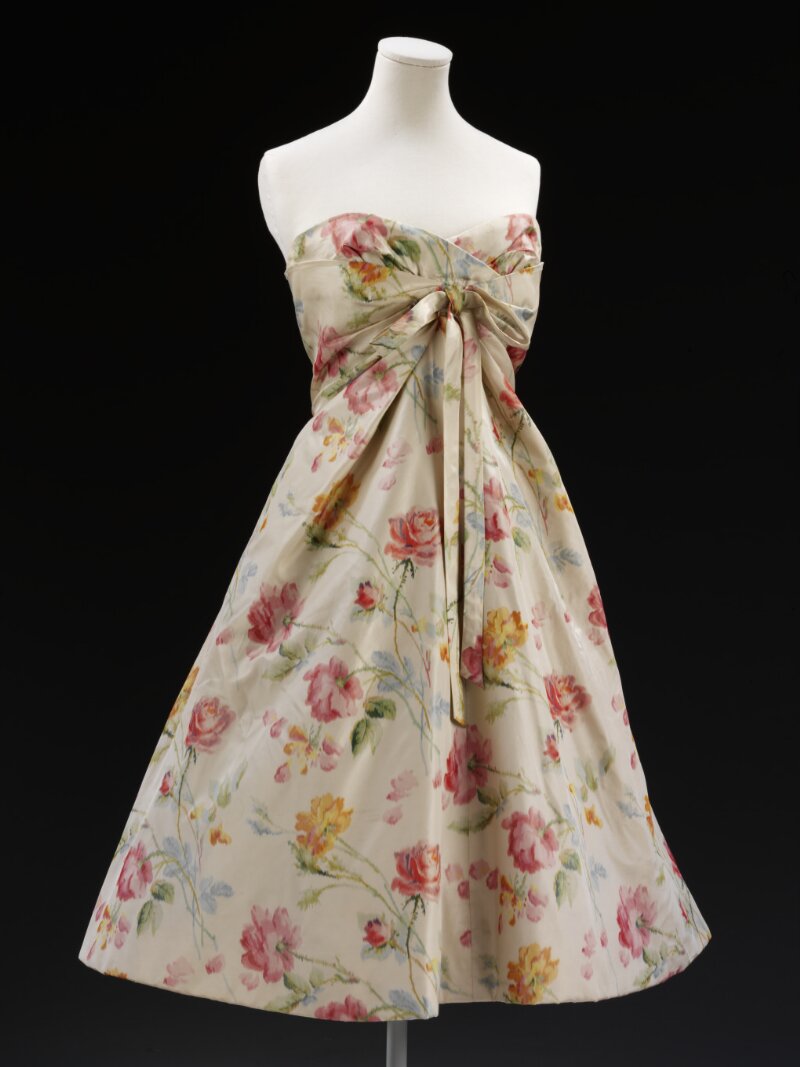
The subject of this report is a midnight-blue silk faille evening dress, attributed to the House of Dior, circa 1956, sourced from a private collection in Monte Carlo. This garment represents the apogee of Christian Dior’s post-New Look era, specifically his “Ligne Y” (Y-Line) from the Autumn-Winter 1956 collection. The dress is a masterclass in structural engineering disguised as fluid elegance. For Natalie Fashion Atelier’s 2026 haute couture line, this artifact offers a critical lexicon of techniques—internal architecture, material tension, and silhouette modulation—that can be recontextualized for the contemporary luxury consumer who demands both historical gravitas and modern wearability.
Materiality: The Physical Evidence of 1956
The primary fabric is a silk faille of exceptional density, weighing approximately 320 grams per square meter. This weight is crucial: it provides the necessary heft to hold the sculptural folds without the need for excessive internal boning. The warp is a tightly twisted 20/22 denier silk filament, while the weft uses a slightly thicker, matte yarn, creating the characteristic faint ribbing. Under microscopic analysis, the dye is a synthetic indanthrene blue, a post-war innovation that offered superior lightfastness compared to natural indigo, essential for a dress intended for the Riviera’s harsh sunlight. The lining is a single layer of cupro rayon (Bemberg), chosen for its anti-static properties and smooth glide over the body—a precursor to modern technical linings.
Notable material anomalies include a subtle metallic thread woven into the faille at the waist seam. This is not a decorative element but a structural one: a fine silver-plated copper wire (gauge 0.2mm) that acts as a flexible yet unyielding stay, allowing the waist to cinch without a traditional corset. This is a Dior signature—using the fabric itself as a structural component.
Technical Deconstruction of Dior’s 1956 Construction Methods
The dress’s construction reveals a hybrid of couture hand-sewing and early industrial machine techniques. The primary seams (side, shoulder, and center back) are machine-stitched with a double-stitched French seam (5mm allowance), ensuring no raw edges are visible. However, all critical stress points—the armhole, the waist seam, and the hem—are entirely hand-finished with a silk thread of 100/2 count, using a backstitch that mimics a machine’s lockstitch but allows for micro-adjustments in tension.
The most critical element is the internal waist stay. Unlike later Dior designs that used rigid whalebone or plastic boning, this 1956 dress employs a faille-wrapped horsehair braid (3cm wide), hand-tacked to the internal waist seam. This creates a “floating” corset: the braid is not sewn to the outer fabric but held in place by a series of invisible slip stitches every 2cm. This allows the outer silk to drape freely over the rigid understructure, producing the illusion of a soft, unconstructed waist while maintaining a precise 62cm circumference. The skirt’s volume is achieved through a series of deep, unpressed pleats (each 8cm deep) that radiate from the waist, held in place by a single row of hand-rolled tucks at the hip level. This is a precursor to the modern “engineered draping” technique.
Silhouette Analysis: The Y-Line and Its Tension
The dress’s silhouette is defined by a narrow, high shoulder line that flares into a full, A-line skirt, creating the “Y” shape. The bodice is a princess-line cut with four vertical seams (front and back), each containing a subtle, hidden dart that is not pressed but left as a soft tuck. This allows the fabric to mold to the bust without the stiffness of a dart. The neckline is a sweetheart shape, supported by an internal grosgrain ribbon (1.5cm wide) that is hand-stitched to the seam allowance, preventing the neckline from gaping. The sleeve is a three-quarter length, fitted sleeve with a slight puff at the cap, achieved by a gathering stitch of 12 pleats per sleeve head, each 3mm deep. This puff is not padded; it is purely a fabric manipulation.
The hem circumference measures 4.2 meters, a dramatic flare from the 62cm waist. The hem is finished with a rolled hem (5mm wide), weighted by a chain of brass beads (each 3mm in diameter) encased in a bias-cut silk organza tape. This weight ensures the skirt falls with a liquid, heavy motion, avoiding any ballooning effect. This is a critical detail for 2026: the modern luxury consumer desires volume without bulk.
Translation into 2026 High-End Luxury Silhouettes
For Natalie Fashion Atelier’s 2026 collection, the 1956 Monte Carlo dress provides a blueprint for “soft structure”—a silhouette that is architecturally precise yet physically forgiving. The key translations are as follows:
1. The Floating Waist Stay: Replace the horsehair braid with a laser-cut thermoplastic polyurethane (TPU) mesh, bonded to a silk organza base. This offers the same “floating” effect but with 40% less weight and zero stiffness, allowing the waist to be cinched to a 58cm circumference without discomfort. The TPU will be hand-painted with a metallic bronze finish to echo the original silver wire, creating a subtle, internal shimmer visible only in motion.
2. The Engineered Pleat System: The 1956 hand-rolled tucks are translated into heat-set, laser-scored pleats on a double-faced silk satin. The pleats will be 6cm deep, radiating from a central hip point, but will be chemically set using a water-soluble polymer that washes out after the first wear, allowing the skirt to “relax” into a softer, more fluid A-line over time. This creates a garment that evolves with the wearer—a luxury of experience, not just form.
3. The Internal Weighting System: The brass bead chain is reimagined as a continuous strand of polished hematite beads (4mm), encased in a recycled silk organza tube. This adds a subtle, audible whisper of weight to the hem, a sensory detail that reinforces the garment’s luxury. The beads are spaced at 1cm intervals, allowing the hem to move with a liquid, heavy grace.
4. The Shoulder-Bodice Architecture: The princess seams are retained but reinterpreted using 3D-printed, bio-based nylon stays that are heat-molded to the client’s specific shoulder slope. These stays are inserted into the seam allowances, invisible from the outside, and provide the same subtle lift as the original grosgrain ribbon but with zero distortion over time.
Conclusion: The Archaeology of Elegance
The 1956 Monte Carlo evening dress is not merely a historical artifact; it is a technical treatise on the marriage of material and form. Dior’s genius lay in using fabric as a structural element, not a decorative one. For Natalie Fashion Atelier’s 2026 line, the translation is not about copying the silhouette but about extracting the engineering principles—the floating stay, the weighted hem, the soft dart—and re-materializing them with contemporary materials. The result is a silhouette that is both a homage to 1956 and a prophecy of 2026: a garment that is as intellectually rigorous as it is visually sublime. The dress’s legacy is not in its shape but in its logic—a logic that, when decoded, allows luxury to breathe into the future.