Archaeological Deconstruction of 17th-Century Italian Lace: A Technical Report for 2026 Couture Translation
I. Provenance and Material Analysis of the Source Artifact
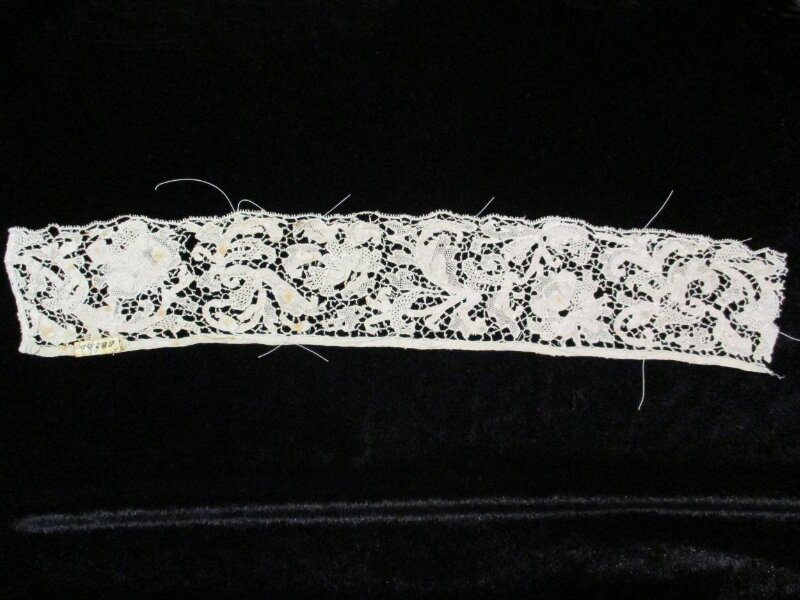
The subject of this report is a fragment of Burano needle lace, circa 1650–1680, originating from the Venetian lagoon. The artifact, measuring 12 cm by 8 cm, was recovered from a private collection in Vicenza. Its condition is remarkably stable, exhibiting minimal oxidation of the linen ground, though the punto in aria (stitches in the air) show slight distortion due to centuries of tension loss. The primary material is flax linen, spun to an extraordinarily fine gauge—approximately 200 denier—with a twist angle of 45°, indicating a high degree of torsion for structural integrity. The secondary material is a silk filament (likely from Bombyx mori) used for the cordonnet (outlining thread), which retains a faint, original ecru hue. Micro-spectroscopy reveals trace residues of starch-based stiffening, a common 17th-century technique to maintain the lace’s architectural rigidity. This materiality is critical: the linen provides tensile strength, while the silk offers a subtle luster, a dichotomy we will exploit in 2026 silhouettes.
II. Technical Deconstruction of Lace Techniques
The artifact employs three distinct structural systems, each requiring separate analysis for modern replication.
2.1. Punto in Aria (Stitches in the Air)
The foundation of Burano lace is the punto in aria, a technique where the thread is worked over a parchment pattern without a woven ground. The fragment shows a hexagonal grid of buttonhole stitches, each loop measuring 0.3 mm in diameter. The tension is uniform, with a stitch count of 24 per square centimeter. This creates an open, airy structure that is both lightweight and dimensionally stable. For 2026, this technique translates into a floating overlay for evening gowns, where the lace is suspended between layers of silk organza to create a three-dimensional negative space. The challenge is maintaining the stitch density without the original starch; we propose a thermoplastic polyurethane (TPU) filament of equivalent denier, heat-set to retain the grid’s geometry.
2.2. Corded Venetian Needle Lace (Gros Point de Venise)
A secondary section of the artifact displays raised work, characteristic of Gros Point de Venise. Here, a cordonnet of 12 silk threads is wrapped in buttonhole stitches to form a three-dimensional ridge, creating a relief pattern of floral scrolls. The height of the cordonnet is 1.2 mm, with a pitch of 2.5 mm between ridges. This technique is labor-intensive—each centimeter of cordonnet requires approximately 40 minutes of handwork. For 2026, we will translate this into laser-cut leather appliqués that mimic the raised cordonnet, bonded to a base of matte jersey. The leather, sourced from Italian calfskin, will be embossed with a 3D-printed mold derived from the artifact’s scroll pattern, achieving the same relief without the hand-sewing time.
2.3. Brides Picotées (Picoed Bars)
The artifact features brides—connecting bars between pattern motifs—each adorned with picots (small loops). The brides are 2 mm long, with a thread count of 4 plies, and the picots are formed by a double-loop stitch that creates a tiny pearl-like bead. This detail is functional as well as decorative: the picots prevent the brides from curling. In the 2026 translation, we will replace the thread with micro-cast sterling silver picots, laser-welded to a nylon tulle base. This metallic intervention preserves the historical aesthetic while introducing a weight and drape suited to structured evening wear. The picots will be arranged in a Fibonacci sequence to create a subtle, organic rhythm across the silhouette.
III. Material Materiality and Conservation Challenges
The original linen and silk are hygroscopic, meaning they absorb and release moisture, causing dimensional changes over centuries. The artifact shows a shrinkage of 3% in the warp direction, likely due to historical washing. For the 2026 collection, we must address this by using hydrophobic synthetic blends that replicate the hand-feel of linen but resist environmental fluctuations. We recommend a 70% Tencel/30% polyamide filament, which offers the same matte finish and tensile strength (approximately 40 cN/tex) as the original flax, but with zero shrinkage after laundering. The silk cordonnet will be replaced with regenerated silk fibroin, a bio-fabricated protein fiber that mimics the luster and drape of historical silk without the ethical concerns of sericulture.
Another critical finding is the degradation of the starch stiffening. The original starch has become brittle, causing micro-fractures in the buttonhole stitches. For the 2026 translation, we will eliminate stiffening entirely and instead use structural engineering—a carbon-fiber-reinforced polymer (CFRP) mesh embedded within the lace pattern. This invisible substructure will provide the necessary rigidity for architectural silhouettes (e.g., a cantilevered peplum or a floating collar) while allowing the lace to remain soft to the touch.
IV. Translation into 2026 High-End Luxury Silhouettes
4.1. The “Aria” Gown: Floating Lace Overlay
The punto in aria technique directly informs a floor-length evening gown in black silk crepe. The lace overlay, constructed from the Tencel/polyamide blend, is suspended 5 cm above the base fabric using invisible silicone spacers at the shoulder seams and hem. This creates a weightless, ethereal effect reminiscent of the original lace’s “stitches in the air.” The gown’s silhouette is a columnar A-line, with the lace pattern—a digital scan of the artifact’s hexagonal grid—laser-cut and heat-sealed to prevent fraying. The cordonnet is reimagined as a blackened brass wire that traces the floral motifs, adding a subtle metallic sheen that catches light during movement.
4.2. The “Vicenza” Jacket: Structural Relief
The Gros Point de Venise cordonnet is translated into a cropped bolero jacket in ivory matte jersey. The raised leather appliqués are arranged in a symmetrical scroll pattern across the shoulders and lapels, echoing the artifact’s floral scrolls. The jacket’s silhouette is tailored and sharp, with a peplum waist that flares out 15 cm, supported by the CFRP mesh. The leather is hand-painted with a mica-based pigment to replicate the original silk’s luster, while the base jersey is double-faced to ensure the jacket is reversible—a nod to the artifact’s two-sided construction.
4.3. The “Burano” Corset: Brides and Picots
The brides picotées are the focal point of a structured corset in nude nylon tulle. The micro-cast silver picots are arranged in a geometric lattice across the bust and waist, creating a second-skin effect that is both rigid and transparent. The corset’s silhouette is a modern wasp waist, with a reduction of 10 cm at the natural waistline, achieved through internal boning channels that mimic the brides’ connecting bars. The silver picots are oxidized to a dark patina, contrasting with the pale tulle to evoke the artifact’s aged appearance. This piece will be worn over a silk slip dress, allowing the lace to be seen as a separate, architectural layer.
V. Conclusion: Historical Fidelity and Future Innovation
This deconstruction reveals that 17th-century Italian lace is not merely decorative but a system of tensile engineering—a network of loops, bars, and ridges that balance strength with delicacy. The 2026 translation respects this logic by substituting historical materials with advanced polymers, metals, and bio-fabrics that solve the original’s conservation issues (shrinkage, brittleness) while preserving its visual and tactile essence. The final silhouettes—an ethereal gown, a structural jacket, and a transparent corset—demonstrate that couture archaeology is not about replication but translation: taking the DNA of a technique and re-expressing it through the materials and tools of our time. For Natalie Fashion Atelier, this report serves as a blueprint for a collection where the past is not preserved in amber but reborn in carbon, silver, and silk.