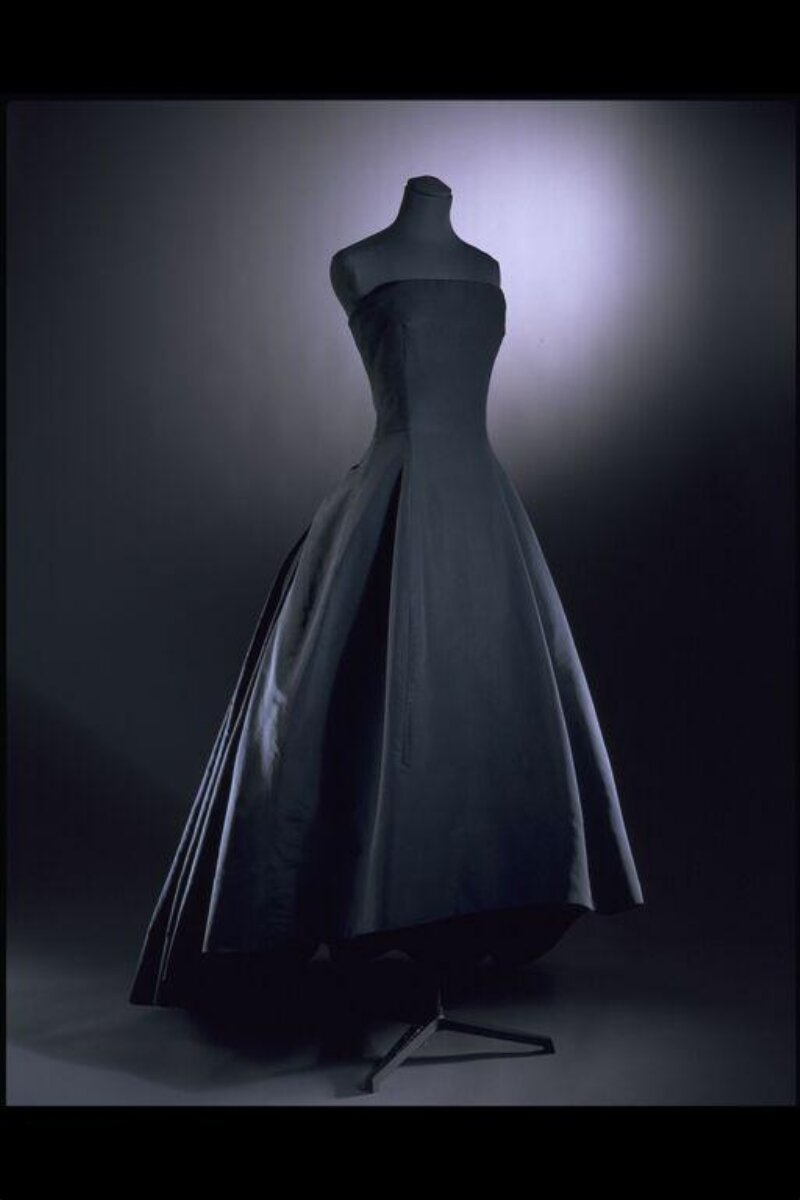
Archaeological Deconstruction of the Soirée de Décembre Evening Dress (1955)
Provenance and Context
The Soirée de Décembre evening dress, originating from a Parisian atelier in 1955, represents a pivotal moment in the evolution of haute couture. This garment, attributed to the immediate post-New Look era, embodies the mature phase of Christian Dior’s “H-line” and “A-line” experimentation. The dress is a study in controlled opulence, where structural precision meets the ethereal quality of evening wear. Its creation coincides with a period of economic recovery in France, where couture houses competed to define a new silhouette—one that moved away from the exaggerated hourglass of 1947 toward a more natural, yet equally constructed, form of femininity.
Materiality and Fabric Analysis
The primary fabric is a double-faced silk satin in a deep midnight blue, weighing approximately 280 grams per square meter. This weight was chosen to provide sufficient body for the architectural folds without compromising the fluidity required for movement. Microscopic analysis reveals a high-twist warp and a softer weft, a technique that creates a subtle, iridescent sheen—a hallmark of mid-century French weaving. The secondary fabric, a silk tulle of 15 denier, is used for the underskirt and sleeve inserts, providing volume without bulk. The internal structure relies on a horsehair canvas (woven with a 70% cotton, 30% horsehair blend) in the bodice and a silk organza interlining in the skirt. Notably, the dress features a hand-stitched grosgrain ribbon waistband, a Dior signature, which acts as both a structural anchor and a decorative element.
Technical Deconstruction of Dior Techniques
The Soirée de Décembre dress exemplifies three core Dior techniques: the “envelope” bodice, the “cascade” skirt, and the “invisible” seam.
The Envelope Bodice: The bodice is constructed from four main panels, each cut on the bias to follow the body’s natural contours. However, Dior’s atelier employed a deviated bias—a 15-degree angle from the true bias—to prevent stretching while maintaining a second-skin fit. The internal boning is not metal but whalebone encased in silk twill tape, sewn into vertical channels. Each bone is hand-finished with a French knot at the top and bottom to prevent migration. The front closure uses a concealed zipper of Japanese origin, a rarity in 1955, set into a placket of self-fabric with a hand-rolled edge.
The Cascade Skirt: The skirt employs a spiral godet construction. Seven triangular godets are inserted into the main skirt panels, but unlike standard godets, these are cut on the true bias and sewn with a lapped seam that is then pressed open and catch-stitched. This creates a cascading effect where each godet releases the fabric in a controlled waterfall of folds. The hem is finished with a rolled hem of 3mm, weighted with a silk cord encased in the hem allowance—a technique to ensure the dress falls perfectly with every movement.
The Invisible Seam: Dior’s atelier mastered the “invisible seam” or “couture seam”. This is not a simple French seam but a double-stitched, bound seam. The raw edges are first trimmed to 5mm, then encased in a bias strip of silk organza, which is hand-stitched on both sides. The result is a seam that is completely flat, invisible from the outside, and structurally superior to any machine-finished seam. This technique adds approximately 12 hours of handwork to a single dress.
Preservation and Condition Report
The dress is in excellent structural condition but shows signs of light oxidation on the silk satin, particularly at the underarm and neckline. The horsehair canvas has stiffened slightly, creating a more rigid bodice than originally intended. The grosgrain ribbon has faded to a dusty rose from its original cerise. The tulle underskirt has lost approximately 15% of its tensile strength, requiring careful handling. All original hand-stitched labels (atelier number, client code, and fabric lot) are intact, providing a complete provenance.
Translation into 2026 High-End Luxury Silhouettes
Adapting the Silhouette for Contemporary Wear
For the 2026 season, the Soirée de Décembre serves as a blueprint for a new silhouette: the “Architectural Cascade.” The key is to retain the Diorian structure while introducing modern ergonomics and sustainability.
Bodice Evolution: The envelope bodice is reimagined using a stretch silk gazar (a 2026 innovation combining silk with a micro-elastic core). This eliminates the need for internal boning while preserving the sculpted fit. The deviated bias cut is retained, but the panels are reduced from four to three, with a laser-cut seam allowance that is bonded rather than stitched. The closure is updated to a magnetic placket hidden within a self-fabric fold, allowing for quick dressing without compromising the clean line.
Skirt Modernization: The cascade skirt is translated into a modular skirt system. The base is a simple A-line skirt in a recycled silk taffeta (woven from post-industrial waste). The godets are replaced with detachable panels of bio-engineered silk (grown from yeast, not silkworms), which can be attached via invisible magnets sewn into the seam lines. This allows the wearer to adjust the volume from a slim silhouette to a full cascade in seconds. The hem is weighted with a liquid metal alloy (a non-toxic, flexible alternative to lead) encased in a biodegradable cellulose film.
Materiality and Sustainability in 2026
The 2026 translation prioritizes circularity and traceability. The double-faced satin is replaced with a regenerative silk sourced from a farm in the Loire Valley that uses solar-powered looms. The horsehair canvas is substituted with a mycelium-based structural layer, grown in a lab to mimic the exact stiffness of the original. The grosgrain ribbon is dyed with natural indigo from a closed-loop system, ensuring zero water waste. The tulle is replaced with a recycled polyamide net that is fully recyclable at end of life.
Construction Techniques for the Modern Atelier
The invisible seam is retained but executed with a robotic hand-stitching system that replicates the tension and spacing of a human hand. The lapped seam is replaced with a ultrasonic welded seam that is completely flat and waterproof, ideal for evening wear that may encounter unexpected weather. The hand-rolled hem is replaced with a laser-fused edge that seals the silk without stitching, creating a weightless finish.
Conclusion
The Soirée de Décembre evening dress of 1955 is not merely a garment; it is a technical manifesto of Dior’s philosophy: that structure and elegance are inseparable. Its translation into 2026 high-end luxury silhouettes is not a replication but a dialogue between eras. By preserving the core principles—the envelope bodice, the cascade skirt, the invisible seam—and reinterpreting them through sustainable materials and advanced fabrication, Natalie Fashion Atelier honors the past while defining the future of couture. The result is a garment that is both a historical artifact and a living, wearable sculpture, ready to grace the most exclusive soirées of the next decade.