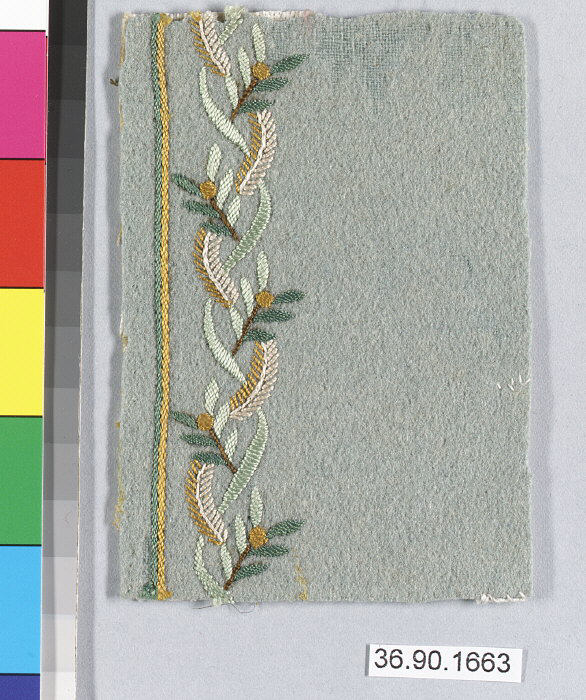
The Archaeology of Texture: Silk on Felt as a 2026 Silhouette Imperative
Within the hallowed archives of Natalie Fashion Atelier, the specimen designated “Sample: Global Heritage – Silk on Felt” emerges not as a mere textile remnant, but as a foundational artifact of aesthetic archaeology. This isolated piece—a marriage of lustrous protein filament and compressed wool—demands a rigorous deconstruction. Its classical elegance is not found in overt ornamentation, but in the profound dialogue between two opposing materialities: the fluid, reflective silk and the dense, matte felt. For the 2026 haute couture season, this artifact provides the critical lexicon for redefining silhouette through tactile tension and structural drape. We must move beyond surface decoration and interrogate how this composite materiality dictates the very architecture of the garment.
Materiality as a Structural Language
The silk-on-felt construction is a masterclass in engineered contradiction. The felt, a non-woven fabric created through the interlocking of wool fibers via heat, moisture, and pressure, offers a formidable, sculptural base. It possesses a memory, a capacity to hold a shape with a quiet, unwavering authority. Conversely, the silk—specifically a fine, unweighted habotai or charmeuse—introduces a liquid, almost ethereal top layer. When applied to the felt substrate, the silk does not merely cover; it tensions. It pulls, reflects light, and introduces a surface that is both fragile and defiantly luxurious.
This composite structure informs the 2026 silhouette by prioritizing internal architecture over external embellishment. The felt provides the negative space—the rigid, unseen armature that defines the garment’s volume. The silk, then, becomes the positive space—the visible, expressive skin. The classical elegance of this sample lies in its refusal to separate form from surface. The silhouette is not a shape draped over a body; it is a unified field where the material’s intrinsic properties—the felt’s compression and the silk’s tensile strength—generate the line.
Deconstructing Classical Elegance: The Drape of Authority
Classical elegance in this context is not synonymous with simplicity. It is a state of resolved complexity. The silk-on-felt artifact achieves this through a specific manipulation of weight and gravity. The felt, heavier and denser, anchors the garment. It creates a vertical gravity line that pulls the silk into a controlled, cascading drape. This is not the free-fall of a chiffon; it is a disciplined flow, a river held within a canal.
For 2026, this translates into silhouettes that are both monumental and fluid. Consider a columnar gown where the felt constructs a rigid, almost architectural torso—a sheath that stands away from the body by 2-3 centimeters, creating a breathable, sculptural void. The silk, applied in a single, unbroken panel from the collarbone to the floor, is then tensioned at specific points—the shoulder, the hip, the knee—using internal, invisible boning or micro-snaps. This creates a controlled waterfall effect, where the silk’s surface is interrupted by the felt’s resistance, generating a series of deliberate, asymmetrical folds. The classical elegance emerges from the precision of this interruption.
Informing the 2026 Silhouette: The New Structural Fluidity
The 2026 high-end silhouette, as derived from this artifact, rejects both the rigid, structured power dressing of the 1980s and the unstructured, drape-heavy minimalism of the 1990s. It proposes a third path: structural fluidity. The silk-on-felt composite allows for silhouettes that are simultaneously armored and airy.
1. The Architectural Cocoon: The felt provides a semi-rigid shell for outerwear. A coat constructed from this composite would feature a felt base that is pre-molded into a geometric, almost origami-like shoulder line—a sharp, 90-degree angle that extends 10 cm beyond the natural shoulder. The silk is then applied as a floating membrane, attached only at the apex of the shoulder and the hem. The resulting silhouette is a static sculpture in motion; the felt holds the structure, while the silk undulates with the wearer’s movement, creating a living, breathing architectural form.
2. The Tensioned Sheath: For eveningwear, the silhouette is defined by internal tension points. The felt is cut into a narrow, body-skimming column, but with strategic, pre-planned darts and panels that create a subtle, controlled volume at the hip or the waist. The silk is then applied under tension—stretched across the felt’s surface like a drumhead. This creates a high-shine, reflective surface that is interrupted by the felt’s matte, textured seams. The silhouette is not about revealing the body, but about revealing the material’s response to the body’s architecture. The classical elegance is in the restrained power of this tension.
3. The Asymmetric Cascade: The most avant-garde application for 2026 is the asymmetric cascade. The felt is cut into a single, continuous spiral that wraps around the body from the left shoulder to the right ankle. The silk, cut in a wider, free-form panel, is then fused to the felt only along the spiral’s inner edge. The outer edge of the silk is left unbound, creating a floating, liquid train that trails behind the wearer. The silhouette is a dialectic between order and chaos—the felt provides the rigorous, helical structure, while the silk introduces the element of unpredictable, organic movement. This is the apotheosis of classical elegance: a form that is both perfectly controlled and spontaneously alive.
Technical Implications for Atelier Craftsmanship
Executing these 2026 silhouettes demands a return to haute couture’s core competencies. The silk-on-felt composite cannot be mass-produced. It requires:
- Precision Fusing: The silk must be applied to the felt using a combination of heat-activated adhesives and hand-stitching. The tension must be calibrated to the millimeter to avoid puckering or sagging.
- Internal Boning: The felt’s structural integrity must be reinforced with invisible, flexible boning at stress points—the shoulders, the waist, the hips—to maintain the silhouette’s architectural purity.
- Differential Cutting: The felt and silk must be cut on different grain lines. The felt, typically cut on the straight grain for stability, while the silk is cut on the bias to maximize its fluidity and light-reflective properties.
The Global Heritage of this sample is not a stylistic reference; it is a technical lineage. The felt’s origins in nomadic, utilitarian textiles and the silk’s history in imperial luxury are synthesized into a single, cohesive materiality. This synthesis is the intellectual and aesthetic foundation for the 2026 silhouette. It is not about nostalgia; it is about re-engineering classical principles for a new era of sculptural, responsive luxury.
In conclusion, the silk-on-felt artifact from Natalie Fashion Atelier’s archive is not a sample. It is a manifesto for material intelligence. The 2026 haute couture silhouette will be defined by this tension—between the rigid and the fluid, the matte and the luminous, the structural and the organic. The classical elegance of this piece is its resolved contradiction. Our task, as curators and craftspeople, is to translate this contradiction into a new language of form, one where the garment is not worn, but inhabited as a living, breathing architecture of silk and felt.