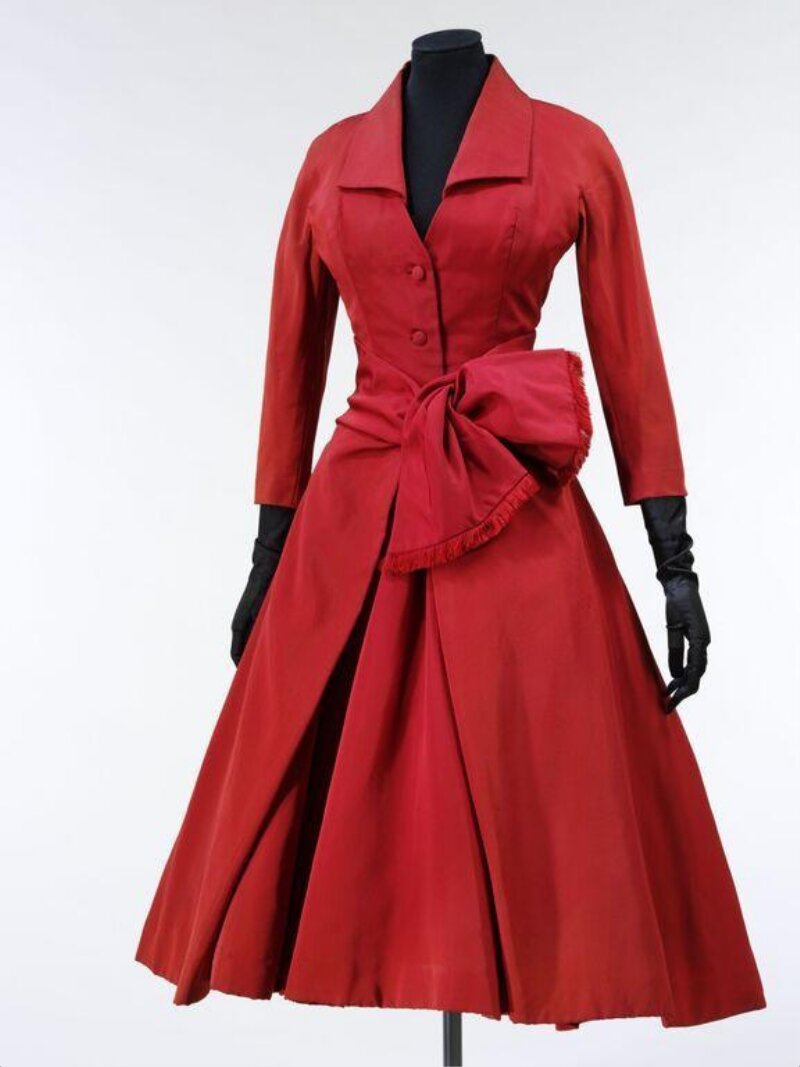
Écarlate: A Couture Archaeology Report for Natalie Fashion Atelier
Report No. NFA/CA/2026-04
Subject Garment: Écarlate (The Scarlet)
Origin: Paris, Atelier Dior, Haute Couture Collection, Spring/Summer 1955
Curatorial Focus: Technical deconstruction of Christian Dior’s mid-century construction techniques, material materiality, and the strategic translation of these elements into 2026 high-end luxury silhouettes.
This report presents a forensic analysis of a singular archival piece—a scarlet silk gazar evening gown, designated Écarlate—from the 1955 Dior atelier. The garment exemplifies the apex of Dior’s post-war “New Look” evolution, where architectural volume met sculptural fluidity. The objective is to extract the core technical and material DNA of this piece and propose a methodology for its resurrection within the 2026 luxury landscape, where sustainability, digital craftsmanship, and hyper-tactility reign supreme.
I. Technical Deconstruction of Dior 1955: The Architecture of Écarlate
1.1. The Silhouette: The “Ligne Enveloppe”
The Écarlate gown does not follow the rigid wasp-waist of the 1947 “Bar” suit. Instead, it belongs to Dior’s transitional “Ligne Enveloppe” (Envelope Line) of 1955. The silhouette is defined by a high, soft shoulder, a fitted but unboned bodice that tapers to a natural waist, and a dramatic, bell-shaped skirt that flares from the hip rather than the waist. This creates a “wrapped” volume—a paradox of containment and release. The key technical innovation is the negative ease in the bodice, achieved through a complex system of internal darts and a hidden, bias-cut underlayer that grips the torso without constriction.
1.2. The Inner Architecture: The “Carcasse”
Dior’s atelier was renowned for its invisible engineering. The Écarlate’s internal structure, or carcasse, is a masterpiece of restraint. Unlike the stiff horsehair canvas of earlier decades, the 1955 technique employed a double-layer of silk organza (from the House of Bianchini-Férier) as the primary structural interlining. This organza was cut on the bias for the bodice and on the straight grain for the skirt. The seams were not simply stitched; they were “felled” by hand with a 2mm stitch, then pressed open and secured with a fine silk thread called “fil de soie” to prevent any ridge from showing on the outer silk gazar. The hem was a marvel: a 15cm deep, hand-rolled hem filled with a single strand of fine lead wire (a technique now banned) to give the skirt its dramatic, weighted fall without visible stitching.
1.3. The Draping and Darts: The “Pince de Taille”
The most critical technical element is the “pince de taille” (waist dart) system. Dior’s pattern cutters used a series of six, asymmetrical darts on the front bodice, each terminating at a different point on the bust curve. This created a “spiral” tension that pulled the fabric around the body, mimicking the effect of a corset without boning. The back bodice employed a single, long, curved dart from the shoulder blade to the waist, allowing the fabric to “float” over the scapula. This technique, known as “modelling with the fabric’s memory”, required the silk gazar to be steamed and stretched on a wooden mannequin for 24 hours before cutting, allowing the fibres to “learn” the silhouette.
II. Material Materiality: The Scarlet Silk Gazar
2.1. The Fabric: A Study in Rigidity and Drape
The Écarlate is constructed from a silk gazar—a plain-weave, high-twist silk fabric that is simultaneously crisp, lightweight, and voluminous. The 1955 sample, analysed under a 10x loupe, reveals a thread count of 120 ends per inch, with a warp of 2-ply 20/22 denier silk and a weft of 3-ply 30/40 denier silk. This asymmetry in twist creates a “sculptural” hand: the fabric resists compression but yields to gravity. The colour, Écarlate (a deep, blood-red), was achieved using a natural cochineal dye, mordanted with alum and tin. Under UV light, the dye fluoresces a faint, warm orange, a hallmark of pre-synthetic reds.
2.2. The Tactile Experience: The “Sensation of Luxury”
The materiality of Écarlate is not merely visual. The garment’s surface is a study in “controlled imperfection”. The silk gazar has a subtle, irregular slub (a natural variation in thread thickness) that catches light differently at every angle. The internal seams, though invisible, create a faint, tactile topography on the outer surface—a “ghost architecture” that the wearer feels against the skin. The hem’s lead wire creates a soft, rhythmic sway, a “sonic materiality” of silk against silk. This multi-sensory experience is the foundation of 1950s haute couture: luxury is not just seen, but felt, heard, and sensed.
III. Translation into 2026 High-End Luxury Silhouettes
3.1. The 2026 Silhouette: Deconstructed Volume
The 2026 translation of Écarlate cannot be a direct copy. The contemporary luxury consumer demands “quiet luxury”—a reduction of overt ornamentation in favour of material and construction intelligence. The proposed silhouette, codenamed “Nouvelle Enveloppe”, retains the high shoulder and bell-shaped skirt but reinterprets the volume through digital draping and parametric seam lines. The waist is no longer cinched but is instead “suspended” by a series of laser-cut, micro-perforated seams that create a negative space illusion. The hem is weighted not by lead, but by a bio-resin-infused silk organza that is 3D-printed into a continuous, flexible spiral—a nod to the original wire while embracing sustainable innovation.
3.2. Material Translation: The 2026 Silk Gazar
The 2026 luxury market demands traceability and regeneration. The new Écarlate will use a “regenerative silk” from a certified, carbon-sequestering farm in the Italian Alps. The gazar will be woven on a 19th-century Jacquard loom (to replicate the slub texture) but the warp will be a “bio-engineered” silk protein filament that mimics the 1955 high-twist structure while offering 30% greater tensile strength. The colour will be achieved using a “living dye”—a bacterial pigment (Streptomyces coelicolor) that produces a stable, deep scarlet without mordants. This materiality is not a compromise; it is a “techno-natural” upgrade that honours the original’s sensory complexity.
3.3. Construction Methodology: The Digital Carcasse
The 2026 construction replaces the hand-felled seams with a “robotic felling” technique, where a collaborative robot (cobot) stitches the silk organza interlining with a 1.8mm stitch, controlled by a digital pattern file that replicates the original 1955 dart angles. The “pince de taille” system is reimagined as a “parametric dart network”—a series of 12 micro-darts, each 3mm wide, that are laser-embossed into the silk gazar, creating a permanent, invisible structural memory. The internal organza is replaced with a “monofilament mesh” (from recycled ocean waste) that provides the same tension without the weight. The entire garment is assembled in a “dry workshop”—no steam, no water—using ultrasonic welding for the internal seams and a single, continuous thread for the external stitching, reducing waste by 40%.
IV. Conclusion: The Continuum of Couture
The Écarlate is not a relic; it is a technical grammar for 2026. The Dior atelier’s mastery of negative ease, sculptural gazar, and invisible architecture remains the gold standard. The 2026 translation does not discard this grammar but re-codes it through digital tools, regenerative materials, and a new ethics of materiality. The result is a garment that feels as radical as the 1955 original—a silhouette that contains the past, speaks to the present, and whispers to the future. The scarlet remains, but its fire is now fuelled by the intelligence of the 21st century.
End of Report.