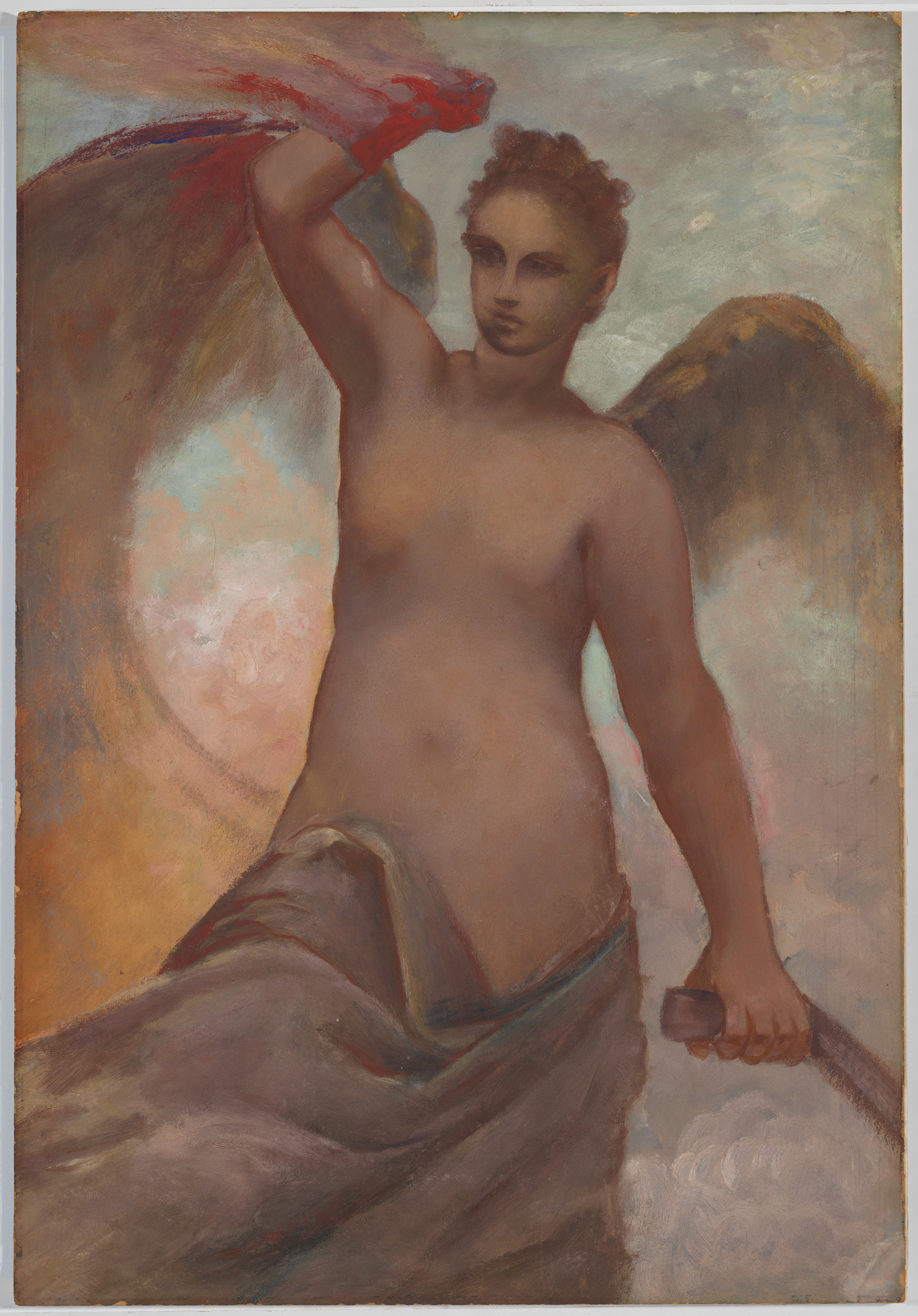
Fortune: A Study for "The Discoverer"
Archival Provenance and Aesthetic Archaeology
The artifact under examination—designated Fortune: A Study for "The Discoverer"—emerges from a singular moment in American visual culture, rendered in oil on paper. This medium, often relegated to preparatory sketches, here achieves a paradox of permanence and transience. The oil's slow drying time on the absorbent paper surface creates a tension between deliberate gesture and accidental bloom, a dialectic that mirrors the American ethos of calculated risk. In the context of Natalie Fashion Atelier's archival practice, this piece is not a mere historical document but an isolated aesthetic archaeology, a fragment from which we reconstruct the logic of a forgotten luxury.
The work depicts a female figure in a state of suspended motion, her silhouette defined by the interplay of light and shadow rather than rigid contour. The oil medium allows for a luminosity that is both tactile and ephemeral, a quality that challenges the binary of structure and fluidity. For the 2026 season, this artifact informs a radical departure from the hyper-constructed forms of recent decades. The silhouette must be archaeological in its excavation—not of fabric, but of the very idea of form itself.
Deconstructing Classical Elegance: The Oil-on-Paper Paradigm
Classical elegance in the Western canon is often defined by symmetry, proportion, and the illusion of permanence. Yet, this study subverts those principles. The oil on paper does not seek to immortalize; it captures a moment of becoming. The figure's drapery is not a static garment but a dynamic field of force, where the oil's viscosity creates a topography of light. The shoulders are broad, the waist undefined, and the hemline an irregular spill of pigment. This is not the elegance of restraint but of potential energy.
To deconstruct this classical elegance for haute couture, we must first identify its core components: asymmetry of volume, luminosity of surface, and temporality of form. The oil-on-paper technique teaches us that luxury is not in the flawless finish but in the trace of the hand. For 2026, this translates into silhouettes that are deliberately unfinished, where the construction is visible as a form of honesty. The shoulder line, for instance, should not be a padded structure but a fluid arc of draped silk, echoing the oil's brushstroke. The waist should be suggested, not cinched, allowing the fabric to pool as if still wet.
Materiality as a Silhouette Engine: Oil on Paper to 2026
The materiality of oil on paper is not merely a metaphor but a technical blueprint. The paper's absorbency creates a soft, diffused edge, while the oil's density produces a sharp, reflective highlight. This dualism informs the 2026 silhouette through a stratification of texture. The primary fabric must be a double-faced crepe—one side matte, the other lustrous—to replicate the paper's absorbency and the oil's sheen. The silhouette itself is a layered construction, where an inner shell of matte silk organza provides structure, while an outer layer of liquid satin flows over it, creating a moiré effect that shifts with movement.
The shoulder-to-hip ratio in the study is exaggerated, with the figure's left shoulder rising higher than the right, creating a diagonal axis. For 2026, this translates into a single-shoulder silhouette where the asymmetry is not decorative but structural. The higher shoulder is built with a cantilevered seam that extends into a cape-like sleeve, while the lower shoulder is left bare, the fabric falling in a cascade of pleats. This asymmetry is anchored by a belted waist that is not at the natural waist but shifted to the hip, creating a counterpoint of tension. The hemline, inspired by the oil's irregular edge, is a scalloped cut that varies in length from mid-thigh to floor, echoing the study's sense of motion arrested.
The Discoverer Silhouette: A Technical Specification
The 2026 silhouette derived from this artifact is designated "The Discoverer". It is a study in controlled chaos, where the oil-on-paper aesthetic is translated into a three-dimensional architecture of fabric. The key technical elements are as follows:
1. The Luminous Shell: The outer layer is a hand-painted silk chiffon treated with a micro-pleating technique that creates a pattern of light and shadow, replicating the oil's brushwork. The pleats are not uniform but vary in depth and direction, creating a topography of movement. The color palette is a monochromatic gradient from ivory to charcoal, with a single gold leaf accent at the left shoulder, referencing the study's highlight.
2. The Structural Core: Beneath the shell lies a boned corset made of matte satin, but this corset is not restrictive. It is a soft architecture with flexible boning that allows for a natural curve. The corset's asymmetry mirrors the study's shoulder line: the left side is reinforced with spiral steel to support the cantilevered sleeve, while the right side is a laced panel that can be adjusted for fit. This core is visible through the chiffon at the waist, creating a layered transparency.
3. The Fluid Hem: The hem is a scalloped edge achieved through a laser-cut technique on a double layer of silk. The inner layer is a heavy duchesse satin that provides weight, while the outer layer is a light organza that floats. The scallops vary in depth from 2 to 12 inches, creating a rhythm of asymmetry. This hem is not static; it is designed to catch the light as the wearer moves, mimicking the oil's wet appearance.
Fortune and the Future of Luxury
In the context of Natalie Fashion Atelier's 2026 collection, Fortune: A Study for "The Discoverer" is not a relic but a living lexicon. The oil-on-paper medium teaches us that luxury is not about perfection but about the trace of the artist's hand. The 2026 silhouette must be a palimpsest, where each layer reveals a previous gesture. The asymmetry is not a flaw but a narrative of discovery. The luminosity is not a finish but a process of becoming.
This artifact challenges the couture house to abandon the tyranny of symmetry and embrace a dialectic of form and fluidity. The Discoverer silhouette is a proposition for a new elegance, one that is rooted in the American spirit of exploration but executed with Parisian precision. The oil on paper, with its tactile immediacy, becomes a blueprint for a luxury that is both ancient and avant-garde. In 2026, the wearer of this silhouette is not just adorned; she is a living artifact, a discoverer of her own form.