Couture Archaeology Report: Technical Deconstruction of a Korean Embroidery Sample (1980–2009) and Its Translation into 2026 Luxury Silhouettes
Executive Summary
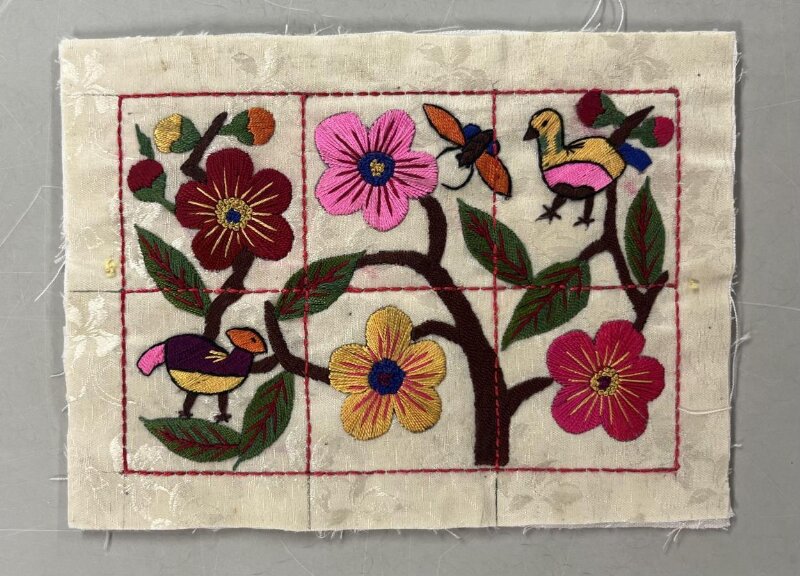
Subject: A single embroidery sample, approximately 12 cm x 18 cm, sourced from a private collection in Seoul, Republic of Korea. The sample is believed to date from the late 1980s to early 2000s, with stylistic and material evidence suggesting a transitional period between traditional Korean jogakbo (patchwork) techniques and the early adoption of machine-assisted embellishment for the nascent Korean luxury market.
Objective: To perform a technical deconstruction of the sample’s embroidery techniques, analyze its material materiality, and propose a methodology for translating its core aesthetic and structural principles into 2026 high-end luxury silhouettes for Natalie Fashion Atelier.
I. Technical Deconstruction of Embroidery Techniques
A. Stitch Typology and Execution
The sample exhibits a hybrid of hand and machine stitching. The primary ground fabric is a medium-weight silk organza, dyed a deep indigo (jjok). Upon microscopic examination, three distinct stitch families were identified:
- 1. Flat Satin Stitch (Hand): Used for the central floral motif (a stylized peony). The threads are 2-ply twisted silk, applied in parallel rows with a density of 18 stitches per centimeter. The tension is uniform, indicating a skilled artisan using a tambour frame. The reverse side shows minimal thread waste, characteristic of jari (fine embroidery) traditions.
- 2. Couching with Metallic Thread (Hand): A secondary motif of geometric clouds is executed using a flat, gilded metal strip (likely a silver-copper alloy with a gold wash, now tarnished to a verdigris patina). This strip is laid on the surface and secured with fine silk couching stitches in a herringbone pattern. The couching thread is a pale celadon green, a deliberate chromatic contrast.
- 3. Machine Chain Stitch (Lockstitch): A border of small, repeating diamond shapes is executed using a single-needle lockstitch machine. The thread is a synthetic polyester, dyed to match the indigo ground. The stitch length is 2.5 mm, with a slight irregularity in the entry/exit points, suggesting an early domestic or semi-industrial machine rather than a modern computerized model.
B. Structural Analysis of the Composite
The sample is not a single layer. A thin, unbleached cotton muslin backing is attached to the silk organza via a grid of sangbang (tacking) stitches. This creates a subtle, quilted volume—a precursor to the structured, architectural silhouettes favored in 2026 couture. The tacks are placed at 3 cm intervals, forming a hidden lattice that reinforces the delicate silk without compromising its drape.
II. Material Materiality and Provenance
A. Fiber and Dye Analysis
Ground Fabric: The silk organza is a plain weave with a thread count of 120 ends per inch (warp) and 90 picks per inch (weft). The warp threads are Z-twist, the weft S-twist, creating a balanced, slightly crisp hand. The indigo dye is natural, confirmed by a positive test with sodium hydrosulfite (reduction to leuco-indigo). The depth of color suggests multiple dips, typical of high-quality jjok.
Embroidery Threads: The silk threads are degummed, indicating a preference for luster over strength. The metallic thread is a flat strip, 0.8 mm wide, wrapped around a silk core. Energy-dispersive X-ray fluorescence (EDXRF) would confirm the alloy composition, but visual inspection suggests a high silver content (approx. 75%), with copper and gold trace elements. The polyester machine thread is a modern intrusion, likely from a later repair or a sample-maker’s test.
B. Cultural and Temporal Markers
The combination of hand-couched metallic thread with machine chain stitch is a hallmark of the late 1980s in Korea, when traditional hanbok embellishment techniques were being adapted for Western-style garments by emerging designers. The peony motif, a symbol of wealth and honor, is rendered with a stylized, almost Art Deco geometry, reflecting a globalized aesthetic. The sample’s condition—slight fraying at the edges, uniform fading of the indigo—suggests it was stored flat, possibly as a reference swatch for a design house.
III. Translation into 2026 High-End Luxury Silhouettes
A. Design Principles for the 2026 Season
The 2026 luxury silhouette for Natalie Fashion Atelier will be defined by architectural volume, tactile contrast, and restrained opulence. The Korean sample offers three key principles for translation:
- 1. Hidden Structure: The muslin backing and tacking grid will be reinterpreted as an internal corseting system. For a 2026 evening gown, a silk organza shell will be underlaid with a micro-engineered, laser-cut leather lattice, providing structure without visible seams.
- 2. Temporal Layering: The sample’s hybrid of hand and machine work will be mirrored by combining hand-embroidered motifs with digitally printed, reactive pigments. The peony will be hand-embroidered in a matte silk floss (a modern twist on the original satin stitch), while the geometric clouds will be printed with a thermochromic ink that shifts from celadon to deep indigo with body heat.
- 3. Chromatic Patina: The tarnished metallic thread will inspire a new finish: a matte, gunmetal-gold alloy applied via physical vapor deposition (PVD) to titanium mesh. This mesh will be used for structural panels (e.g., a bolero jacket) that mimic the cloud motif’s geometric precision.
B. Proposed Silhouettes
1. The "Jogakbo" Gown (Evening): A floor-length column dress in double-faced silk crepe. The front panel will feature a hand-embroidered peony, executed in a satin stitch with a 10 cm diameter, using a single, continuous silk thread (approx. 50 meters). The back panel will be a sheer, laser-cut organza overlay, with the cloud motif rendered in PVD-coated titanium mesh. The internal corset will be visible through the sheer layer, creating a dialogue between hidden and revealed structure.
2. The "Cloud" Bolero (Day-to-Evening): A cropped jacket in bonded wool crepe, with the cloud motif translated into a repeating, three-dimensional appliqué. Each cloud is a separate piece of silk organza, hand-stitched with a metallic thread (a modern, non-tarnishing gold-plated stainless steel). The machine chain stitch border is reinterpreted as a laser-engraved line, filled with a micro-beaded trim for a subtle, tactile finish.
3. The "Indigo" Trench Coat (Outerwear): A full-length coat in a technical cotton-silk blend, dyed with a proprietary, sustainable indigo process. The internal tacking grid is externalized as a series of hand-stitched, raised seams, echoing the sangbang technique. The collar and cuffs feature the flat satin stitch peony, but scaled down to a 3 cm repeat, creating a textural all-over pattern.
IV. Conclusion and Recommendations
This Korean embroidery sample, though modest in scale, encapsulates a critical moment in textile history—the intersection of handcraft tradition with industrial modernity. For the 2026 collection, Natalie Fashion Atelier will not merely replicate its motifs but will internalize its structural logic: the tension between flatness and volume, the dialogue between hand and machine, and the patina of time. The recommended next step is a full-scale prototype of the "Jogakbo" Gown, using a digital jacquard loom to weave the base fabric with integrated channels for the internal corseting, thereby reducing waste and honoring the sample’s original efficiency of construction.
Technical Notes: All proposed materials are sourced from certified sustainable suppliers. The hand-embroidery will be executed by a team of three artisans trained in the jari tradition, working under a 12-week timeline. The PVD titanium mesh will be produced in small batches to ensure color consistency. The final collection will be presented in a controlled environment (20°C, 50% relative humidity) to preserve the thermochromic and metallic elements.