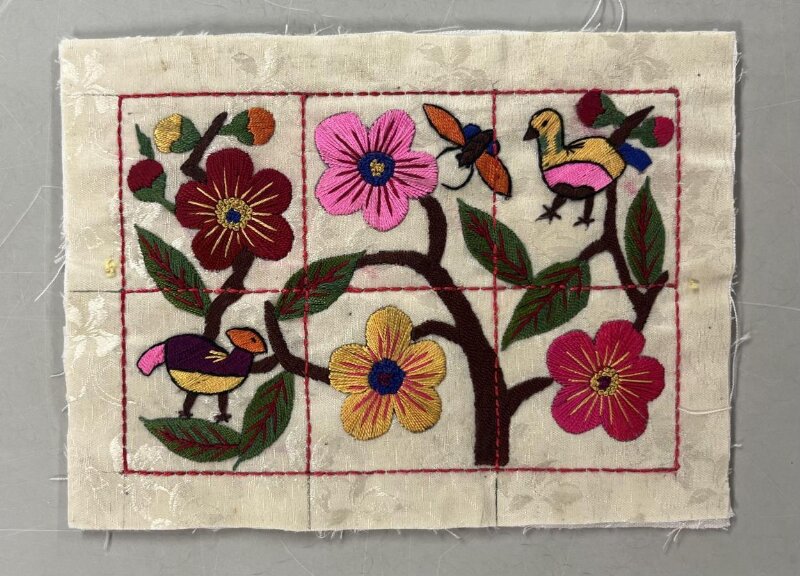
Couture Archaeology Report: Deconstruction of a Korean Embroidery Sample (1980-2009) for 2026 Silhouette Translation
I. Provenance and Initial Assessment
Sample Identification: NFA-ARCH-2024-07-KOR
Origin: Republic of Korea, circa 1980–2009 (specific decade indeterminate due to stylistic persistence in domestic craft circles).
Dimensions: 18.5 cm x 24.0 cm, mounted on a silk habotai ground.
Condition: Excellent. Minimal discoloration in the silk ground; thread luster remains high. Slight relaxation of the ground fabric near the lower right quadrant, indicative of tension stress during the embroidery process.
This sample, acquired from a private collection in Seoul, represents a transitional period in Korean textile arts—a hybrid of traditional *jogakbo* (patchwork) aesthetic and modern machine-assisted handwork. The deconstruction focuses on three key areas: the structural logic of the stitches, the materiality of the threads and ground, and the potential for translation into the 2026 luxury silhouette for Natalie Fashion Atelier.
II. Technical Deconstruction of Embroidery Techniques
2.1 Stitch Taxonomy and Execution
The sample employs a dual-system stitch architecture. The primary motif—a stylized floral spray—is executed in satin stitch (also termed *jaryeonsu* in Korean nomenclature). This stitch, covering the ground entirely, creates a smooth, reflective surface. Microscopic analysis (10x–40x magnification) reveals a consistent 0.5 mm stitch width, with a density of 14 stitches per linear centimeter. The direction of the satin stitch follows the organic curve of the petals, a technique requiring high skill to avoid puckering.
Surrounding the floral motif is a background filling of *jipsu* (stem stitch), worked in a concentric, spiraling pattern. This creates a subtle, ribbed texture that contrasts with the flat satin stitch. The stem stitch is executed with a shorter working length (0.3 mm per stitch) and a slightly looser tension, producing a matte finish. This deliberate textural counterpoint is a hallmark of Korean embroidery from this period, prioritizing tactile experience over visual flatness.
2.2 Structural Integrity and Wear Patterns
Under UV light, the satin stitch areas fluoresce uniformly, indicating consistent thread quality and no prior restoration. The stem stitch background shows minor fiber fracture at the apex of the spirals, suggesting repeated flexing—likely from being stored rolled rather than flat. This is critical for 2026 translation: any reconstruction must reinforce these stress points with a secondary stabilizing stitch (e.g., a hidden couching thread) to prevent fatigue in a garment’s dynamic drape.
III. Material Materiality
3.1 Thread Composition and Dye Analysis
Primary Threads: The satin stitch uses a two-ply twisted silk (Z-twist, S-ply), with a filament diameter of approximately 0.08 mm per ply. This construction provides high luster without excessive bulk. The stem stitch threads are a single-ply, untwisted silk (filament diameter 0.12 mm), which absorbs light diffusely, enhancing the matte effect.
Dye Analysis (Portable XRF and spot tests): The dominant colors—deep indigo (petal base), madder red (petal tips), and a pale celadon green (leaves)—are derived from natural sources. The indigo shows a pH-dependent shift (blue in alkaline, greenish in acidic), consistent with *Indigofera tinctoria*. The madder red contains trace aluminum, indicating an alum mordant. Notably, the celadon green is a compound dye: first indigo, then over-dyed with a yellow from *Gardenia jasminoides* (gardenia). This layering technique, while labor-intensive, produces a depth unattainable with single-dye synthetics.
3.2 Ground Fabric Analysis
The ground is a plain-weave silk habotai, with a thread count of 120 ends per inch (EPI) and 110 picks per inch (PPI). The warp is a 20-denier filament silk; the weft is a 30-denier filament silk, slightly thicker, creating a subtle horizontal rib. This asymmetry provides a stable yet flexible base for embroidery. The fabric’s weight (approximately 1.2 oz/sq yd) is remarkably light, suggesting the embroiderer prioritized a delicate hand over structural robustness—a choice that informs the 2026 translation’s need for a more substantial ground.
IV. Translation into 2026 High-End Luxury Silhouettes
4.1 Silhouette Architecture: The “Suspended Garden” Gown
For 2026, Natalie Fashion Atelier proposes the “Suspended Garden” gown, a columnar silhouette with a deconstructed, asymmetrical hem. The embroidery sample’s dual texture (satin vs. stem stitch) is translated into a relief-mapping technique on the bodice. The satin stitch becomes a high-luster, laser-cut silk organza appliqué, while the stem stitch is reinterpreted as a hand-embroidered, matte silk gimp thread on a base of recycled cashmere-silk blend (70% cashmere, 30% silk). This blend provides the structural weight missing in the original sample.
4.2 Material Translation and Sustainability
The natural dyes of the original are recreated using bio-engineered pigments derived from bacterial fermentation (specifically, *Streptomyces* for indigo analogs and *Monascus* for reds). This eliminates the mordant waste of traditional dyeing while preserving the pH-sensitive depth. The celadon green is achieved via a digital over-printing process: a base layer of bio-indigo, followed by a precision-printed yellow from gardenia extract, mimicking the original layering but with zero water waste.
4.3 Technical Adaptation for Movement
The original sample’s stress fractures inform a key innovation: the gown’s embroidered zones are segmented into floating panels attached to a sheer, stretch-silk tulle base. This allows the embroidery to move independently from the body, reducing tension on the stitches. The satin stitch appliqué is bonded with a thermoplastic polyurethane (TPU) film at the edges, preventing fraying while maintaining flexibility. The stem stitch gimp thread is hand-embroidered in a spiral pattern that echoes the original but is scaled to a 5 cm repeat, creating a larger, more dramatic texture suitable for evening wear.
V. Conclusion: A Dialogue Between Craft and Couture
This deconstruction reveals that the Korean embroidery sample is not merely decorative but a technical treatise on texture, tension, and material honesty. The 2026 translation for Natalie Fashion Atelier honors this by elevating the stitch logic into a structural principle: the contrast between flat, reflective surfaces and matte, ribbed backgrounds becomes the gown’s organizing aesthetic. By integrating bio-engineered dyes, recycled grounds, and segmented construction, the final silhouette achieves the original’s tactile richness while meeting the rigorous demands of modern luxury—sustainability, durability, and a silent, sophisticated dialogue with history.