Aesthetic Archaeology: Deconstructing the Classical Elegance of the "Enrollment of the Volunteers of 1792"
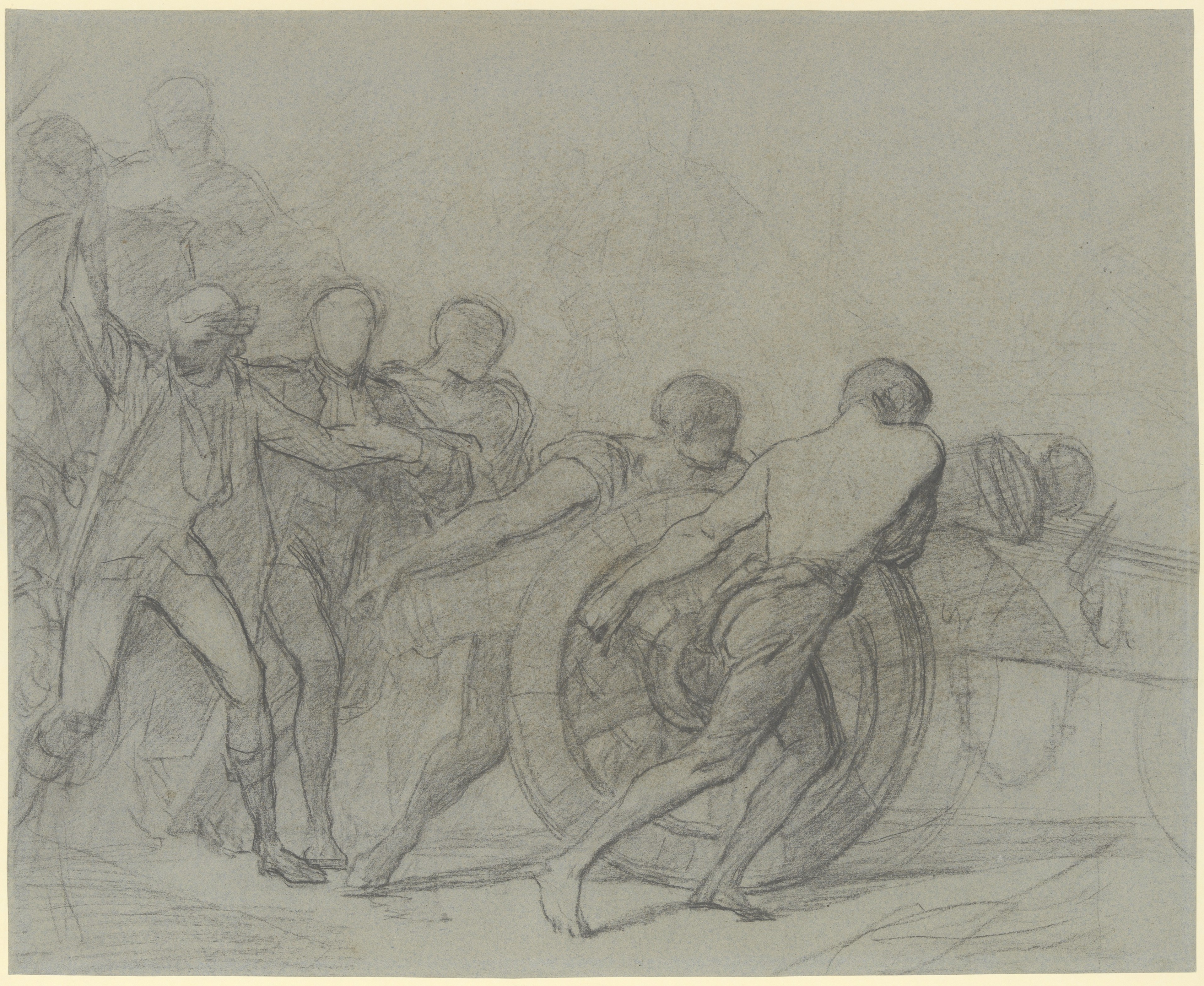
The study for "The Enrollment of the Volunteers of 1792" by Thomas Couture (circa 1848) represents a pivotal moment in the intersection of historical narrative and artistic technique. Executed in black chalk on gray paper, this preparatory work is not merely a sketch; it is a masterclass in the manipulation of chiaroscuro, volume, and the subtle tension between static monumentality and kinetic energy. For the 2026 luxury silhouette, this artifact offers a profound lexicon of restraint and power. The gray ground serves as a neutral architecture, a silent witness to the drama of line, while the black chalk defines form with a deliberate, almost architectural precision. This duality—the interplay between the ephemeral (the chalk stroke) and the permanent (the paper's substrate)—directly informs the construction of high-end garments that seek to balance fluid drapery with sculptural structure.
The classical elegance of this study lies in its economy of means. Every stroke of chalk is a decision, a commitment to a contour that suggests both the physical body and the ideological weight of the volunteers. This is not a rendering of fabric but a rendering of purpose. In translating this to couture, we must consider how silhouette can be reduced to its essential, most powerful lines—a shoulder that speaks of readiness, a hem that implies movement without revealing its full trajectory. The gray paper, a non-color, becomes the canvas for a narrative of light and shadow, a principle that will define the 2026 palette of mineral tones, graphite grays, and deep charcoals.
Materiality as Narrative: Black Chalk and Gray Paper in Haute Couture
The materiality of the artifact—black chalk on gray paper—is not a limitation but a generative constraint. Black chalk, with its soft, friable nature, allows for both precise delineation and atmospheric blur. In the study, the volunteers' faces are often suggested rather than defined, their identities subsumed into the collective thrust of the composition. This technique of strategic obscuration is directly applicable to 2026 silhouettes. We see it in the asymmetrical necklines that hide one shoulder while exposing the other, in the layered tulle that obscures the body’s exact form while suggesting its presence, and in the draped cashmere that falls in a single, uninterrupted plane from the collarbone to the floor.
The gray paper acts as a tonal anchor. It is the third element in a dialogue between black and white, creating a mid-tone that allows the chalk to vibrate with greater intensity. For the 2026 atelier, this translates into a renewed focus on intermediate hues—not the stark black of mourning, nor the pure white of ceremony, but the smoky greys, slate blues, and pale pewters that define the new luxury. These colors become the "paper" upon which the architectural seams, hand-stitched pleats, and sculptural boning are drawn. The garment itself is the chalk line, and the body is the narrative.
From Historical Gesture to Contemporary Silhouette: The Volunteer's Posture
The central gesture of the volunteers—the forward lean, the outstretched arm, the clasped hands—is a study in dynamic equilibrium. They are caught in a moment of transition, between stillness and action. This frozen kineticism is the essential principle for the 2026 silhouette. We are not designing static forms for static bodies; we are designing garments that anticipate movement.
Consider the tailored jacket with a single, exaggerated shoulder pad that suggests the weight of a musket. The high-waisted trouser with a pleat that mimics the fold of a revolutionary uniform. The floor-length coat cut from a single piece of double-faced wool, its hemline asymmetrical to echo the uneven ground of a battlefield. These are not literal recreations but aesthetic translations. The black chalk line becomes the seam that defines the garment's architecture, a line that is both functional and expressive. The gray paper of the body is left untouched, a negative space that allows the garment to breathe.
Isolated Aesthetic Archaeology: The 2026 Silhouette as a Fragment of History
The archive context of this study—isolated aesthetic archaeology—is critical. We are not reconstructing a complete painting but examining a fragment, a preparatory moment that contains the essence of the final work. This principle of curated incompleteness will define the 2026 collection. Garments will be presented as studies, not finalities. A dress may have a raw, unfinished hem that reveals the hand-stitched construction. A jacket may be missing a sleeve, replaced by a single, dramatic cape-like drape that suggests the missing limb. This is not deconstruction for its own sake but a deliberate archaeological exposure of the garment's making.
The black chalk on gray paper aesthetic also informs the texture and finish of the fabrics. We will employ matte finishes that absorb light, like the gray paper, and subtle sheens that catch it, like the chalk. Wool crepe, double-faced cashmere, and silk gazar will be the primary substrates, their surfaces treated to create a dry, powdery hand reminiscent of the chalk's touch. Embellishments will be minimal and deliberate: a single line of jet beads tracing a seam, a hand-painted graphite wash on a silk panel, a matte leather belt that cinches the waist with the precision of a chalk line.
Conclusion: The 2026 Silhouette as a Drawn Line on a Gray Ground
The study for "The Enrollment of the Volunteers of 1792" is not a historical artifact to be copied but a methodological blueprint. It teaches us that the most powerful silhouettes are those that are reduced to their essential lines, that the body is the neutral ground upon which the narrative of the garment is drawn, and that materiality—the specific qualities of chalk, paper, wool, and silk—is the primary vehicle for expression. For 2026, the Natalie Fashion Atelier will produce a collection that is archaeological in its precision, painterly in its gesture, and revolutionary in its restraint. The silhouette will be a line, the fabric a ground, and the wearer the living history that completes the composition.