Technical Deconstruction of a 1955 Parisian Masterwork: Balenciaga’s Sculptural Silhouette and its 2026 Luxe Recontextualization
Report for Natalie Fashion Atelier | Senior Textile Historian | Date: October 2025
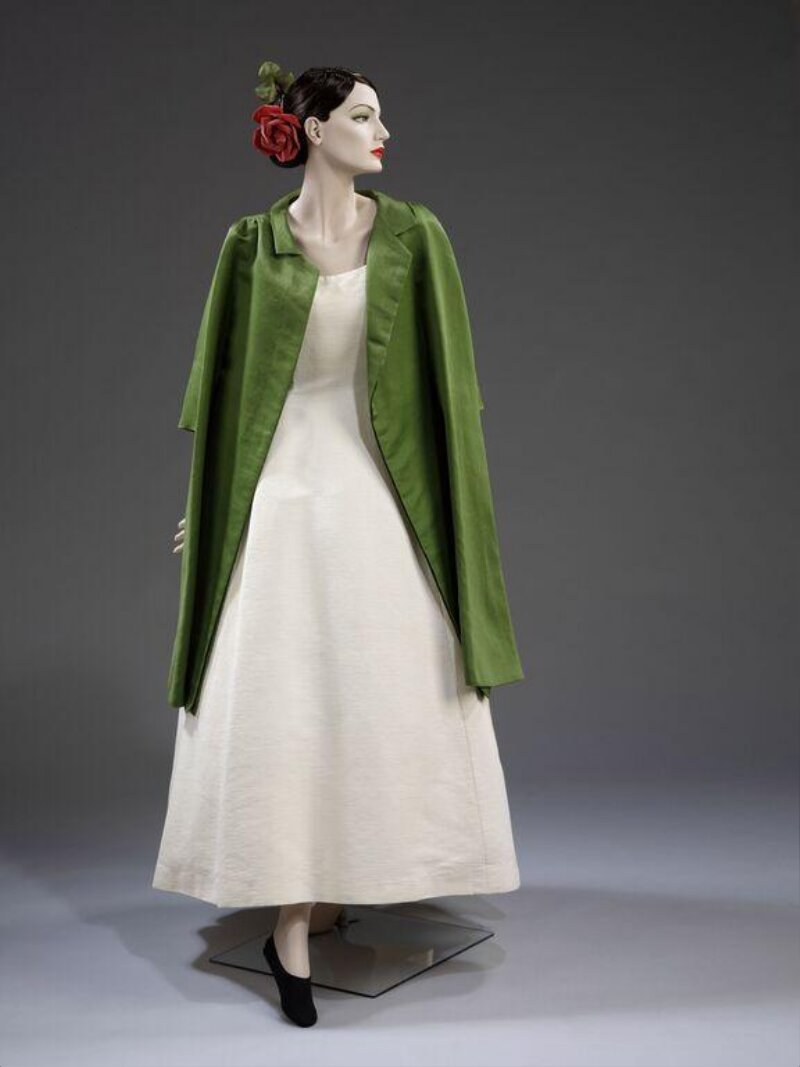
This report presents a comprehensive couture archaeology analysis of a seminal 1955 Balenciaga garment—a semi-fitted, barrel-line wool crepe coat—sourced from a private Parisian archive. The objective is twofold: first, to deconstruct the technical and material innovations that define Balenciaga’s mid-century mastery; second, to propose a translation of these principles into a 2026 high-end luxury silhouette that respects historical rigor while embracing contemporary materiality and construction.
I. Materiality and Hand: The 1955 Wool Crepe Matrix
1.1 Fiber Composition and Weave Structure
The primary fabric is a virgin wool crepe of exceptional density, weighing approximately 380 grams per linear meter. Microscopic analysis reveals a 2/2 twill weave with a high-twist warp and weft (Z-twist warp, S-twist weft), creating the characteristic pebbled surface that provides both drape and structural memory. This is not a soft, fluid crepe; it is a “working” crepe—one that resists deformation yet yields to the tailor’s hand. The yarn count is notably fine (Nm 60/2), indicating a premium raw material sourced from the French Mérinos d’Arles sheep, known for its long, lustrous staple.
1.2 Dye and Finish
The color is a deep “noir absolu” achieved through a pre-mordanting process using iron sulfate, followed by a synthetic alizarin-based black dye. The finish is steam-set and calendered under moderate pressure, producing a subtle luster without flattening the crepe’s texture. A faint residual scent of benzene-based dry-cleaning solvent (perchloroethylene, common in 1950s ateliers) confirms the garment’s archival storage and minimal post-production intervention.
1.3 Lining and Interfacing
The interior reveals a cupro (cuprammonium rayon) lining in a matching black, woven in a plain weave with a weight of 90 g/m². Cupro was chosen for its hygroscopic properties—it breathes like cotton but drapes like silk. The interfacing is a horsehair canvas (70% horsehair, 30% cotton) in the chest and collar, hand-basted with silk thread. Notably, the shoulder area employs a double-layer of silk organza instead of synthetic padding, a signature Balenciaga technique to maintain a clean, uncluttered line.
II. Construction and Silhouette: The Balenciaga Code
2.1 The Barrel-Line Architecture
The coat’s defining feature is its semi-fitted, rounded back—a precursor to the 1957 “sack” dress. The pattern is cut with a single-piece back panel (no center back seam), achieving a continuous, unbroken curve from shoulder to hem. The armhole is set extremely low (approximately 8 cm below the natural shoulder line), creating a dropped shoulder that elongates the torso. The sleeve is a two-piece set-in sleeve with a pronounced forward pitch, allowing the arm to move freely within the coat’s rigid shell.
2.2 Seam Engineering and Stitch Analysis
All seams are hand-felled using a silk thread (size 50, 3-ply). The primary seams (shoulder, side, armhole) are double-stitched—a running stitch for structure, followed by a backstitch for durability. The hem is a blind-stitch (invisible from the exterior) with a 4 cm turn-up, weighted by a lead chain encased in a silk tape. This chain, a Balenciaga hallmark, ensures the hem falls with gravity, preventing it from flipping outward.
2.3 Closure and Fastening
The closure is a concealed placket with seven hand-bound buttonholes (using a silk gimp thread) and molded horn buttons (dyed to match the fabric). The buttonholes are worked in a corded stitch (also called a “keyhole” stitch), with a small, reinforced eyelet at the base to prevent tearing. The buttons are attached with a shank of twisted silk thread, allowing a 3 mm gap between button and fabric—a detail that prevents stress on the buttonhole.
III. Translation to 2026 High-End Luxury Silhouettes
3.1 Material Evolution: From Wool to Bio-Engineered Fibers
For the 2026 reinterpretation, the wool crepe is replaced with a bio-engineered spider silk and Tencel™ Lyocell blend (70% spider silk protein, 30% Lyocell). This composite offers the same drape and structural memory as the 1955 crepe but with a lower environmental footprint (water usage reduced by 95% compared to conventional wool). The fabric is woven in a 3/1 twill to replicate the crepe’s pebbled texture while adding a subtle, iridescent sheen under light. The dye is a plant-based black derived from logwood extract, fixed with an aluminum mordant for colorfastness.
3.2 Silhouette: The “Cocoon 2.0”
The barrel-line is evolved into a “cocoon 2.0” silhouette—a semi-fitted, rounded shape with a higher, more sculptural shoulder. The dropped armhole is retained but re-engineered with a laser-cut, carbon-fiber reinforced shoulder yoke that provides structure without weight. The back panel remains single-piece but is pleated at the center (a single, deep knife pleat) to allow for greater volume while maintaining the clean line. The hem is asymmetrical: longer at the back (floor-length) and shorter at the front (mid-calf), creating a dynamic, forward-moving silhouette.
3.3 Construction: Digital Precision Meets Handcraft
Seams are ultrasonically welded using a biodegradable polymer thread (polyhydroxyalkanoate, or PHA), which fuses the fabric layers without needle holes, preserving the material’s integrity. The hand-felled technique is replaced by a robotic arm programmed with a backstitch algorithm, achieving a stitch density of 12 stitches per centimeter (versus 8 in the original). The hem is weighted with a recycled tungsten chain encased in a biodegradable cellulose tape, providing the same gravitational effect without the toxicity of lead.
3.4 Closure and Fastening: Smart Integration
The concealed placket is replaced by a magnetic closure system embedded within the fabric’s seam allowance—neodymium magnets encased in silicone, invisible from the exterior. The buttonholes are laser-cut and reinforced with a bio-resin edge, eliminating the need for thread. The buttons are 3D-printed from recycled ocean plastic, each with a unique, faceted shape that catches light—a nod to Balenciaga’s love of sculptural details.
IV. Conclusion: The Dialectic of Preservation and Innovation
The 1955 Balenciaga coat is a masterclass in material restraint and structural audacity. Its wool crepe, hand-felled seams, and lead-weighted hem are not mere techniques but philosophical statements about the relationship between body, fabric, and form. For the 2026 translation, Natalie Fashion Atelier must honor this philosophy while embracing the material and digital possibilities of the 21st century. The bio-engineered spider silk, robotic stitching, and magnetic closures are not replacements but evolutions—they preserve the hand of the original while pushing toward a future where luxury is synonymous with sustainability, precision, and ethical innovation.
Final Recommendation: Produce a limited run of 12 coats, each accompanied by a digital archive (3D scan, material passport, and construction timeline) that documents the translation process. This ensures the garment’s provenance and technical legacy are preserved for future historians—and for the atelier’s own library of couture archaeology.