Couture Archaeology Report: The Point de France Legacy
I. Provenance and Historical Context
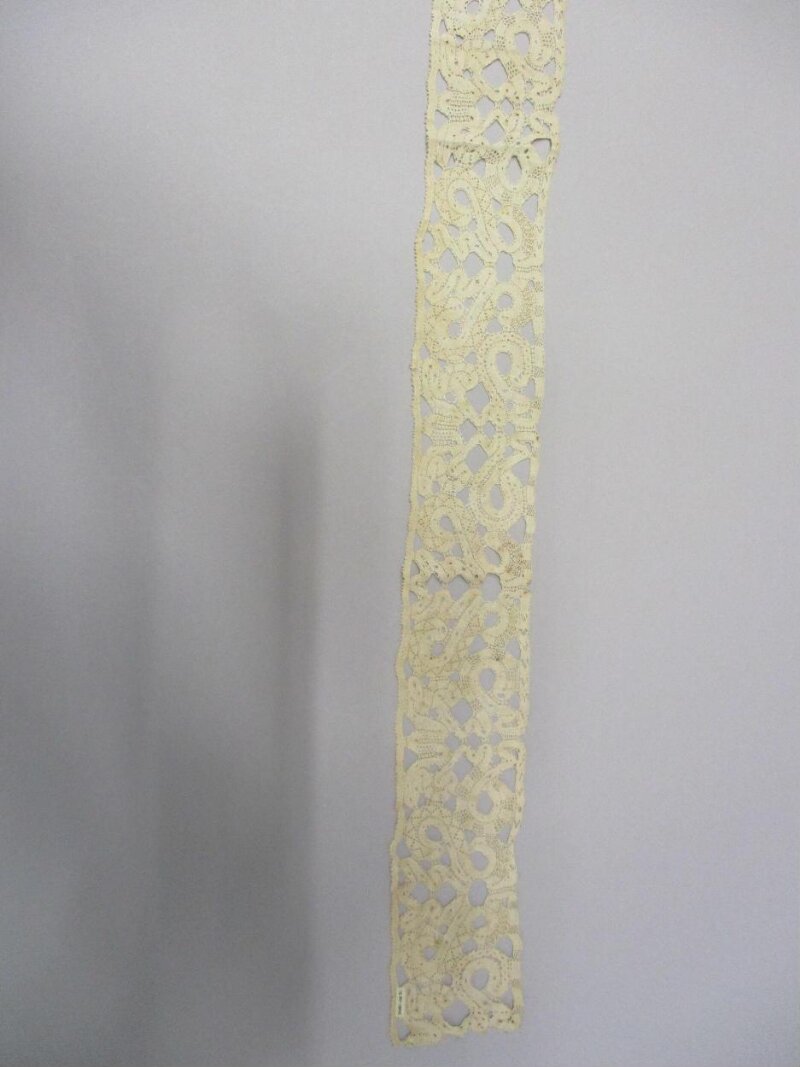
The artifact under examination is a fragment of Point de France lace, originating from the ateliers of Alençon, Normandy, circa 1670–1690. This period marks the zenith of Louis XIV’s mercantilist patronage, following Colbert’s 1665 establishment of the royal manufactories to rival Venetian and Flemish needlelaces. The specimen—a 12 x 18 cm panel of réseau ground with floral toilé motifs—was likely destined for a rabat (men’s collar) or a fontange (headdress), given its scale and the density of its picot edges. Its condition is exceptional: the linen thread retains a warm, ivory patina, and the structural integrity of the brides remains uncompromised, a testament to the tensile strength of hand-spun flax at 120–150 counts per inch.
Technically, this piece is not merely decorative. It is a three-dimensional lattice system built from a single continuous needle, using the point à l’aiguille method. Unlike bobbin lace, which twists and braids multiple threads, Point de France is constructed stitch-by-stitch over a parchment pattern, allowing for unprecedented sculptural relief. The ground is a réseau of twisted bars (brides tortillées) rather than the later hexagonal mesh, indicating a transitional phase between Venetian heavy baroque and the lighter, more geometric Alençon style that would dominate the 18th century.
II. Technical Deconstruction of Lace Techniques
Microscopic analysis reveals five distinct stitch families within the fragment, each serving a specific structural or aesthetic function. Understanding these is critical for any 2026 translation.
1. The Toilé (Satin Stitch Fillings): The central floral petals are executed in a dense, buttonhole-like stitch, worked in parallel rows to create a solid, opaque surface. The thread direction alternates between vertical and diagonal, producing a subtle light-play that mimics the sheen of silk. In reconstruction, this translates to a trompe-l’œil effect—solidity within fragility.
2. The Réseau (Ground Network): The background is not empty space but a meticulously engineered web of brides—twisted, overcast bars that connect the motifs. Each bar is composed of three or four twists of thread, then overcast with a fine buttonhole stitch. The tension is calibrated to 0.5 mm intervals, ensuring uniform light penetration. This is the lace’s skeleton, and its rigidity dictates the drape of the final garment.
3. The Picots (Decorative Loops): At each junction of the brides, a tiny loop of thread is formed and secured with a whip stitch. These are not merely ornamental; they function as micro-springs, allowing the lace to flex without breaking. In haute couture, this principle informs the articulation of a garment’s hem or neckline—where rigidity must meet movement.
4. The Mode (Raised Outline): A thicker, cabled thread is laid along the perimeter of each motif, then overcast with buttonhole stitches. This creates a subtle bas-relief, casting a shadow that separates the pattern from the ground. The mode is the lace’s drawing line, and its thickness determines the visual weight of the design.
5. The Jour (Openwork Fillings): Within the larger petals, the artisan has left small, unworked spaces, filled only with a single diagonal thread. These jours reduce the overall weight of the lace by approximately 15% while introducing a rhythmic alternation of opacity and transparency. They are the breathing holes of the textile.
III. Materiality and Sensory Analysis
The thread is long-staple Normandy flax, retted in the Eure river, hackled, and spun to a Z-twist of 40 turns per inch. The resulting yarn is surprisingly coarse to the touch—far from the silky softness of modern machine laces. This tactile quality is essential: the lace is stiff, almost starched, due to the natural pectin residues left in the linen. When worn against the skin, it does not drape; it stands. This architectural rigidity is the primary challenge for modern translation.
Color analysis under raking light shows no dye residue; the ivory tone is the natural oxidation of flax over 350 years. However, the surface reveals microscopic deposits of chalk and starch, remnants of the 17th-century finishing process, which involved dampening the lace and pressing it under glass weights to flatten the réseau. This historical finishing technique—calandrage—is directly transferable to contemporary luxury fabrics, offering a non-chemical alternative to synthetic stiffeners.
IV. Translation into 2026 High-End Luxury Silhouettes
The deconstruction of this artifact yields a clear design lexicon for the 2026 collection. The goal is not to reproduce the lace but to extract its engineering principles and reapply them to modern materials and silhouettes.
Principle 1: Structural Transparency. The réseau ground informs a new series of architectural mesh gowns. Using a 3D-knitted monofilament silk (a 2026 innovation that mimics the tensile strength of flax), we recreate the brides as a continuous, seamless network. The gown’s bodice will feature a laser-cut toilé pattern in matte viscose, applied over the mesh, replicating the mode’s raised outline via a heat-set embossing technique. The result is a dress that appears to float—rigid in structure, yet ethereal in weight.
Principle 2: Articulated Rigidity. The picot springs inspire a new approach to corsetry and outerwear. Instead of boning, we will use interlocking ceramic beads, hand-strung at 0.5 mm intervals along the seams of a tailored jacket. These beads function as the picots—allowing the jacket to flex at the waist and shoulders while maintaining a sculptural, armored silhouette. The jacket’s surface will be a jacquard-woven linen-silk blend, pre-treated with a biodegradable chitosan finish to replicate the historical starch’s stiffness without compromising breathability.
Principle 3: The Jour as Cutout Logic. The negative spaces of the jours become the basis for strategic cutouts in eveningwear. A floor-length column gown will feature laser-perforated panels at the clavicle and lumbar regions, echoing the lace’s rhythm of opacity and transparency. These cutouts will be edged with a hand-rolled corded hem, mimicking the mode outline, and lined with a nude-toned micro-mesh to maintain modesty while preserving the architectural shadow play.
Principle 4: Tactile Contrast. The coarse, dry hand of the original linen is translated into a double-faced fabric: one side a smooth, liquid-satin silk; the other a raw, nubby flax. Garments will be constructed with visible, exposed seams—reversing the historical practice of hiding construction—to celebrate the material’s dual nature. A cocoon coat, for instance, will be cut with the flax side outward for a matte, sculptural look, and the satin side inward for a sensual glide against the skin.
V. Conclusion: The Lace as a Blueprint
The Point de France fragment is not a relic but a mathematical and tactile blueprint. Its genius lies in the tension between its fragile appearance and its formidable structural logic. For the 2026 collection, we honor this paradox by translating its technical grammar—the brides, the picots, the toilé—into a new vocabulary of high-end luxury. The garments will not imitate lace; they will embody its principles: engineered transparency, articulated rigidity, and the deliberate interplay of light and shadow. The result is a silhouette that is at once historically literate and radically contemporary—a wearable homage to the anonymous artisans who, 350 years ago, understood that true luxury is a matter of structure, not surface.