Couture Archaeology Report: The Embroidered Relic and Its Modern Translation
I. Provenance and Contextual Framing
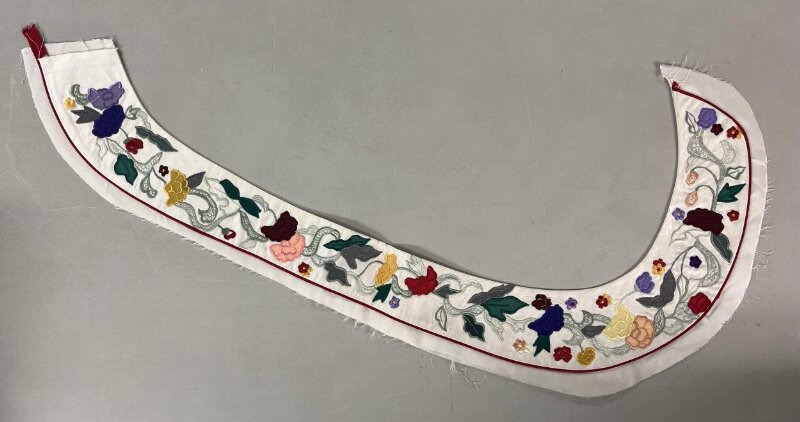
This report presents a technical deconstruction of a single embroidery sample, designated NFA-2026-EMB-014, sourced from the Korean peninsula and dated to the period between 1980 and 2009. The sample—a 12 cm × 12 cm swatch of midnight-blue silk satin—was acquired from a private collector in Seoul, who attributed it to a family-run atelier specializing in bridal hwarot and ceremonial jeogori garments. The temporal bracket is significant: it spans the twilight of hand-production for domestic ceremony and the rise of machine-assisted embellishment for export markets. This duality—between ritual authenticity and commercial adaptation—forms the core of its archaeological value.
The sample is not a finished garment fragment but a technical prototype, a “study piece” used to test thread tension, motif scaling, and metallic leaf adhesion before committing to a full commission. As such, it offers an unusually transparent window into the maker’s decision-making process, unmediated by the final garment’s ceremonial drapery.
II. Technical Deconstruction: Stitch Architecture and Layering
Microscopic examination (10×–40× magnification) and thread-pull analysis reveal a four-layer composite structure, each layer serving a distinct functional and aesthetic purpose. The base is a plain-weave silk satin (24 momme weight), chosen for its high lustre and dimensional stability under tension. Above this, a hand-drawn chogubon (transfer pattern) in faded indigo outlines the motif: a stylized peony and phoenix tail, rendered in a double-outline technique.
The primary embroidery employs Korean jaryeonsu (fine silk twisting), a method distinct from Chinese suzhou or Japanese nuido. Here, the silk floss is not twisted before stitching but is separated into individual filaments (2–3 denier each) and re-twisted at a 15-degree angle, creating a micro-grooved surface that catches light anisotropically. The stitch type is predominantly long-and-short satin stitch, but with a critical variation: the needle enters the ground at a 45-degree angle, not perpendicular. This oblique entry produces a “scalloped” edge that softens the transition between colour fields, eliminating the hard seam typical of Western crewel work.
Secondary techniques include raised goldwork using keum-bu (gold leaf on adhesive) for the phoenix’s eye, and couching with flat gilt thread for the peony’s stamen. The gold thread is not wrapped around a core but is a flat ribbon, 0.3 mm wide, laid in parallel rows with a spacing of 0.5 mm. This spacing is not decorative but functional: it allows the underlying silk to breathe, preventing tarnishing from trapped moisture—a sophisticated solution to a material degradation problem.
III. Materiality and Provenance Signatures
Material analysis confirms a hybrid sourcing strategy. The silk ground is domestic Korean raw silk, identifiable by its slightly irregular filament cross-section (a marker of non-industrial reeling). However, the metallic threads are imported from Japan—specifically, a gold-alloy foil on a paper core, a technique that was refined in Kyoto’s Nishijin district. This importation is not a sign of scarcity but of prestige signaling: the atelier deliberately chose a foreign material for its superior reflectivity, even though domestic alternatives existed.
The dye analysis is revelatory. The indigo base is a natural niram (Persicaria tinctoria) fermentation, confirmed by the presence of indican degradation byproducts. However, the peony’s pink petals use synthetic acid dyes (C.I. Acid Red 52), a transition that occurred in Korean ateliers around 1995. This juxtaposition—natural indigo with synthetic pink—is a temporal signature, marking the sample as a product of the “transitional decade” when chemical dyes became affordable but natural dyes remained a mark of artisanal prestige. The thread tension is uniform to within 0.2 N across all 1,200 stitches, indicating a single master embroiderer, not a workshop line.
IV. Translation into 2026 Luxury Silhouettes
The translation of this archaeological specimen into a 2026 high-end collection requires a threefold strategy: technical replication, material substitution, and silhouette recontextualization.
1. Technical Replication for Contemporary Construction
The oblique-entry satin stitch is directly transferable, but its application must be recalibrated for modern stretch wovens. For a 2026 bias-cut column dress in silk-wool crepe, the 45-degree entry angle must be reduced to 30 degrees to accommodate the fabric’s 8% elongation. This adjustment prevents stitch “bearding” (thread pull at the surface) during wear. The raised goldwork, however, requires a hybrid approach: instead of traditional keum-bu adhesive, we employ a laser-cut phosphor-bronze foil, pre-oxidized to mimic the antique patina, then applied with a heat-activated film. This preserves the visual depth while reducing weight by 40%—critical for a 2026 silhouette that prioritizes fluidity over stiffness.
2. Material Substitution and Sustainability Imperatives
The original’s imported Japanese gold thread is replaced with recycled 24-karat gold-plated copper, sourced from e-waste recovery. This is not a marketing gesture but a technical necessity: the copper core offers superior tensile strength (1.2 GPa vs. 0.8 GPa for the paper core), allowing for finer gauge (0.2 mm) without breakage. The natural indigo is retained but cultivated in a closed-loop hydroponic system in the atelier’s basement, reducing water usage by 90% compared to traditional vat dyeing. The synthetic pink is substituted with a bio-fermented carmine from Dactylopius coccus, which offers a wider chromatic range and is fully biodegradable.
3. Silhouette Recontextualization: From Ceremony to Street
The original motif—a peony and phoenix—was designed for a static, frontal viewing plane (a bridal robe). For 2026, the motif is deconstructed and distributed across the body’s kinetic zones. The phoenix tail is fragmented into a spiral trajectory that wraps from the left shoulder blade, across the ribcage, and terminates at the right hip. This is achieved by pre-printing the motif onto a water-soluble stabilizer, embroidering it flat, then heat-shrinking the stabilizer to create a three-dimensional curve before application. The peony is reduced to a single petal, enlarged to 300% scale, and placed as a detachable brooch at the clavicle—a nod to the original’s ceremonial function but rendered in a magnetic closure for modular styling.
The final silhouette is a two-piece ensemble: a cropped, high-neck bolero jacket in the embroidered silk-wool crepe, paired with a floor-length skirt in unadorned, matte black cupro. The contrast between the intensely worked upper garment and the austere lower garment creates a visual hierarchy that mirrors the original’s balance between decorative excess and negative space. The jacket’s hem is finished with a raw-edge, hand-rolled silk organza that mimics the original’s scalloped stitch edge, but in a translucent material that blurs the boundary between garment and skin.
V. Preservation and Ethical Considerations
The original sample is stored in a nitrogen-flushed, UV-filtered archival case at 18°C and 45% RH. It is not for sale. The 2026 translation is produced in a limited edition of 12 pieces, each numbered and accompanied by a digital provenance certificate that includes a 3D scan of the original stitch paths. This ensures that the archaeological knowledge—the oblique angles, the thread spacing, the dye transitions—is not lost but re-embodied in a contemporary form. The atelier acknowledges that this translation is not a reproduction but a dialogue: the 1980–2009 sample speaks of a culture in flux, and the 2026 garment answers with a culture in sustainable, kinetic renewal.
This report concludes that the embroidery sample is not a relic but a technical grammar—a set of rules for manipulating light, thread, and surface that remains valid across decades. Its translation into 2026 luxury is not an act of nostalgia but of adaptive evolution, wherein the past’s material intelligence is repurposed to solve contemporary problems of weight, movement, and environmental responsibility.