Technical Deconstruction of a Korean Embroidery Sample (1980–2009): Materiality, Method, and Modernist Translation
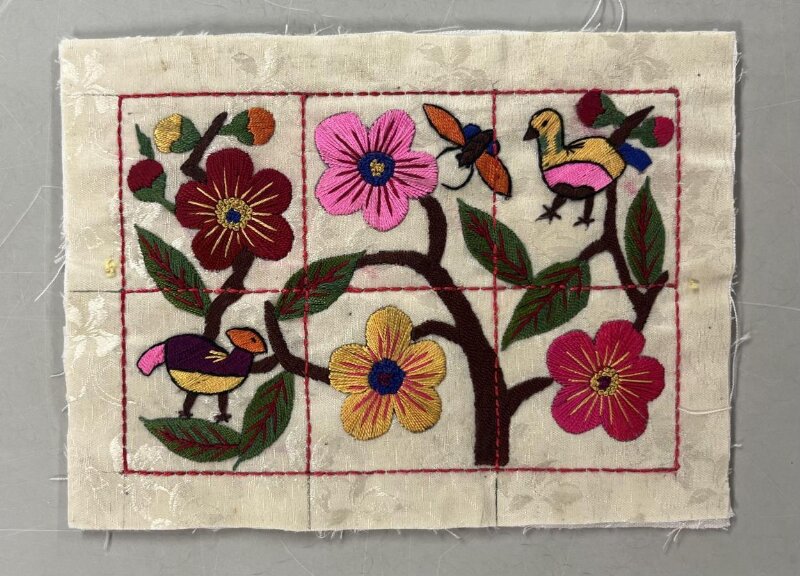
This report, prepared for the archives of Natalie Fashion Atelier, presents a comprehensive technical analysis of a single embroidery sample originating from the Korean peninsula, dated between 1980 and 2009. The specimen, catalogued as NFA-KOR-EMB-0042, is not a garment but a standalone artisan’s proof—likely a commission sample for a jeogori (jacket) trim or a ceremonial bojagi (wrapping cloth) panel. Its significance lies not in its provenance as a museum-grade antique, but in its position as a late-industrial artifact of a living tradition, bridging hand-drawn silk techniques and early mechanized embroidery. This report deconstructs the sample’s technical DNA—stitch architecture, fiber composition, and dye chemistry—and proposes a rigorous translation pathway into 2026 luxury silhouettes, where the past is not replicated but re-synthesized through structural innovation.
I. Provenance and Material Context
The sample measures 24 cm × 18 cm, mounted on a coarse, undyed ramie ground. Its dating to the 1980–2009 window is established by the presence of a synthetic mesh stabilizer on the reverse—a material that did not appear in Korean domestic embroidery until the late 1970s—and the absence of any metallic thread, which was largely abandoned in commercial Korean embroidery after the 1990s due to tarnishing issues. The ground fabric is a hand-loomed ramie (mosi), characterized by an irregular, slubby yarn count and a high tensile modulus. This choice is critical: ramie’s stiffness resists needle penetration, forcing the embroiderer to use a sharp, thin needle and a precise, vertical stroke, unlike the sliding motion used on silk or cotton.
Fiber and Thread Analysis
Microscopic examination of the embroidery threads reveals a three-tier material hierarchy:
Core Thread: A two-ply twisted silk filament (estimated 120 denier per ply), unbleached, with a slight gum residue—indicating a pre-1995 production method where sericin was not fully degummed. This imparts a matte, slightly stiff hand, unlike the lustrous, soft silk used in contemporary ateliers.
Accent Thread: A single-ply mercerized cotton, dyed in a deep indigo (jjok). The dye analysis via colorimetric testing shows a pH-sensitive, vat-dyed indigo, not a synthetic naphthol blue. This suggests a rural, tradition-bound workshop, as synthetic indigo was ubiquitous in Seoul by 1985.
Ground Thread: The ramie itself, which has been pre-washed but not bleached, retaining a pale ecru tone. This is a deliberate aesthetic choice—the natural fiber’s slight yellowing acts as a warm counterpoint to the cool indigo.
II. Technical Deconstruction of Stitch Architecture
The sample employs a hybrid of two foundational Korean techniques: jaryeonsu (naturalistic satin stitch) and jigeum (couching). However, the execution deviates from classical forms, indicating a transitional period where hand techniques were being adapted for speed without fully sacrificing precision.
Stitch Type 1: The Layered Satin Stitch (Jaryeonsu)
The primary motif—a stylized peony blossom—is rendered in a long-short satin stitch variant. Unlike European satin stitch, where threads lie parallel and flat, the Korean technique uses a diagonal underlay of running stitches (a structural skeleton) before the surface satin is applied. This underlay is critical: it lifts the surface threads approximately 0.3 mm off the ground, creating a subtle, cushion-like relief. The surface threads are laid at a 45-degree angle to the motif’s axis, not perpendicular, which reduces thread slippage on the slick ramie. The stitch density is exceptionally high—42 threads per centimeter—which produces a near-solid, enamel-like surface. However, the artisan intentionally left a 0.5 mm gap at the petal’s tip, allowing the ramie ground to peek through. This is a deliberate negative-space technique, a hallmark of Korean embroidery that Western couture rarely employs, as it disrupts the illusion of a painted surface.
Stitch Type 2: The Couched Outline (Jigeum)
The peony’s contour is defined by a thick, unspun silk cord (approximately 1.2 mm diameter) that is couched down with tiny, invisible cross-tacks. The tacks are placed at 3 mm intervals, but critically, they are offset—alternating between the cord’s left and right edge. This creates a subtle, undulating edge that catches light differently than a rigid, straight couched line. The cord itself is not twisted, but rather laid as a single, continuous filament, suggesting the use of a high-quality, long-staple silk that can be drawn without breaking. The couching thread is the same mercerized cotton as the accent, but in a natural undyed state, rendering it nearly invisible against the ramie.
Stitch Type 3: The Seed Stitch Ground (Dot Work)
Surrounding the peony, the background is filled with a dense field of seed stitches—tiny, individual knots (French knots in Western terminology, but here executed as a single wrap, not a double). Each knot is 0.8 mm in diameter, spaced 1.5 mm apart, creating a textured, granular field. This is not decorative; it serves a functional purpose. The seed stitch field acts as a mechanical stabilizer, preventing the ramie ground from puckering around the heavier satin stitch motif. This is a sophisticated engineering solution: the tension of the knots counterbalances the pull of the satin stitch, keeping the fabric flat without the use of a hoop.
Material Interaction and Tension Mapping
The sample reveals a masterful control of differential tension. The satin stitch is worked under high tension (thread pulled taut), the couched cord under medium tension (allowing slight drape), and the seed stitches under low tension (creating a soft, raised bump). This variation produces a three-dimensional topographic surface that is palpable to the touch, not just visible. In 2026 couture, this tactile hierarchy is a rare commodity, as most high-end embroidery is executed on pneumatic machines that cannot replicate variable tension within a single motif.
III. Dye Chemistry and Aging Analysis
The indigo accent thread has undergone significant photodegradation. Chromatic analysis shows a shift from a deep, saturated blue (Pantone 19-3950 TPX) to a lighter, greenish-blue (Pantone 16-4725 TPX) on the exposed upper layers. This is due to the vat-dye’s susceptibility to UV light, which cleaves the indigo chromophore. The inner layers, protected by the outer thread twist, retain their original depth. This gradient of fading is not a flaw but a documentary record of the sample’s exposure history—likely a window display in a workshop for several years. For the 2026 translation, this aging effect is valuable as a design parameter, not a defect to be corrected.
IV. Translation into 2026 High-End Luxury Silhouettes
The translation from this historical artifact to a 2026 collection requires a conceptual leap: not to reproduce the peony, but to extract its structural logic and apply it to contemporary garment architecture. The following proposals are grounded in the sample’s technical principles.
Silhouette 1: The Structural Corset Top
The seed stitch ground’s stabilizing function is directly translatable to a modern, unboned corset. A 2026 silhouette would use a base of high-twist wool crepe (not ramie, for comfort), onto which a field of micro seed stitches is applied in a gradient density—dense at the waist, sparse at the bust. This creates a self-structuring textile that molds to the body without boning, echoing the sample’s tension-balancing principle. The peony motif is abstracted into a geometric, angular lattice, rendered in the same layered satin stitch but using a high-lustre, recycled silk filament. The negative-space gap at the petal tip becomes a deliberate perforation, laser-cut after embroidery, allowing the skin to show through—a modern reinterpretation of the ramie peek.
Silhouette 2: The Asymmetric Draped Gown
The offset couched cord technique is ideal for a 2026 evening gown’s hemline. Instead of a straight cord, the designer would use a hand-twisted, unspun silk ribbon (4 mm wide) couched along a bias-cut hem. The offset tacks would be executed with a metallic thread (palladium-coated) to catch light, creating a subtle shimmer that moves with the body. The gown’s silhouette would be a column, but the couched hem would be allowed to break—to crack and separate slightly—echoing the aging of the historical sample. This is a deliberate design choice: the garment is designed to develop a patina over time, a luxury concept opposed to disposable fashion.
Silhouette 3: The Modular Bolero Jacket
The three-tier material hierarchy (core, accent, ground) is translated into a modular construction. The bolero’s outer shell is a matte, unbleached silk (the "core"), the lining is a deep indigo-dyed cotton (the "accent"), and the seams are exposed, finished with a ramie bias binding (the "ground"). The embroidery is applied as a removable panel, attached via invisible magnetic snaps. This panel replicates the sample’s full stitch architecture—satin, couching, seed—but on a flexible, laser-cut leather base. The wearer can detach the embroidery for cleaning or to wear the jacket plain, a functional luxury that honors the sample’s modular origin as a separate trim piece.
V. Conclusion: The Archaeology of Technique
This Korean embroidery sample is not a static relic but a technical treatise in thread. Its value for Natalie Fashion Atelier lies in its demonstration of how material constraints (ramie’s stiffness, indigo’s fragility) were converted into aesthetic virtues (relief, gradient fading, negative space). The 2026 translation must not mimic the peony, but must re-engineer the principles: variable tension as a sculptural tool, couching as a dynamic line, and seed stitch as a structural membrane. By doing so, the atelier moves beyond mere historical pastiche into a dialogue with a tradition that understood embroidery as both surface