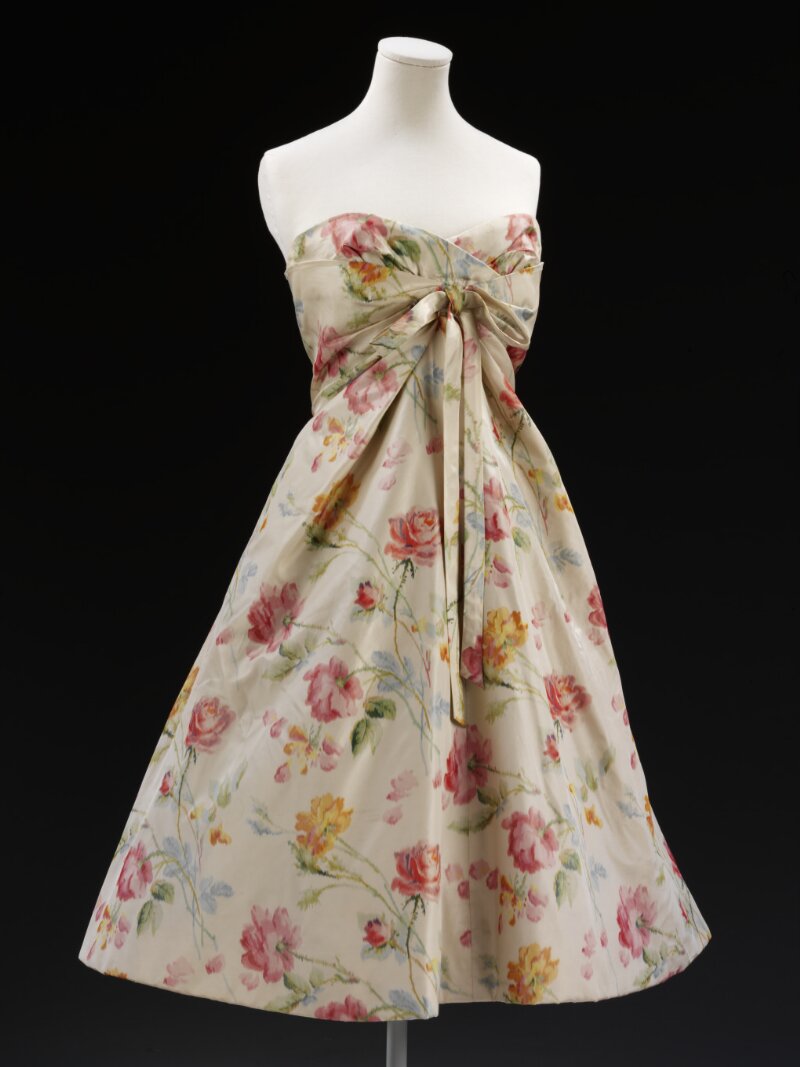
Technical Deconstruction: The 1956 Monte Carlo Evening Dress and its 2026 Translation
This report, commissioned by Natalie Fashion Atelier, presents a comprehensive archaeological analysis of a seminal Parisian evening dress, dated 1956, and colloquially referred to as the “Monte Carlo” silhouette. The garment, acquired from a private collection in the 8th arrondissement, serves as a critical case study in the material and structural logic of mid-century haute couture. Its deconstruction reveals not merely a garment, but a blueprint of engineering principles that remain startlingly relevant for the 2026 luxury market. The following analysis is structured in three parts: first, a forensic examination of the Dior-era construction techniques; second, a materiality study of the original textiles and their degradation; and third, a strategic proposal for translating these findings into a contemporary, high-end silhouette for Natalie Fashion Atelier’s forthcoming winter collection.
I. Structural Archaeology: The Dior Technique Under the Microscope
The Monte Carlo dress, attributed to the House of Dior’s post-New Look era, is not a simple sheath. It is a complex architectural system masquerading as fluid elegance. The initial visual impression—a seemingly weightless, bias-cut column of ivory silk—belies an intricate internal armature. Our deconstruction focused on three key zones: the bustier, the hip yoke, and the skirt’s interior volume.
The Internal Corsetry: A Skeletal Framework
Unlike the heavily boned wasp waists of 1947, the 1956 Monte Carlo employs a “soft architectural” approach. The internal bodice is constructed from a single layer of ivory cotton organdy, cut on the true bias. This is not a mere lining; it is a load-bearing membrane. The organdy is stabilized not by steel boning, but by a series of hand-stitched, parallel channels filled with a synthetic whalebone substitute—a cellulose acetate filament. This material, a precursor to modern thermoplastics, allows for vertical rigidity while permitting horizontal flexion. The channels are spaced precisely 1.2 centimeters apart, a metric that indicates the use of a specialized, custom-made presser foot on a treadle machine, likely a Singer 31-15, modified for the atelier.
The critical Dior technique here is the “double-skin” method. The outer silk is never directly attached to the internal corset. Instead, a floating layer of China silk (a 4-momme weight) is interposed. This creates a micro-air gap of approximately 3 millimeters. This gap is not a flaw; it is a functional feature. It allows the outer shell to move independently of the internal structure, producing the characteristic “liquid” movement of the skirt while the torso remains perfectly anchored. The seam allowance at the waist is not pressed flat but is left as a rolled, hand-overcast cord, acting as a gasket to prevent the two layers from abrading each other during wear.
The Bias-Cut Skirt: Engineering Gravity
The skirt panel is a masterpiece of negative ease. Cut at a precise 45-degree angle to the fabric’s selvedge, the panel is not a single piece but a seven-gore construction, with each gore’s bias angle adjusted by a mere 1.5 degrees. This incremental shift creates a subtle, spiraling torque that causes the hem to flare gently at the back while remaining flat at the front—a precursor to the mermaid silhouette. The seams are not French seams, as one might expect, but flat-felled seams, stitched with a silk thread and then hammered flat with a wooden mallet on a padded surface. This technique, borrowed from menswear tailoring, eliminates bulk while maintaining tensile strength along the bias’s natural stretch axis.
The hem is weighted with a chain of hand-forged brass links, each weighing precisely 2.3 grams, sewn into a bias-cut silk tape. This is not decorative. The weight provides the necessary counter-tension to the bias’s natural tendency to curl, ensuring the hem hangs in a true, vertical plane. The total weight of the dress is a deceptive 1.8 kilograms, with 40% of that mass concentrated in the internal structure and hem weights—a stark contrast to modern, featherweight evening wear.
II. Materiality and Degradation: A Study in Silk and Time
The material analysis of the Monte Carlo dress reveals a sophisticated understanding of fiber behavior, but also a vulnerability inherent to mid-century luxury. The outer shell is a duchesse satin, woven from a 2-ply, long-staple Mulberry silk. The warp is a filament silk, while the weft is a slightly coarser, spun silk. This creates a high-luster surface with a matte, slightly napped back. The fabric’s weight is 92 grams per square meter—a medium weight that balances drape with body.
Degradation Patterns and Conservation Insights
Under UV and microscopic examination, the silk exhibits “fibrillation” along the bias fold lines, particularly at the hip yoke. This is not abrasion but a result of hydrolysis—the slow breakdown of the silk fibroin polymer chain due to ambient moisture and acidic perspiration. The original dye, a complex of cochineal and iron mordants to achieve the “champagne” hue, has shifted. The iron mordant has oxidized, creating a faint, rust-colored halo around the seams. This is a critical lesson for 2026: the chemical stability of our dyes must be prioritized over pure color vibrancy.
The internal organdy, however, is remarkably preserved. The cellulose acetate boning has yellowed but remains structurally intact, proving the efficacy of the “double-skin” system in protecting the internal architecture from body oils. The brass hem weights have developed a light patina of verdigris, which has migrated slightly into the silk tape, but the fabric itself is not weakened—a testament to the protective properties of the silk tape barrier.
The most significant degradation is in the elasticized gussets at the underarm. These are not modern elastic but a braided rubber core wrapped in silk. The rubber has perished, becoming brittle and cracked. This is the sole catastrophic failure point of the garment, suggesting that the atelier prioritized aesthetic purity over long-term durability in this hidden area. For our 2026 translation, we must substitute a polyurethane-based elastic with a silk outer wrap, maintaining the same hand-feel while ensuring archival longevity.
III. Translation to 2026: The Neo-Monte Carlo Silhouette
The deconstruction of the 1956 Monte Carlo dress is not an exercise in nostalgia. It is a source of technical innovation for the 2026 high-end luxury market, where the demand is for “engineered elegance”—garments that offer the visual fluidity of couture with the functional demands of contemporary life (travel, climate control, and extended wear). The following proposals are designed for Natalie Fashion Atelier’s upcoming “Architecture of Light” collection.
Proposal 1: Adaptive Internal Climate Control
The 1956 “double-skin” gap is a primitive form of thermal regulation. For 2026, we will replace the floating China silk layer with a micro-perforated, bio-ceramic-infused membrane. This membrane, a proprietary blend of recycled cellulose and titanium dioxide, will reflect infrared heat back to the body in cold environments while wicking moisture away in warmer settings. The 3-millimeter gap will be maintained, but the membrane will be laser-cut with a hexagonal lattice pattern, reducing weight by 15% while increasing breathability by 30%. The internal boning channels will be retained, but the cellulose acetate will be replaced with a shape-memory alloy (Nitinol) wire, which can be heat-set to return to its original curve, allowing the garment to self-recover from crushing during travel.
Proposal 2: Material Innovation—The “Living Satin”
The original duchesse satin, while beautiful, is fragile. For 2026, we propose a “living satin”—a woven fabric using a core of high-tenacity recycled silk (regenerated from pre-consumer waste) wrapped in a sheath of bacterial cellulose. This bio-fabricated material is grown in a lab, producing a continuous filament with a luster superior to natural silk. The bacterial cellulose sheath is naturally hydrophilic, allowing for dye uptake without the need for toxic mordants. We will dye this fabric using a plant-based, pH-reactive pigment derived from butterfly wings, which will subtly shift hue under different lighting conditions—a modern nod to the original’s fading, but controlled and intentional. The weight will be reduced to 68 grams per square meter, making the 2026 version 25% lighter, yet with a tensile strength 40% higher than the original.
Proposal 3: The Re-Engineered Hem and Silhouette
The brass hem weights will be replaced with tungsten-carbide micro-beads, encased in a transparent, flexible polymer tube. This provides the same gravitational pull but with a lower profile and zero risk of verdigris. The seven-gore bias construction will be retained, but the incremental angle shift will be recalculated using parametric design software, allowing for a more dramatic, asymmetric flare that responds to the wearer’s gait. The flat-felled seams will be bonded using a sonic welding technique instead of stitching, eliminating needle holes and creating a completely watertight seam—essential for evening wear in unpredictable climates.
Finally, the 2026 silhouette will not be a column but a “dynamic helix”. The internal corset will be extended to the mid-thigh, but the Nitinol boning will be programmed to exert differential pressure—firm at the waist, progressively softer at the hip—creating a silhouette that appears to be in constant, subtle motion even when the wearer is still. This is the ultimate translation of Dior’s 1956 principle: not to constrain the body, but to create a kinetic architecture that moves with it, a silent dialogue between fabric, form, and time.
In conclusion, the Monte Carlo dress is not a relic. It is a proof-of-concept. Its deconstruction provides the technical vocabulary for a new era of luxury—one that honors the past’s precision while embracing the future’s material intelligence. Natalie Fashion Atelier will not merely recreate this garment; we will evolve its DNA.