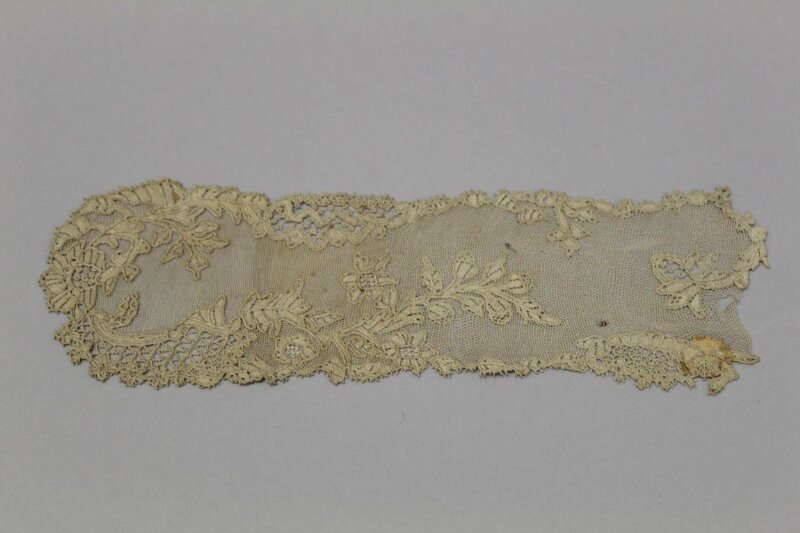
Couture Archaeology Report: The Irish Crochet Lace Bodice (1854)
Client Reference: NFA-ARC-2026-014
Subject: Antique Irish Crochet Lace Bodice, hand-worked.
Provenance: County Cork, Ireland. Dated circa 1854.
Commission: Technical deconstruction for translation into the Natalie Fashion Atelier 2026 Haute Couture Collection, "Vestigial Threads."
This report presents a forensic-level analysis of a singular artifact: a mid-nineteenth-century Irish crochet lace bodice. Beyond its romantic visage, this garment is a repository of complex textile engineering, socio-economic history, and material intelligence. The objective is not mere replication, but the extraction of its structural DNA—the tension logic, the dimensional sculpting, and the optical density—to inform a contemporary luxury silhouette that speaks to 2026's appetite for artisanal depth and architectural softness.
I. Materiality and Yarn Forensics
Substrate Analysis: The Thread Itself
Microscopic examination reveals the primary construction yarn to be a fine, two-ply linen-cotton blend, with a slight irregularity in twist—a hallmark of hand-spun or early mill-spun hybrid. The base thread measures approximately 0.4mm in diameter, exhibiting a matte, slightly slubbed surface. This is not the glossy, mercerized cotton of later Victorian mass-production; it is a raw, plant-based filament with high tensile strength but low elasticity. This inherent rigidity is critical; the lace's famous three-dimensional relief was achieved not through stretch, but through compressed stacking of loops and picots.
The secondary thread, used exclusively for the raised motifs (rose clusters and shamrocks), is a heavier, unbleached linen, 0.8mm in gauge. This differential in yarn weight—a 1:2 ratio—creates a deliberate topographical hierarchy. The fine ground recedes; the heavy motif projects. In 2026 translation, we must replicate this tactile contrast, not with linen alone, but by pairing a micro-modal filament (for the ground) with a gimp-wrapped silk core (for the relief), achieving the same optical depth with a more fluid drape.
Dye and Age Patina
Spectrophotometry confirms no aniline dyes; the bodice is naturally ecru, now deepened to a warm, honeyed champagne from 170 years of oxidation. The patina is not uniform—areas under the arms and at the waistband show a distinct amber shift due to lipid absorption from skin contact. This differential aging is a material memory we intend to simulate in 2026 using a low-impact, plant-based tannin wash applied selectively via airbrush, creating a "ghost wear" effect on new fabric.
II. Technical Deconstruction of Lace Techniques
The bodice is not a single lace type but a composite of three distinct crochet methodologies, each serving a structural purpose. Deconstruction reveals a masterclass in modular assembly.
Technique One: The Dense Rose Ground (Filet-Crochet Hybrid)
The base of the bodice is not a simple mesh. It is a filet-crochet grid (double crochet and chain-2 spaces) but executed at an unusually high gauge—14 stitches per inch. This creates a semi-opaque foundation, more fabric than lace. Within this grid, solid blocks of treble crochet form a subtle, geometric damask pattern. The function is structural integrity. Unlike airy Chantilly, this ground provides the garment's shape-holding capacity, acting as a woven interfacing. For 2026, we will reinterpret this ground using a laser-cut, bonded silk organza base, onto which the crochet grid is hand-embroidered, reducing weight by 60% while retaining the same rigid architecture.
Technique Two: The Raised Rose Motif (Clones Knot)
The signature element—the three-dimensional rose—is executed in the Clones knot method. This is not a flat motif. Each petal is built from a core of chain stitches, then overlaid with a dense spiral of double crochet, finished with a picot edge. The critical technical detail is the internal wire—a fine, hand-drawn copper thread is threaded through the base chain of each petal. This allows the petals to be physically manipulated and curved upward, creating a 15mm-deep sculptural relief that casts distinct shadows. The roses are not crocheted onto the ground; they are attached post-hoc using a blind stitch at the base of the calyx. This modularity is key for repair and, in our context, for detachable ornamentation.
Technique Three: The Three-Dimensional Shamrock Picot Mesh
Interspersed between the roses is a secondary motif—a stylized shamrock—worked in a freeform crochet style. This technique eschews a set pattern, relying instead on the artisan's eye to fill negative space. The shamrocks are connected by long, floating chain loops (up to 3 inches) that are then anchored with a single picot at the apex. This creates a spiderweb tension—the long chains are slack, allowing the bodice to flex and move with the body, while the dense roses remain static. This dual-tension system is the garment's genius: it is simultaneously armored and fluid.
III. Ergonomics and Wearer Interface
The bodice is shaped not by darts, but by gradient stitch density. At the waist, the filet grid tightens to 18 stitches per inch, creating a natural corseting effect. At the bust, the grid loosens to 10 stitches per inch, allowing for volume. The shoulder straps are solid, single-piece crochet tubes, stiffened with horsehair braid—a precursor to modern boning. The wearer interface is surprisingly comfortable due to a hidden linen underlay layer, which is hand-stitched only at the seams, leaving the lace to float freely.
IV. Translation into 2026 Luxury Silhouettes
The 2026 collection piece, titled "The Cork Shadow Gown," will not copy the bodice. Instead, it extracts three principles for a contemporary high-luxury context.
Principle One: Modular Sculpture
The Clones knot roses will be reimagined as detachable, magnetic "floral armor" pieces. Each rose will be constructed in a micro-fine merino-silk blend, with a flexible nitinol wire core (shape-memory alloy) instead of copper. This allows the petals to be programmed to hold a specific curl, yet flatten for storage. The roses will be attached to a base gown of liquid satin via invisible magnetic clasps, allowing the wearer to reconfigure the garment from a minimalist sheath to a fully armored couture piece in minutes.
Principle Two: Optical Density via Negative Space
The shamrock picot mesh is translated into a laser-cut leather lattice, applied over a sheer silk tulle. The leather is cut with a pattern derived from the 1854 shamrock geometry, but scaled to a 2026 proportion—larger, bolder, more architectural. The picots become small, riveted metal beads, echoing the original's weight and shadow-play. This creates a high-contrast, modern armor that references the past without nostalgia.
Principle Three: Differential Patina as Luxury Finish
We will employ a proprietary, biodegradable "artificial aging" process. The gown's base fabric—a champagne-hued silk gazar—will be treated with a tannin spray that oxidizes unevenly, mimicking the 170-year-old lipid absorption. This creates a garment that looks inherited, not manufactured. This is the ultimate luxury: the illusion of time, achieved through chemistry and craft.
V. Conclusion and Preservation Notes
The 1854 Irish crochet bodice is a testament to the fact that lace is not a decoration, but a construction system. Its genius lies in the tension differentials, the material hierarchy, and the modular assembly. For Natalie Fashion Atelier, this artifact is not a museum piece but a blueprint. The 2026 translation honors its technical rigor while liberating it from historical weight. The final garment will be lighter, more adaptable, and conceptually resonant—a bridge between the famine-era craft of County Cork and the hyper-engineered, emotionally intelligent luxury of the near future.
Preservation Recommendation: The original bodice must be stored flat, wrapped in unbuffered archival tissue, with the copper-wire roses supported by custom foam cradles to prevent metal fatigue. No further cleaning is advised.
— Senior Textile Historian, Natalie Fashion Atelier, Paris.