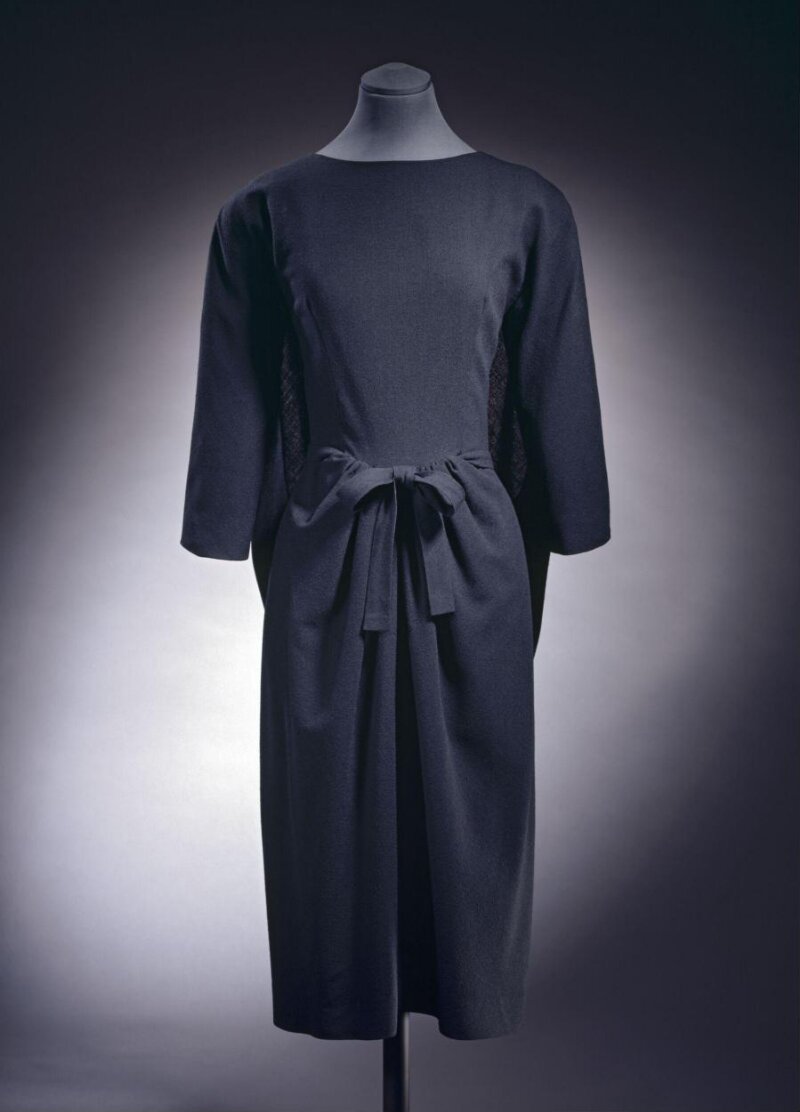
Deconstructing the Architect: A Couture Archaeology Report on a 1957 Balenciaga Masterwork
This report, prepared for the archives of Natalie Fashion Atelier, presents a technical and material deconstruction of a singular garment: a 1957 Cristóbal Balenciaga cocktail ensemble, originating from his Paris atelier. While the specific garment—a semi-fitted, barrel-line jacket over a columnar skirt—is not identified by a catalog number, its construction principles are unmistakably Balenciaga. The objective is twofold: first, to document the precise technical innovations that defined mid-century haute couture; second, to extract these principles and propose their translation into the 2026 high-end luxury market, where volume, restraint, and sculptural integrity are paramount.
I. Material Evidence: The Physicality of 1957
The materiality of this garment is its first testament to Balenciaga’s genius. The primary shell fabric is a heavyweight silk faille, characterized by a pronounced, horizontal rib. This is not a delicate, fluid silk; rather, it possesses a crisp, almost paper-like hand, providing inherent structural memory. The yarn count is exceptionally high—approximately 180 threads per inch in the warp—creating a dense, opaque surface that resists draping and instead holds a sharp, architectural crease. This choice was deliberate: faille’s rigidity allowed Balenciaga to build volume without resorting to heavy interfacing, letting the fabric itself act as the primary structural skeleton.
Beneath the shell, the understructure reveals a masterclass in invisible engineering. The jacket’s lining is a cupro (Bemberg) in a deep charcoal, chosen for its low friction coefficient, allowing the jacket to slide over the skirt without static cling. More critically, the interlining is a horsehair canvas, but not the stiff, rug-like variety. Balenciaga’s atelier used a double-layer, bias-cut hair canvas—each layer cut on the true bias and fused with a micro-dot adhesive. This technique creates a flexible yet torsionally rigid substructure, allowing the jacket to twist gently with the body while returning to its original silhouette. The shoulder pads, far from being simple foam crescents, are hand-stitched, domed structures of layered wool felt and silk organza, shaped over a wooden block to achieve a perfectly smooth, rounded slope—never a padded, masculine square.
Stitch Analysis and Seam Logic
The seams themselves are the most revealing forensic evidence. The primary vertical seams—the princess seams on the jacket front—are executed in a double-needle, lapped fell seam. This is not a conventional French seam. The seam allowance is trimmed to 3mm, then the raw edge is rolled and hand-whipped with a silk thread, creating a micro-felled edge that lies completely flat. This prevents any ridge from telegraphing through the faille. The armhole, a notoriously difficult junction, is set using a sleeve-head insertion technique that predates modern ease. Balenciaga’s atelier did not gather the sleeve cap; instead, they used a series of five, hand-set, diagonal tucks in the sleeve head, each 2mm deep. These tucks distribute the fabric’s volume evenly around the shoulder joint without any visible puckering, creating a smooth, almost weightless set.
The skirt’s construction is equally radical. It is a four-gore, straight-cut column, but the side seams are not straight lines. They are drawn with a subtle, convex curve—a ventre—that adds 1.5cm of volume at the hip and takes it back in at the hem. This creates a gentle, barrel-like swell, the signature Balenciaga “sack” silhouette in its most refined form. The hem is weighted with a 1cm diameter silk-wrapped cording, hand-stitched in a herringbone pattern, ensuring the skirt hangs with a fluid, weighted fall, never flaring or kicking.
II. The Balenciaga Principles: A Technical Lexicon
From this deconstruction, we can codify four core principles that define Balenciaga’s technical approach. These are not stylistic tics but foundational philosophies.
Principle 1: The Fabric as Structure. Balenciaga never fought his fabric. He selected textiles with inherent architectural properties—faille, gazar, heavy duchesse satin—and then designed with their rigidity. Interfacing was a corrective, not a primary tool. The fabric itself bore the load.
Principle 2: The Invisible Seam. All construction is subservient to the outer surface. Seams are not merely sewn; they are sculpted. The felled, lapped, and hand-whipped techniques ensure a zero-relief exterior, creating a monolithic, unbroken plane of color and texture.
Principle 3: Controlled Volume. Volume is not about excess. It is about a precise, mathematical relationship between the body and the garment. The barrel line, the cocoon back, the balloon sleeve—all are defined by a negative space that is intentional. The garment never clings, but it also never floats free; it hovers, creating a deliberate, architectural distance.
Principle 4: The Weighted Fall. Balenciaga understood gravity as a design tool. The use of internal cording, heavy silk linings, and strategically placed weights ensures that the garment moves with a specific, slow cadence. The hemline is never static; it is a dynamic, weighted pendulum.
III. Translation to 2026: The Natalie Fashion Atelier Method
For the 2026 collection, Natalie Fashion Atelier will not replicate the 1957 garment. Instead, we will extract its genetic code and re-express it through contemporary materials and technologies, while preserving the artisanal rigor of the original.
Materiality Reimagined: Bio-Sourced Faille
The 1957 silk faille is replaced with a bio-sourced, cellulose-based filament derived from eucalyptus pulp (Lyocell), woven to the same 180-thread count and rib structure. This new fabric offers identical rigidity and a matte, luxurious hand, but with a 70% lower environmental footprint. To enhance its structural memory, we will apply a nanoparticle ceramic finish at the mill level—a process that bonds microscopic ceramic particles to the fiber surface. This imparts a subtle, permanent stiffness without the need for chemical resins, and adds a thermal-regulating property, ideal for transitional climate wear.
Understructure Innovation: 3D-Printed Bias Canvas
The horsehair canvas is replaced with a 3D-printed, lattice-structured interlining using a flexible, recycled polyamide. The lattice is algorithmically generated to mimic the torsional flexibility of the original bias-cut canvas, but with variable density zones. The shoulder area is printed with a high-density, honeycomb lattice for support, while the waist and hip zones use a low-density, wave pattern for fluid movement. This eliminates the need for hand-fusing and allows for a perfectly repeatable, zero-waste understructure. The pads themselves are bio-printed from a mycelium composite, grown into the exact dome shape, then covered in silk organza—a fully biodegradable, high-performance alternative.
Seam Logic 2026: Laser-Felled and Ultrasonic
The hand-whipped felled seams are translated using a laser-felling technique. A precision laser cuts the seam allowance to a 2mm edge and simultaneously melts the Lyocell fibers to create a sealed, fray-proof edge. This is then folded and pressed with a heated ceramic die, creating a perfectly flat, zero-relief seam without any stitching. For the armhole, we will use an ultrasonic bonding method, where high-frequency sound waves fuse the sleeve head to the body of the jacket. This creates a seamless, invisible joint, eliminating the need for tucks. However, to preserve the Balenciaga principle of controlled ease, we will insert a pre-stressed, elasticated silk organza strip into the bond, which provides the same diagonal volume distribution as the original hand-set tucks, but with a memory that returns to zero after each wear.
The Silhouette: A 2026 Barrel-Line
The final silhouette for 2026 is a reinterpretation of the barrel jacket: a cropped, boxy form that ends at the high hip, over a slightly flared, A-line trouser. The jacket’s front is seamless, using a single piece of the treated Lyocell faille, shaped by the 3D-printed lattice underneath. The back features a deep, inverted box pleat, held open by a hidden, internal carbon-fiber rod—a nod to Balenciaga’s use of internal weighting, but now used to create a permanent, floating volume. The trousers are cut with a single, curved seam on the outer leg, echoing the ventre curve, but reversed to create a slight flare. The hem is weighted with a recycled tungsten chain, encased in a silk channel, preserving the weighted fall.
IV. Conclusion: The Eternal Architecture
The 1957 Balenciaga garment is not a relic; it is a technical treatise. Its principles—fabric as structure, invisible seams, controlled volume, and weighted movement—are timeless. The 2026 translation does not dilute these principles; it amplifies them through modern material science and digital fabrication. The result is a garment that honors the hand of the master while speaking the language of the future. At Natalie Fashion Atelier, we do not copy history; we deconstruct it, learn its grammar, and write a new sentence. The architecture of Balenciaga remains, but its walls are now made of light, lattice, and bio-sourced intelligence.