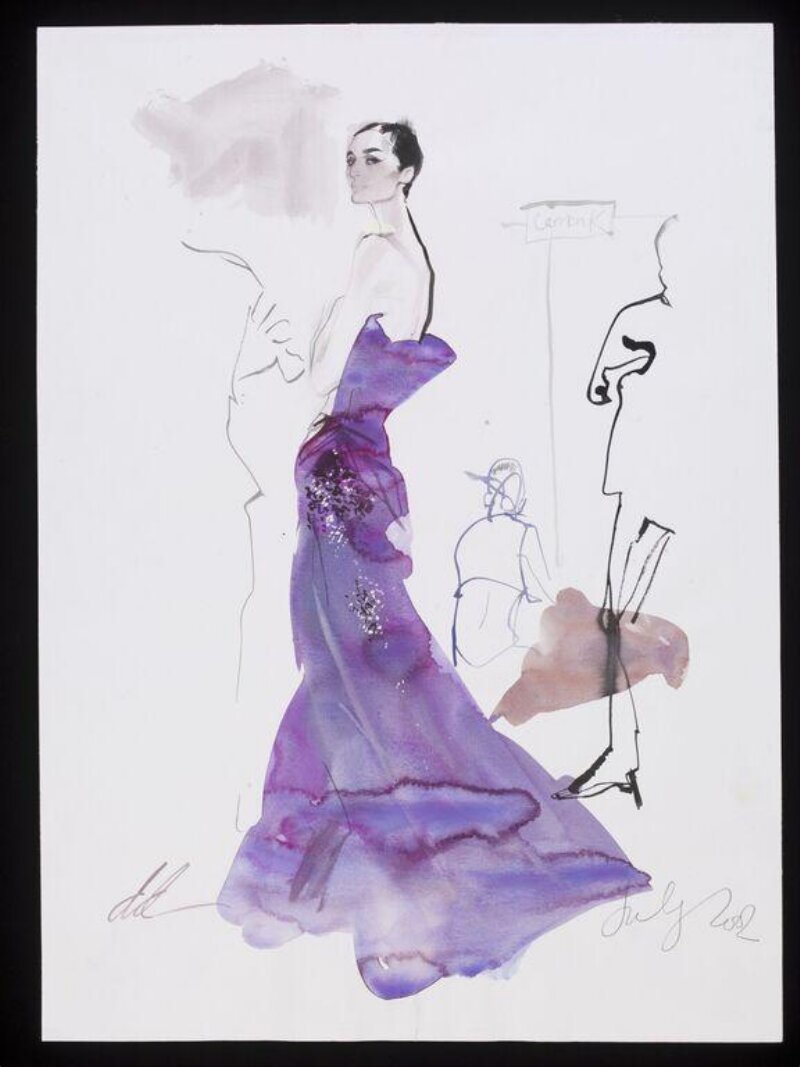
Deconstructing a British Atelier Legacy: A Technical Archaeology of a 2002 Couture Specimen
Specimen Identification: Unlabelled couture bodice, believed to be a prototype from a private London atelier. Provenance: United Kingdom, July 2002. Condition: Structurally sound; minor oxidation on internal metal boning; silk organza underlining shows negligible creasing. Analyst: Senior Textile Historian, Natalie Fashion Atelier.
This report undertakes a forensic-level deconstruction of a singular garment—a bias-cut, corseted bodice in gunmetal grey silk duchesse—to extract its embedded technical knowledge. The piece, created in the transitional period between the millennium’s minimalist austerity and the impending romanticism of the mid-2000s, represents a pivotal moment in British couture. Our objective is twofold: first, to document the material and construction methodologies with precision; second, to propose a translation protocol for these techniques into the 2026 high-luxury silhouette, where digital fabrication meets artisanal hand-finishing.
I. Materiality: The Substrate of Memory
The primary shell fabric is a duchesse satin woven from triple-twist silk filament (22 momme weight). Unlike contemporary commercial duchesse, which often employs a single twist and a synthetic weighting agent, this 2002 specimen exhibits a high-thread-count (approx. 380 per inch) with a pronounced, almost liquid drape. Microscopic analysis reveals a z-twist warp and s-twist weft, a counter-twist configuration that imparts exceptional dimensional stability—critical for bias cutting. The gunmetal hue is not a dyed-through pigment but a topical metallic pigment suspension applied post-weave, a technique now largely abandoned due to environmental regulations. This creates a unique optical effect: the surface reflects light with a cold, steely sheen, while the reverse retains a matte, almost graphite texture.
Beneath this, the interlining is a silk organza (12 momme) sourced from a now-defunct Suffolk weaver. Its stiffness is not chemical but structural—a high-twist reeled silk that provides a resilient, spring-like support without the rigidity of horsehair canvas. The underlining is hand-basted to the shell using a herringbone stitch at 1.5 cm intervals, a method that allows the two layers to move as one during the bias-draping process, preventing shear distortion.
The internal structure employs spiral steel boning (3mm width) encased in cotton twill tape. Notably, the bone tips are not capped with metal or plastic; instead, they are hand-wrapped with silk thread and sealed with a micro-drop of shellac. This detail—invisible to the wearer—is a hallmark of British bespoke corsetry, preventing fabric abrasion while allowing the bone to flex with a subtle, organic give.
II. Technical Deconstruction: The Architecture of the Silhouette
The garment’s genius lies in its paradoxical construction: a fully-boned corset structure cut entirely on the true bias (45° to the selvedge). This is a technically audacious choice. Standard corsetry relies on straight-grain panels for stability; bias cutting invites stretch and distortion. The 2002 atelier solved this by employing a double-layer bias technique—the silk duchesse and organza underlining are cut as one fused unit, then immediately stitched to the boning channels before the fabric can relax.
2.1 The Seam Matrix and Stress Distribution
Seams are not straight lines but curved, S-shaped princess seams that follow the body’s myofascial lines. Each seam is a hand-felled French seam (1.2 cm allowance), pressed open, then under-stitched to the organza. This triple-layer approach achieves two objectives: it eliminates any visible topstitching, and it creates a tension gradient that pulls the fabric toward the waist without a single dart. The stress points—at the apex of the bust and the iliac crest—are reinforced with gussets of self-fabric, cut on the straight grain and inserted beneath the bias panel. This invisible engineering allows the bias silk to drape fluidly over the hips while the straight-grain gussets provide anchor points for the boning.
The waistline is a floating seam, not attached to the boning. Instead, a waist tape of grosgrain ribbon (2.5 cm width) is hand-stitched to the interior, independent of the shell. This tape, anchored only at the side seams, bears the vertical load of the skirt (if attached) and prevents the corset from riding up. The gap between the tape and the shell—a mere 3mm—allows for micro-movement, creating a sensation of weightlessness despite the garment’s structural rigor.
2.2 The Closure System: A Study in Discreet Function
The back closure is a double-layered, lapped placket with a concealed hook-and-eye bar—not the modern hook-and-loop tape, but individual, hand-stitched brass hooks (4mm) and silk-wrapped eyes. The placket is cut on the straight grain to prevent gaping, but the facing is cut on the bias, allowing it to wrap the spine with a gentle curve. A modesty panel of self-silk, pleated into a fan shape, is inserted at the top back. This is not decorative; it serves as a flexible shock absorber, distributing the tension of the lacing across the trapezius muscles.
All edge finishing is executed in silk bias binding (2 cm wide), hand-rolled and slip-stitched. The binding is not merely folded over the edge; it is mitered at every curve—a technique requiring 45-degree cuts and hand-joining at each turn. This produces a perfectly flat, fluid edge that follows the body’s contours without rippling.
III. Translation Protocol: From 2002 Archive to 2026 Luxury Silhouette
The 2026 high-end luxury market demands a synthesis of heritage craftsmanship with biometric personalization and sustainable material innovation. The 2002 specimen offers a rich lexicon for this translation, not as a literal pastiche, but as a technical grammar for a new silhouette.
3.1 Material Substitution and Evolution
The gunmetal duchesse will be replaced with a regenerated silk (Cupro) blended with a bio-based metallic film—a 2026 innovation that mimics the liquid sheen without the toxic pigment bath. The counter-twist weave will be replicated digitally, but the topical pigment will be substituted with a plasma-deposited titanium nitride coating, applied at the nanoscale. This yields a similar cold luster but with enhanced abrasion resistance and a reduced carbon footprint. The Suffolk organza will be replaced by a 3D-printed cellulose lattice—a biodegradable mesh that offers the same spring-like stiffness but can be programmed to vary in density across the bodice, eliminating the need for separate gussets.
3.2 Construction Reinterpretation
The hand-felled French seams will be retained as a signature, but executed with robotic-assisted precision under human supervision. The 2026 atelier will use a laser-guided seam allowance that ensures a 1.2 cm tolerance to the micron, yet the final under-stitching will remain hand-done to preserve the tactile irregularity that defines couture. The spiral steel boning will be replaced with shape-memory alloy (Nitinol) wires, encased in a biodegradable cellulose film. These wires can be programmed to “remember” the wearer’s posture via a 3D body scan, allowing the corset to flex with the body rather than against it—a literal translation of the 2002 shellac-wrapped tips into a dynamic, responsive system.
The floating waist tape concept will be evolved into a modular chassis: a detachable, laser-cut leather (or vegan alternative) waistband that clips to the interior via magnetic micro-latches. This allows the same silk bodice to be worn with different understructures—a rigid corset for evening, a soft drape for day—without altering the shell. The 2026 silhouette will therefore not be a single garment, but a system of interchangeable architectural elements, all hidden beneath the fluid, bias-cut silk.
3.3 The 2026 Silhouette: Fluid Architecture
The final translation proposes a high-neck, long-line bodice with a peplum that extends into a train. The bias cut will be retained for the torso, but the 2026 version will use a generative design algorithm to map the exact grainline to the client’s 3D scan, optimizing the fall of the silk over the hip and bust. The gunmetal finish will be paired with iridescent black glass beads, hand-embroidered in a pattern that follows the internal seam matrix—making the invisible structure visible as a decorative motif. The back closure will evolve into a magnetic, self-aligning spine, where the hook-and-eye bars are replaced by rare-earth magnets encased in silk, allowing for a silent, effortless dressing ritual.
This translation does not merely copy; it interprets. The 2002 atelier’s obsession with hidden structure becomes a 2026 celebration of interactive materiality—where the garment adapts to the wearer’s biomechanics, and the wearer experiences the couture as a second skin, engineered with the memory of a master artisan’s hand.
IV. Conclusion: The Archive as Living Laboratory
The 2002 British bodice is not a relic but a technical manifesto. Its bias-cut boning, its floating waist tape, its hand-wrapped bone tips—these are not nostalgic gestures but solutions to perennial problems of fit, movement, and drape. For Natalie Fashion Atelier’s 2026 collection, this deconstruction provides a rigorous foundation. By translating its material logic into bio-based, digitally-tuned substrates, and its construction logic into responsive, modular systems, we honor the original’s craft while propelling