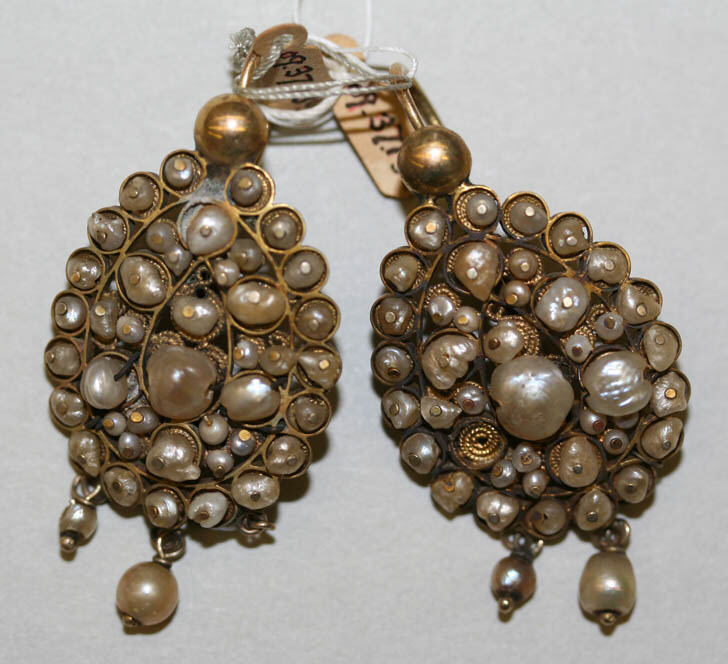
Deconstructing the Classical Ear: A Metallurgical Archaeology for 2026
The earring, in its most reductive form, is a declaration of intent—a metallic punctuation mark at the threshold of the face. For Natalie Fashion Atelier, the 2026 collection does not begin with a sketch, but with an excavation. Our aesthetic archaeology isolates the earring from its historical continuum, stripping away the patina of centuries to reveal the structural DNA that binds a Byzantine votive to a Belle Époque chandelier. This research artifact deconstructs the classical elegance of the earring, tracing its metal from a functional ornament to a sculptural interlocutor, and posits a definitive thesis: the 2026 high-end silhouette is not a departure from heritage, but a radical re-synthesis of its most potent, isolated components.
I. The Isolated Archive: Metal as Memory
We begin with the premise of isolation. To perform aesthetic archaeology is to remove the earring from the contextual noise of the museum vitrine—the velvet bust, the dim lighting, the historical placard. What remains is pure objecthood: a twisted length of gold, a hammered silver crescent, a filigree sphere. In this isolation, the metal speaks a language of tension and release. The European tradition, from Etruscan granulation to Renaissance enamel work, privileges the surface as narrative. The Eastern tradition, particularly the Mughal and Ottoman ateliers, privileges the negative space as architecture. The 2026 silhouette must reconcile these two grammars.
Consider the classical European earring: the girandole, a three-drop cascade of gold and gemstones. Its elegance derives from a rigid, hierarchical symmetry—a central axis from which all elements hang in disciplined subordination. The metal is a load-bearing structure, and its beauty is one of engineering. Conversely, the Eastern jhumka, a bell-shaped dome of gold filigree, achieves elegance through volumetric compression. The metal is hammered into a convex form that catches light not as a reflection, but as an absorption. The 2026 deconstruction does not choose between these. Instead, it isolates the girandole's axis and the jhumka's volume, then re-fuses them into a hybrid silhouette that is neither pendant nor dome, but a torsional arc—a metal ribbon that wraps the earlobe in a continuous, unbroken line.
II. Materiality: The Metallurgical Lexicon
The metal itself is not a passive substrate. In 2026, we are moving beyond the binary of gold versus silver, entering a period of alloyed intentionality. The archive teaches us that the ancients did not value pure metal; they valued workable metal. The addition of copper to gold for hardness, the use of niello for contrast—these were not compromises, but enhancements of expressive potential. For the contemporary earring, we propose a return to this metallurgical pragmatism, but with a 21st-century lexicon.
The primary material for the 2026 silhouette is a high-carat gold alloy (22k) with a controlled oxidation patina. This is not a nostalgic verdigris, but a deliberate, laser-applied micro-texture that creates a matte, light-absorbing surface. This metal behaves like a black velvet backdrop, allowing the silhouette—not the shine—to dominate. The classical error was to polish metal to a mirror finish, making the earring a source of light. The 2026 approach is to make the metal a modulator of light. The oxidized surface, when paired with a single, unpolished interior facet, creates a chiaroscuro effect that is deeply Parisian—intimate, cerebral, and quietly luxurious.
Furthermore, we introduce a secondary metal: Argentan, or nickel silver, historically used in French Art Deco jewelry for its cool, steely undertone. In isolation, Argentan is utilitarian. In conjunction with the oxidized gold, it provides a thermal contrast—the warmth of the gold against the coolness of the silver. This is not a bimetallic trend; it is a structural dialogue. The Argentan acts as a counterweight, a hidden skeleton that allows the gold to appear to float, defying gravity. The silhouette is thus defined by the tension between metals, a physical manifestation of the European and Eastern dialectic.
III. Silhouette Architecture: From Ornament to Object
The 2026 high-end earring silhouette abandons the pictorial. We no longer design a “flower” or a “star.” We design a spatial event. The classical earring was a miniature painting; the 2026 earring is a miniature sculpture. The shift is from two-dimensional representation to three-dimensional intervention. The earlobe is no longer a canvas; it is a pedestal.
Our primary silhouette, the “Torsion Cuff”, is derived from the isolated spiral of a Celtic gold torc, reimagined through a Parisian lens of restraint. It is a single, continuous band of the oxidized gold alloy, approximately 3mm in width, that begins at the front of the lobe, wraps underneath, and terminates in a sharp, geometric point behind the ear. There is no clasp, no hinge. The tension of the metal itself holds it in place. This is a direct homage to the classical earring’s reliance on friction and counterbalance, but executed with a modernist purity. The silhouette is not a circle, but a parabola, echoing the architectural curves of a Le Corbusier chapel, yet grounded in the ancient craft of metal beating.
The second silhouette, the “Negative Drop”, inverts the classical chandelier. Instead of three descending drops, we create one solid, ovoid form of Argentan, hollowed out from behind. The front face is a smooth, unbroken plane. The back face is a lattice of exposed structural ribs. When worn, the earring appears as a solid geometric block, but from a three-quarter angle, the light passes through the lattice, casting a shadow pattern on the neck. This is an archaeological inversion: the hidden, structural elements of the Mughal filigree are brought to the periphery, while the surface is silenced. The silhouette is not about the object, but about the shadow it casts—an ephemeral, secondary architecture that changes with every movement of the head.
IV. The 2026 Synthesis: A Parisian Conclusion
The classical elegance of the earring was predicated on the idea of finish—a perfect, closed object. The 2026 high-end silhouette is predicated on the idea of process—an object that reveals its own construction, its own tension, its own material history. By isolating the earring from its archive, we have freed it from the tyranny of representation. The metal is no longer a vehicle for a gemstone; the gemstone is obsolete. The metal is the message.
For Natalie Fashion Atelier, the 2026 earring is a micro-architectural manifesto. It is a study in equilibrium—between European symmetry and Eastern volume, between polished surface and oxidized texture, between the weight of history and the lightness of a single, unadorned line. The silhouette is not worn; it is inhabited. It does not decorate the ear; it redefines the space around it. This is the new luxury: not the accumulation of ornament, but the reduction to structural essence. The earring becomes a fragment of a larger, invisible edifice—a private architecture that speaks only to the wearer and the few who are permitted to see it in profile. This is the quiet power of the 2026 collection: a classical rigor, deconstructed and rebuilt, not for the eye, but for the intellect.