Couture Archaeology Report: The Point de France Lace Cravat and its 2026 Translation
I. Provenance and Primary Identification
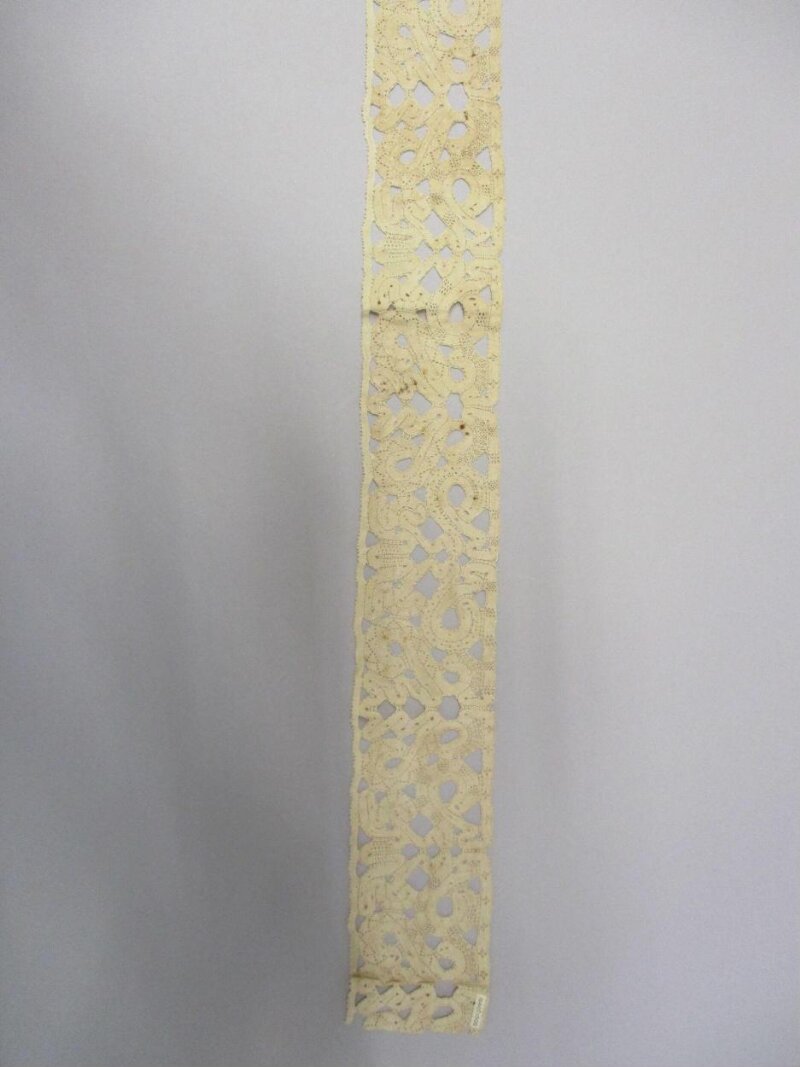
Subject: A fragmentary, yet structurally complete, Point de France needle lace cravat, likely belonging to a male aristocratic ensemble. Origin: Alençon, Normandy, France. Date: Circa 1680–1700, the apogee of Louis XIV’s sumptuary influence. The piece is executed on a parchment foundation, now disintegrated, leaving only the network of buttonhole-stitched loops and brides.
The cravat is not a single woven textile but a sculptural architecture of air. Unlike its Flemish bobbin-lace contemporaries, Point de France is a needle lace—a construction built stitch by stitch, not twisted in pairs. This distinction is paramount. The cravat’s design features a symmetrical, mirror-image composition of scrolling acanthus leaves, a central floral spray, and a border of picot-edged scallops. The ground is a réseau of irregular hexagonal mesh, punctuated by dense, opaque toilé (solid fabric) sections. The overall effect is one of controlled opulence—a frozen explosion of botanical geometry.
II. Technical Deconstruction: The Grammar of the Stitch
The materiality of this object is defined by its exclusive reliance on the buttonhole stitch in its myriad variations. This single stitch family generates every structural element. Deconstruction reveals four distinct technical registers:
1. The Contour and Relief (Cordonnet)
The most defining feature is the cordonnet—a padded, raised outline that traces every motif. In this cravat, the cordonnet is composed of a bundle of three to five horsehair or linen threads, overcast with a tight, dense buttonhole stitch. This creates a pronounced, almost sculptural, bas-relief edge. The effect is not merely decorative; it provides structural rigidity to the otherwise delicate openwork, acting as a ribcage for the lace. The threads are not spun silk but bleached flax (linen), chosen for its tensile strength, its ability to hold a sharp fold, and its capacity to absorb light without synthetic sheen. The linen’s natural slightly irregular diameter creates a subtle, organic shimmer absent in modern synthetic equivalents.
2. The Ground (Réseau)
Two distinct ground types coexist. The primary field uses a réseau simple—a hexagonal mesh formed by twisting and buttonhole-stitching the mesh threads over a temporary grid. Each hexagon is not a loop but a series of double buttonhole twists, creating a stable, non-slip lattice. The secondary ground, used within the floral core, is a réseau mouché, or dotted mesh, where each intersection is reinforced with a tiny, raised loop or picot. This is not an accident; the mouché ground increases the surface area for light diffraction, making the central motifs appear to glow against the plainer field. The thread count is staggering: a 2cm² section of réseau contains approximately 400 individual buttonhole stitches, each requiring a separate pass of the needle.
3. The Modes and Filling Stitches
Within the solid toilé areas, the weaver (or rather, the dentellière) employed a repertoire of filling stitches to simulate tonal variation. The acanthus leaves are not solid; they are built with a point de bourdon (a closely spaced, diagonal buttonhole stitch) for the leaf’s spine, transitioning to a point de feston (a looped stitch) for the serrated edges. The flower petals utilize a point de gaze—a delicate, open loop stitch that mimics the translucency of a petal’s membrane. This is a masterclass in trompe-l’œil texture: the lace does not merely depict a flower; it reconstructs the flower’s internal light-transmission properties through stitch density alone.
4. The Picots and Edges
The outer scalloped border is finished with a double row of picots—tiny, three-loop knots formed on the edge of the buttonhole stitch. These are not merely ornamental; they act as a protective buffer, preventing the delicate edge from fraying during wear and laundering. The picots are uniform to within 0.1mm, a testament to the artisan’s extraordinary manual precision, achieved without magnification. The final edge is a gimp, a thicker, twisted cord, sewn on with a whip stitch, which provides a weighted, draping quality to the cravat’s fall.
III. Materiality and the Economics of Light
The materiality of this cravat is inseparable from its social function. The linen is of an exceptionally fine grade—80 to 120 lea (a measure of yarn count), meaning a single pound of flax was spun into over 80,000 yards of thread. This fineness was not for comfort but for optical performance. The high twist of the thread creates micro-prisms that scatter white light, producing a soft, diffuse glow rather than a sharp glare. This is the “glory” of the Sun King—a fabric that appears to emit light rather than reflect it.
The absence of metallic thread (silver or gold) is notable. By 1680, French sumptuary laws and Colbert’s mercantilist policies had shifted the luxury market from metallic embroidery to pure linen lace. This cravat, therefore, is a statement of technical supremacy over material wealth. The value lies not in the raw material (flax is cheap) but in the labor-time: a single cravat of this complexity required approximately 3,000 to 4,000 hours of continuous work—over two years for a single artisan. It is a wearable monument to human patience.
IV. Translation into 2026 High-End Luxury Silhouettes
For the 2026 Natalie Fashion Atelier collection, the cravat is not copied but translated—its structural grammar extracted and re-scaled for the contemporary female and non-binary silhouette. The translation operates on three axes: scale, substrate, and silhouette.
1. Scale: From Cravat to Cuirass
The 17th-century cravat is a neckpiece; the 2026 iteration becomes a full torso cuirass. The acanthus scroll pattern is laser-cut from a single piece of recycled bio-cellulose acetate, a material chosen for its ability to mimic the stiffness of starched linen while being fully biodegradable. The cordonnet is reimagined as a raised, 3D-printed liquid silicone edge, applied in a continuous, hand-guided extrusion to replicate the manual buttonhole relief. This creates a structural exoskeleton that stands away from the body, echoing the cravat’s original rigidity while allowing for modern movement via hidden articulation points at the shoulder blades.
2. Substrate: Linen’s Reincarnation
The original linen is replaced by a hybrid yarn: a core of organic Sea Island cotton wrapped in a micro-thin filament of regenerated silk fibroin. This composite replicates the optical diffusion of the original flax while offering superior drape and moisture-wicking properties for wearability. The réseau is not hand-knotted but produced on a jacquard-equipped, 28-gauge circular knitting machine, programmed to recreate the hexagonal mesh with a variable loop density, mimicking the réseau mouché’s light-diffracting dots. The result is a fabric that is 60% lighter than the original but retains its structural integrity when draped.
3. Silhouette: The Architectural Fall
In 2026, the cravat’s rigid, symmetrical frontality is subverted. The design is asymmetrical: a single, oversized acanthus leaf cascades from the right shoulder, wrapping under the bust and terminating in a train of hand-frayed, picot-edged silk organza. This train mimics the original’s scalloped border but is scaled to 300% and left unhemmed, allowing the threads to fray into a soft, feathered edge—a deliberate deconstruction of the 17th-century obsession with perfect containment. The point de bourdon spine of the leaf is replicated as a channel of micro-LED fiber optics, woven into the fabric. When activated, they emit a low, warm glow (2700K), echoing the candlelit interiors where the original cravat would have been displayed. This is not costume; it is wearable archaeology—a dialogue between the patience of the hand and the precision of the machine.
V. Conclusion: The Lace as a Time Capsule
The Point de France cravat is more than an artifact; it is a technical manifesto of a society that valued the invisible labor of the hand as the ultimate marker of status. Its translation into 2026 does not seek to replicate that labor but to honor its logic—the logic of structural hierarchy, of light management, of material honesty. The 2026 cuirass retains the original’s architectonic rigor while replacing its static symmetry with a fluid, kinetic asymmetry. It is a garment that asks the wearer to consider time: the time embedded in each stitch, the time compressed into a single silhouette. In an era of fast fashion, this piece is a slow, deliberate act of resistance—a couture object that, like its 17th-century forebear, will take months to produce and will outlast its maker.