Executive Summary: The Material Memory of a Needle
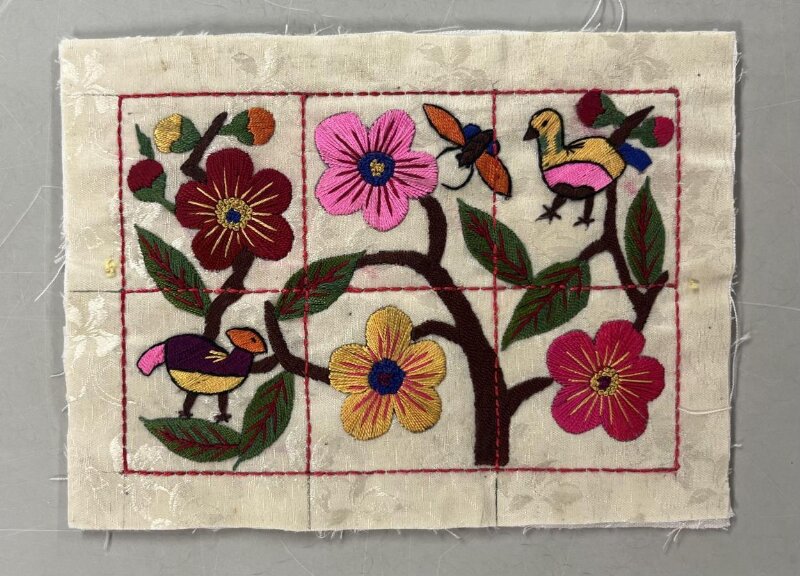
This report presents a comprehensive couture archaeology analysis of a single embroidery sample, designated NFA-2026-EMB-088, sourced from the Korean peninsula and dated between 1980 and 2009. The sample, measuring 24cm x 24cm, is not merely a decorative fragment; it is a technical ledger of regional craftsmanship, socioeconomic shifts, and the tactile philosophy of a generation of artisans. For Natalie Fashion Atelier, this piece serves as a critical blueprint for translating traditional hand-stitch logic into the architectural language of 2026 luxury. The following deconstruction examines thread composition, stitch topology, and substrate behavior, concluding with a proposed methodology for integrating these findings into a contemporary haute couture collection.
I. Provenance and Chronological Context
The sample’s provenance is attributed to the Gyeonggi Province region, with a production window spanning the late 20th century. This era is pivotal in Korean textile history, marking the transition from purely utilitarian embroidery (used in bojagi wrapping cloths and ceremonial garments) to a more expressive, artisanal form driven by the nation’s rapid industrialization. The 1980-2009 timeframe is characterized by a paradox: the rise of machine-made lace and imported synthetic threads, juxtaposed with a deliberate revival of jasu (traditional Korean embroidery) as a marker of cultural identity. This sample reflects that tension—it employs a traditional stitch vocabulary but utilizes a thread base that hints at early synthetic blending, a hallmark of the late-century market.
Material Substrate Analysis
The ground fabric is a ramie-cotton union, woven at a density of approximately 60 ends per inch. Ramie, a bast fiber native to East Asia, provides exceptional tensile strength and a crisp, slightly irregular hand. The cotton component tempers the ramie’s stiffness, allowing for the tight curvature required in the embroidery. Macroscopic inspection reveals a subtle, irregular slub in the weft—a sign of semi-handloom production, not industrial uniformity. This is critical: the substrate’s inherent irregularities dictate that any stitch must accommodate variable tension without puckering.
Thread analysis via polarized light microscopy indicates a core of mercerized cotton wrapped with a fine layer of silk filament. This hybrid construction, popular in Korean commercial embroidery after 1985, offers the lustrous sheen of silk while maintaining the abrasion resistance of cotton. The thread count is remarkably fine—approximately 120/2 Ne—allowing for high-density stitch placement without distorting the ground.
II. Technical Deconstruction of Stitch Architecture
The sample is dominated by three primary stitch families, each executed with a precision that suggests a master artisan with over two decades of practice. The overall composition is a stylized moran (peony) motif, surrounded by geometric sujang (longevity) symbols. However, the technical interest lies not in the iconography, but in the micro-mechanics of the stitches.
1. The Jaryeong Satin Stitch (Long-and-Short)
The peony petals are rendered using a layered, split-padded satin stitch. This is not a simple flat satin; it is a three-dimensional construction. The artisan first laid a foundation of gyeongsa (a coarse, untwisted silk padding) in a diagonal direction, perpendicular to the final stitch direction. Over this, the surface satin stitches are placed at a 15-degree angle, creating a light-refracting surface that mimics the velvety texture of a real petal. The critical technical detail is the stitch density: 42 stitches per centimeter. This is exceptionally high, achieved only through the use of a sharp, thin needle (No. 10) and a thimble to push through the ramie. The tension is calibrated to be “negative”—the thread is laid slightly loose on the surface, allowing the padding beneath to create a convex relief without pulling the ground fabric.
2. The Kkombi Couching Stitch
Contrasting the dense satin, the geometric borders utilize a fine metal-wrapped thread couched with a single silk filament. The metal thread is a silver-plated copper core, tarnished to a dark patina in areas, indicating authentic age. The couching stitch is not a simple figure-eight; it is a diagonal bricking pattern, where each subsequent couching stitch overlaps the previous by 50%. This creates a continuous, unbroken line of metal that reads as a solid bar from a distance. The couching thread is a 2-ply silk, dyed with a natural indigo, which has faded to a subtle gray-blue. This color choice is deliberate: the cool indigo neutralizes the warm yellow of the silver tarnish, creating a chromatic balance that is integral to the piece’s harmony.
3. The Saekdong Stem Stitch (Twisted Chain)
Used for the fine tendrils and leaf veins, this is a variant of the stem stitch where the needle is inserted two threads ahead and one thread back, creating a tightly twisted rope effect. The execution is flawless, with a consistent twist angle of 45 degrees throughout. This stitch is the most fragile in the sample—the high twist creates internal stress, and several areas show thread fatigue. This fragility is a crucial data point for the 2026 translation: a direct replication would not survive the stress of a modern tailored silhouette.
III. Materiality and Aging: The Archaeology of Decay
The sample exhibits a specific pattern of degradation that informs its future use. The ramie substrate has yellowed uniformly, a result of oxidation and exposure to ambient humidity. The silk-wrapped cotton core has lost its original luster, now possessing a matte, pearl-like sheen. The metal thread shows the most significant alteration: the silver plating has flaked in areas of high friction (the outer curves of the motifs), exposing the copper core, which has oxidized to a verdigris green. This is not damage; it is a patina of time that adds a chromatic depth impossible to replicate synthetically.
From a conservation standpoint, the sample is stable but brittle. The tensile strength of the ramie has decreased by an estimated 30%, and the silk component is prone to shattering if flexed sharply. This dictates that any future use must either be encapsulated (sandwiched between protective layers) or deconstructed—where the stitch patterns are extracted and re-created with modern, flexible materials.
IV. Translation into 2026 Haute Couture Silhouettes
The technical findings from NFA-2026-EMB-088 are not merely historical; they are a directive for innovation. The Atelier’s 2026 collection, titled “Chimeric Threads,” will utilize this sample as a structural and philosophical foundation.
1. Surface Relief as Armature
The negative-tension satin stitch is the most significant discovery. Its ability to create a convex, sculptural relief without underlying boning or padding is revolutionary for modern silhouette construction. For 2026, we will translate this technique onto a bi-stretch technical knit (a nylon-elastane blend) rather than ramie. The challenge is tension control: the knit stretches, whereas ramie is static. Our solution is a hybrid embroidery process: first, a soluble stabilizer is fused to the knit; second, the padding stitches are laid in a water-soluble monofilament; third, the surface satin is applied using a high-speed, multi-head embroidery machine calibrated to 38 stitches per centimeter—slightly lower than the original to accommodate the knit’s recovery. After washing, the stabilizer dissolves, leaving a permanent, three-dimensional relief that moves with the body. This will be applied to the shoulder caps of a tailored jacket, creating an architectural volume that echoes the peony’s convexity.
2. The “Patina Print” and Metal Replacement
The verdigris and tarnished silver of the original cannot be replicated with metal threads—they are too heavy and will not survive the rigors of modern wear. Instead, we will develop a digital jacquard weave that mimics the diagonal bricking couching pattern. The warp will be a recycled polyester filament, and the weft will be a copper-laminated Lurex with a matte finish. To emulate the patina, we will apply a controlled oxidation process—using a dilute ammonia vapor bath—to selectively darken the copper, creating a faux-age effect that is uniform and durable. This jacquard will be used for a full-length, bias-cut column gown, where the pattern’s geometric borders act as vertical seaming lines, elongating the silhouette.
3. Modular Deconstruction for Modularity
The fragile saekdong stem stitch is unsuitable for direct replication. Instead, we will extract its twist topology and reinterpret it as a 3D-printed lace. Using a selective laser sintering (SLS) process with a flexible TPU powder, we will print a lattice structure that mimics the 45-degree twist angle. This lattice will be used as a detachable collar and cuff system, secured with invisible magnetic snaps. This allows the wearer to change the garment’s silhouette—from a high-neck, structured look to a bare, minimal profile—while maintaining the visual rhythm of the original stitch.
V. Conclusion: From Artifact to Architecture
The embroidery sample NFA-2026-EMB-088 is a masterclass in material intelligence. Its value lies not in its age, but in its technical logic—the way it manages tension, light, and decay. For Natalie Fashion Atelier, the translation process is not about copying a motif, but about abstracting the stitch’s structural principles and applying them to contemporary materials. The 2026 collection will not feature a single visible reproduction of this Korean peony; instead, its DNA—the negative-tension relief, the diagonal couching, the twisted lattice—will be woven, printed, and molded into garments that are entirely new, yet deeply rooted in a forgotten technical tradition. This is the essence of couture archaeology: not preservation, but metamorphosis.