From Infernal Sketch to Sartorial Structure: An Aesthetic Archaeology of Delacroix’s Damned Man
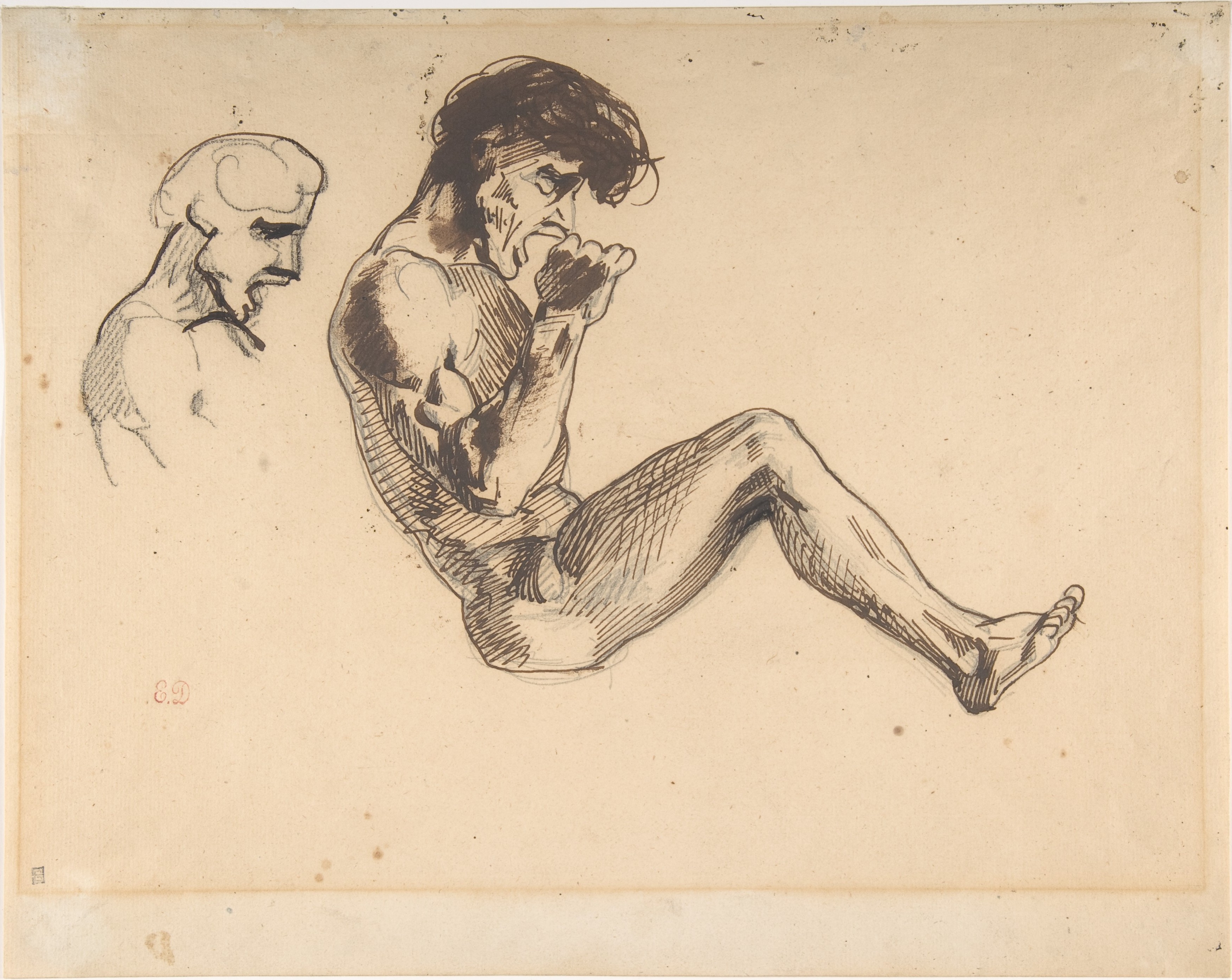
The atelier’s 2026 pre-autumn collection finds its foundational thesis not in the gilded salons of the Second Empire, but in the raw, visceral immediacy of a preparatory sketch. Specifically, we turn to Eugène Delacroix’s Studies of a Damned Man, executed for the monumental Barque of Dante (1822). Isolated from its final pictorial context, this sheet of pen, brown ink, black wash over black chalk and graphite offers a masterclass in tension, torsion, and the architecture of despair. For Natalie Fashion Atelier, this is not a source of morbid inspiration, but a technical blueprint. We deconstruct its classical elegance—the underlying academic draftsmanship subverted by Romantic energy—to inform a new lexicon of high-end silhouettes for 2026, where structure is fluid, and elegance is defined by controlled volatility.
I. The Graphic Anatomy of Torment: Deconstructing the Medium
The materiality of the work is paramount. Delacroix did not employ a single, monolithic stroke. Instead, he layered media to achieve a sculptural dimensionality on a two-dimensional plane. The black chalk and graphite form the armature—the classical skeleton of the figure. This is the dessin, the academic foundation that speaks to the artist’s rigorous training. In couture terms, this is the toile, the initial muslin prototype that establishes proportion and fit. It is the invisible, yet essential, logic that prevents the composition from collapsing into chaos.
Upon this base, the brown ink is applied with a quill, creating decisive, calligraphic lines that define the contours of muscle and bone. These are not passive outlines; they are active forces, carving the figure from the page. The line thickens and thins, accelerating and decelerating, mimicking the pulse of the damned soul. This translates directly to our 2026 silhouette through the use of structural piping and exposed seam work. We are not hiding the construction; we are celebrating it as a graphic element. A jacket’s lapel is not merely folded; it is drawn with a sharp, unbroken line of horsehair canvas that visually cuts through the fabric, echoing the ink’s decisive stroke.
Finally, the black wash is the agent of atmosphere and volume. It is the shadow that both obscures and reveals, creating a dramatic chiaroscuro that plunges the figure’s back into darkness while thrusting the chest and shoulder into stark relief. This is the modelé, the painterly mass. In our 2026 collection, this is achieved through graded opacity and tonal layering. We employ double-faced fabrics—a matte, deep-charcoal wool on one side, a liquid, almost metallic silk on the other. As the wearer moves, the fabric shifts, creating a living wash of light and shadow that mimics the ink’s fluidity. The silhouette is no longer a static form but a dynamic play of tonality.
II. The Torsion of the Spine: Silhouette as Narrative
The most compelling aspect of the sketch is the figure’s posture. It is not a passive fall, but an active, muscular struggle against gravity. The spine is not straight; it is a coiled spring. The shoulders are asymmetrical, one thrust forward, the other wrenched back. The head is thrown back, the neck a taut column of sinew. This is the essence of contrapposto taken to its Romantic extreme—a classical balance point deliberately destabilized to express psychological turmoil.
For 2026, we translate this torsion into the very cut of the garment. We abandon the symmetrical, two-dimensional pattern-making of traditional tailoring. Instead, we introduce a biomimetic, spiral-cut construction. The fabric is cut on a bias that follows the diagonal line of the torso’s twist, allowing the material to cling and release in a controlled manner. A trench coat, for example, is not cut with a standard front and back panel. It is cut as a single continuous piece that wraps around the body, with the closure point shifted dramatically off-center. The result is a silhouette that appears perpetually in motion, even at rest.
This is further articulated in the sleeve head and shoulder construction. The traditional, padded, and rigid shoulder is replaced with a pagoda or dropped shoulder that is internally wired to hold a slight, deliberate cant. One shoulder may sit higher and more forward, creating a protective carapace, while the other falls lower, exposing the neckline. This asymmetry is not a stylistic quirk; it is a direct quotation of the sketch’s anatomical tension. The garment becomes a prosthetic extension of the wearer’s own potential for drama, a wearable manifestation of the internal struggle between composure and abandon.
III. The Elegance of the Abyss: Materiality and Finish
The palette for this collection is dictated by the sketch’s monochromatic intensity. We move beyond simple black. We introduce ink-blot greys, deep umber browns, and graphite charcoal, all with a deliberate variance in sheen. A single ensemble might combine a matte, dense wool for the main body, a semi-glossy, rubberized silk for a panel that mimics the black wash, and a fine, almost invisible metallic thread woven into the fabric to catch the light like a dry ink stroke.
The finishing is where the classical elegance is most apparent. The garments are not distressed or deconstructed in a punk aesthetic. They are meticulously finished, with hand-rolled hems, silk-thread buttonholes, and internal corsetry that provides the structural support for the twisted silhouettes. The elegance lies in the paradox: the chaos of the form is contained within an impeccable, couture-level execution. This is the "classical elegance" we speak of—not a reference to Grecian drapery, but to the discipline and precision required to render a state of sublime agitation in a permanent, wearable form.
IV. Conclusion: A New Romanticism for 2026
Delacroix’s Damned Man is not a relic of the past; it is a prophecy of our contemporary condition. In a world of curated perfection, the atelier’s 2026 silhouette offers a more profound truth: the beauty of the struggle. By deconstructing the artist’s technical process—the chalk armature, the ink line, the wash of shadow—we have constructed a new architecture for the body. The Natalie Fashion Atelier client is not merely dressed; she is composed. She wears a garment that holds the tension of a drawing, the drama of a masterpiece, and the quiet, powerful elegance of a soul in motion. The collection is an ode to the power of the unfinished, the beauty of the sketch, and the enduring relevance of a damned man’s grace.