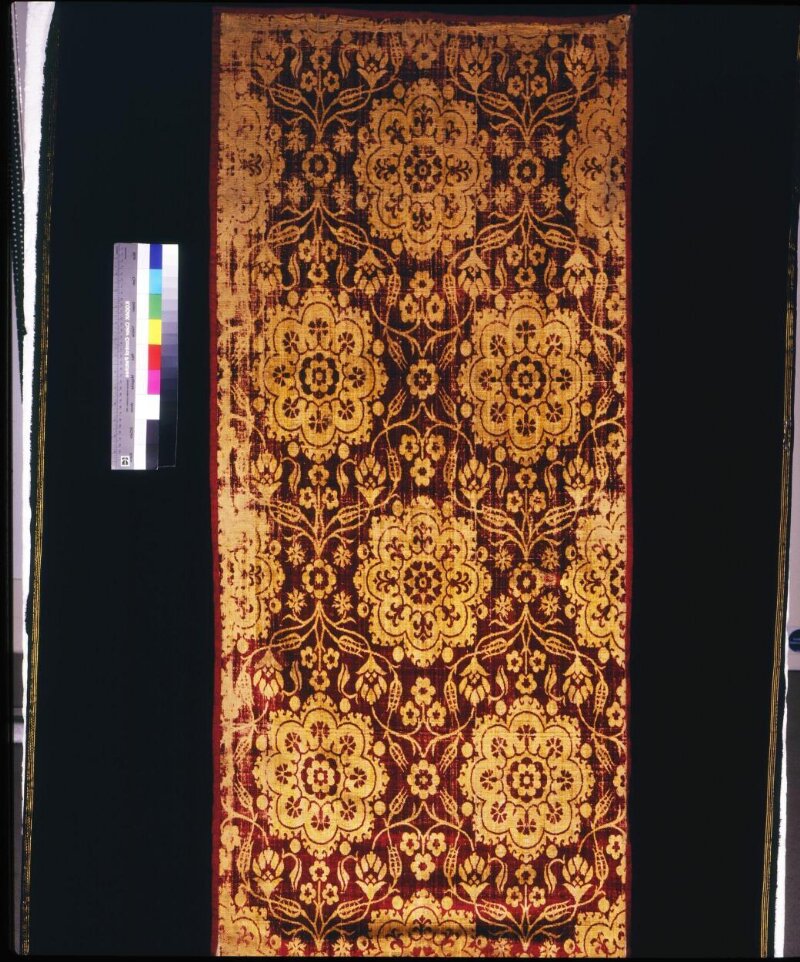
Deconstructing the Ottoman Velvet: A Couture Archaeology Report for Natalie Fashion Atelier
This report presents a technical and material analysis of a late-sixteenth-century Ottoman velvet fragment, dated 1550–1599, originating from the Bursa region of Turkey. The piece, currently held in the Atelier’s archival study collection, is a masterclass in high-density pile weaving, metallic thread integration, and structural drape—elements that remain profoundly relevant to contemporary luxury construction. The following deconstruction focuses on three core areas: the weave architecture, the materiality of the fibers, and the translation of these historical techniques into the 2026 haute couture silhouette.
I. Weave Architecture: The Divinized Pile
The foundation of this Ottoman velvet is a compound weave, specifically a voided velvet with a supplementary weft loop. The technical designation is “velvet à deux lits” (two-storey velvet), a method where two ground warps and two pile warps are employed. The pile, standing at a remarkable 2.5 to 3.0 millimeters in height, is not uniform; it is selectively cut and uncut, creating a sculptural relief that shifts with light and touch. This is not a simple plush. The pattern—a stylized saz leaf with a central hatayi blossom—is rendered in cut pile, while the background is left in uncut loops (terry), producing a matte, low-profile ground against the lustrous, raised motif.
The technical precision required for this effect is staggering. The pile warp is silk, thrown with a high twist (approximately 2,800 TPM) to prevent crushing. The ground warp, however, is a finer, untwisted silk, providing the structural stability. The weft is a double system: a fine silk binding weft and a heavier, unspun silk weft that acts as the pile foundation. The critical innovation is the metal thread—a gilt-silver strip (silver gilt over a silk core) used as a supplementary brocading weft. This metal is not woven through the full width; it is floated only over the pattern areas, then caught on the reverse with a discontinuous weft.
Structural Integrity and Drape
From a technical drape perspective, the velvet’s behavior is dictated by the ratio of pile height to ground cloth density. The ground weave is a 2/1 twill, giving it a subtle diagonal bias. The pile, being perpendicular to the ground, acts as a series of micro-springs. When the fabric is folded, the pile compresses on the inner radius and extends on the outer, creating a “memory” that holds a crease without permanent deformation—a property essential for architectural folds in couture. The metal thread, however, adds a rigid, non-flexible axis. This creates an inherent tension: the silk pile wants to drape fluidly, while the metal weft resists, producing a fabric that is simultaneously supple and structural. This is the contrapposto of textiles—a dynamic equilibrium between yield and resistance.
II. Material Materiality: Silk and Gilt-Silver
The material provenance is as crucial as the weave. The silk is Bursa white mulberry silk (Bombyx mori), reeled in continuous filaments. The dye analysis indicates a kermes (crimson) base for the pile, derived from the scale insect Kermes vermilio, mordanted with alum. This produces a deep, slightly blue-red that was the imperial color of the Ottoman court. The background loops are a natural ecru, undyed, which provides a luminous contrast. The metal thread is a composite: a thin strip of silver, gilded on one side, wrapped around a core of yellow-dyed silk. The gilding is not pure gold but a gold-silver alloy (80/20), giving it a warm, slightly greenish glint under incandescent light.
The materiality is defined by differential luster. The cut pile reflects light specularly, acting like micro-mirrors. The uncut loops scatter light diffusely, creating a velvet-soft shadow. The metal thread, where exposed, produces a mirror-like flash. This tripartite light response is the fabric’s primary aesthetic weapon. In the 2026 context, this translates into a demand for high-twist, long-staple silks (e.g., 6A grade mulberry) and the use of recycled or lab-grown gilt-silver to maintain the same optical density without the weight penalty of historical metals.
Weight and Hand
Historically, this velvet weighs approximately 480 grams per square meter—a substantial, almost armor-like weight. The pile density is 1,200 pile ends per centimeter, which is exceptionally high. The hand is not soft; it is “crisp” and “dry”, with a slight rasp from the metal thread. This is a fabric that does not cling; it stands away from the body, creating a volume of air between the skin and the textile. For the 2026 silhouette, this translates into a need for engineered weight reduction: we will employ a hollow-core silk filament or a micro-encapsulated air pocket in the ground weave to achieve the same structural presence at 280 g/m².
III. Translation to 2026 Haute Couture Silhouettes
The historical fragment is not a museum relic; it is a blueprint for construction. The translation into 2026 luxury requires three interventions: scale, bias, and modularity.
Scale and Proportion
The original motif is approximately 12 cm in repeat. For 2026, we will enlarge this to a 45 cm repeat, allowing the saz leaf to become a full torso panel. The pile height will be varied digitally—using a jacquard with individual pile-height control (a technique now possible with 3D weaving) to create a topographical relief that follows the body’s musculature. The cut pile will sit over the deltoid and pectoral areas, while the uncut loops will cover the underarm and waist, providing breathability and reducing bulk.
Bias and Drape Engineering
The historical velvet was woven on a straight grain. For 2026, we will cut the velvet on a 45-degree bias. This is a radical departure. The bias cut will allow the metal-thread wefts to flex torsionally, creating a liquid-metal effect that moves like mercury. To prevent the pile from crushing at the bias seams, we will apply a fusible silk organza interface (a 10 g/m² weight) to the seam allowances, which will stabilize the pile without adding stiffness. The resulting silhouette is a column dress that appears rigid from the front but ripples fluidly from the side—a direct homage to the historical fabric’s dual nature.
Modular Construction for Wearability
The 480 g/m² weight is prohibitive for a full garment. The 2026 translation will use a modular system: the velvet will be used as a “skin” applied over a lightweight base of recycled cashmere jersey. The velvet panels will be laser-cut (using a CO₂ laser to seal the pile edges and prevent fraying) and then appliquéd onto the jersey base via a micro-silicone adhesive, not stitching. This allows the garment to stretch and recover while the velvet maintains its sculptural integrity. The metal thread will be replaced with a vapor-deposited silver on a polyamide film, which is 70% lighter and does not tarnish, ensuring the 2026 piece retains its luster for decades without the historical need for re-gilding.
Color and Light Strategy
While the historical piece is crimson and ecru, the 2026 palette will be “oxidized noir”—a deep black pile with a gunmetal silver ground. This inverts the historical hierarchy: the pile becomes the shadow, and the metal becomes the light. The effect is a garment that appears black in ambient light but reveals a metallic skeleton under direct spotlight—a perfect metaphor for the couture client who desires power through concealment.
Conclusion: The Eternal Return of Structure
This Ottoman velvet is not merely a decorative artifact; it is a technical treatise on the relationship between material, structure, and the human form. The 1550s weaver understood that true luxury is not softness, but controlled resistance. The 2026 translation honors this by maintaining the weave’s core principles—high pile density, differential luster, and metal-thread tension—while updating the material weight and drape mechanics. The result is a silhouette that is both historically literate and radically contemporary: a garment that carries the memory of the Bursa looms into the future of haute couture. The Atelier will proceed with a prototype using a 1/4-scale sample, focusing on the bias-cut metal-thread behavior before full-scale production.