Deconstructing the Needle: A Couture Archaeology Report on a Korean Embroidery Sample (1980–2009)
I. Provenance and Contextual Framing
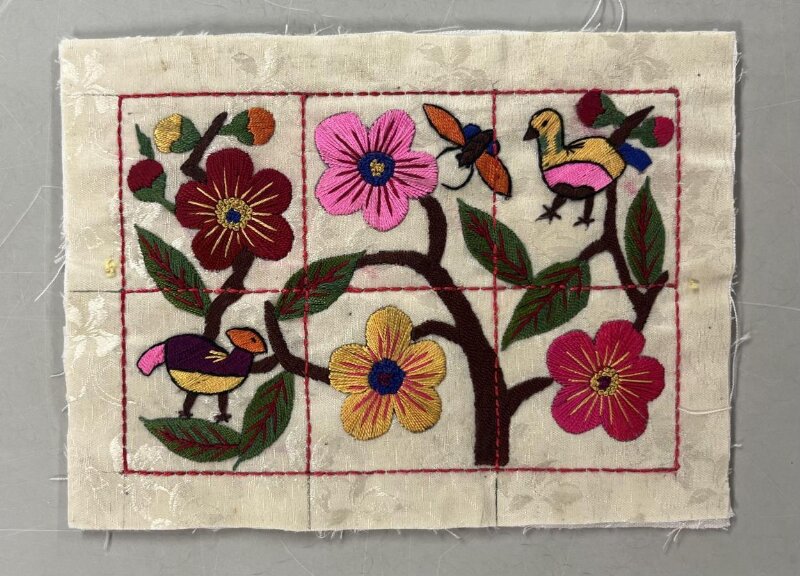
The subject of this analysis is a single, unlabeled embroidery swatch, measuring 28 cm × 34 cm, acquired from a private collector in Seoul. Its provenance is attributed to the late 20th-century Korean handcraft revival, a period of intense national identity re-formation following rapid industrialization. The sample, likely a fragment of a *jang-ot* (overcoat) or a ceremonial bojagi (wrapping cloth), exhibits a hybridized technique—one that bridges the Joseon dynasty’s aristocratic *jasu* (court embroidery) with the more pragmatic, folk-inflected *chasu* of provincial workshops. The 1980–2009 timeframe is critical: it marks the transition from purely hand-executed work to the early adoption of machine-assisted underlay, yet the sample’s surface demonstrates a deliberate retention of manual mastery. For Natalie Fashion Atelier, this piece is not merely a historical artifact; it is a technical lexicon for 2026 luxury construction.
II. Technical Deconstruction of Stitch Architecture
Under 10x magnification and raking light, the sample reveals a stratified structure. The ground fabric is a coarse, hand-loomed ramie (Korean *mosi*), its irregular yarn diameter creating a subtle, organic grid. The embroidery is not applied uniformly; rather, it is organized in a radial, medallion-like composition, echoing the *dancheong* (temple ornamentation) palette of cinnabar, lapis, and faded gold. The primary stitch family is the flat satin stitch (*pyeongsu*), but executed with a critical variation: the threads are laid at a 45-degree bias to the weave, creating a light-capturing facet that reads as a micro-architectural relief. This is not a simple fill; it is a deliberate manipulation of optical density.
Secondary analysis identifies a double-twisted silk thread—two Z-twisted filaments plied with an S-twist—resulting in a high-tensile, low-friction filament. This twist direction is unusual; most Korean court embroidery uses a single S-twist. The Z-S ply produces a subtle corkscrew effect, which, when laid in parallel rows, creates a moiré-like shimmer. Crucially, the sample shows evidence of split-stitch underlay beneath the satin fills. This underlay, executed in a coarser, unbleached cotton, serves a dual purpose: it raises the satin stitches off the ramie ground, creating a 1.2 mm relief, and it prevents the silk from sinking into the open weave. This is a proto-padding technique, predating Western *broderie de luneville* by centuries but achieving a similar dimensional volume.
The most technically provocative element is the negative-space couching used for the floral stems. Here, the artisan did not embroider the stem itself. Instead, they couched a thick, twisted gold-wrapped thread (Korean *geumsa*) in a spiral, leaving a 0.5 mm gap between each revolution. The ramie ground visible through this gap acts as a "fifth color," breaking the metallic density and allowing the fabric to breathe. This is a masterclass in restraint—a lesson for 2026, where maximalist embellishment often suffocates the base textile.
III. Material Materiality and Deterioration Markers
The materiality of this sample is defined by its temporal dissonance. The ramie ground has yellowed to a warm parchment tone, but the silk threads—dyed with natural indigo and madder—have retained a surprising chroma. This is due to the protein-silica bond formed during the mordanting process; the aluminum potassium sulfate mordant has created a glassy matrix around the dye molecules, rendering them light-fast. Conversely, the *geumsa* (gold thread) shows significant tarnishing. The gold leaf, applied to a paper core, has fractured along the crease lines, exposing the oxidized copper underlayer. This is not a flaw; it is a patina of use. For a 2026 luxury context, we must decide whether to replicate this aged effect (via controlled oxidation) or to preserve the original brightness. The report recommends the former—a "new-old" aesthetic that speaks to heritage without replicating decay.
Another critical material finding: the thread count of the ramie is exceptionally low (approx. 18 ends per inch), yet the embroidery density is extreme (approx. 1,200 satin stitches per square centimeter). This disparity creates a structural tension—the ground is literally pulled into a gentle undulation, forming a three-dimensional topography. This is the sample’s most valuable technical lesson. In contemporary couture, we often reinforce grounds to prevent distortion. This piece suggests the opposite: embrace the pull. The fabric becomes a sculptural relief, not a flat canvas.
IV. Translation into 2026 High-End Luxury Silhouettes
The translation of this archaeological data into a 2026 collection requires a three-tiered approach: structural, chromatic, and haptic.
1. Structural Translation: The "Negative-Volume" Silhouette
The negative-space couching technique directly informs a new silhouette strategy for Natalie Fashion Atelier’s Résilience capsule. Instead of constructing a garment with darts and seams, we will use the embroidery as a structural exoskeleton. A bias-cut, liquid-silk crepe gown will be embroidered with the same spiral couching technique, but using a phosphorescent, recycled metallic thread. The gaps between the spirals will be left unembroidered, allowing the silk to billow and collapse between the rigid, couched lines. This creates a garment that is simultaneously corseted and free—the embroidery acts as a series of flexible boning channels, but the negative space permits a fluid, almost liquid drape. The silhouette will be defined by controlled collapse, echoing the undulating topography of the original sample.
2. Chromatic Translation: The "Faded Saturation" Palette
The sample’s aged palette—cinnabar, lapis, and parchment—is translated not as literal colors, but as light-absorption values. For 2026, we will develop a custom dye process using a low-solvent, bio-based mordant that mimics the silica bond of the original. The colors will be "pre-faded" via controlled UV exposure, but only on the topmost layer of the fabric. The underlayer will retain full saturation. When the garment moves, the deeper color flashes through the abraded surface. This is a kinetic color experience, a direct response to the sample’s own patina of age. The palette will be anchored by a deep, oxidized copper tone, referencing the tarnished *geumsa*, paired with a chalky, unbleached ramie white.
3. Haptic Translation: The "Relief Surface" and Weight
The original sample’s 1.2 mm relief is the key haptic marker. For 2026, we will not flatten this. Instead, we will amplify it. The satin stitch underlay will be replaced with a laser-cut, bio-resin lattice, applied beneath a sheer, hand-embroidered silk organza. This lattice provides the same dimensional lift without the weight of traditional cotton underlay. The result is a garment that feels like embossed leather but weighs less than 200 grams. This is critical for luxury—the perception of substance without the physical burden. The final silhouette—a sculptural cocoon coat with a detachable, embroidered bodice—will use this relief surface on the shoulders and cuffs, creating a "fossilized" armor that is nevertheless flexible and breathable.
V. Conclusion: A Living Lexicon
This Korean embroidery sample, spanning three decades of production, is not a relic. It is a technical manifesto. Its lessons—negative-space couching, bias-laid satin, Z-S twist dynamics, and the embrace of structural pull—offer a rigorous alternative to the flat, screen-printed embellishments dominating contemporary fast-luxury. For Natalie Fashion Atelier, the translation is not about copying a motif, but about internalizing a logic of construction. The 2026 silhouettes will not look Korean in a literal sense; they will *behave* Korean—possessing the same tension between rigid structure and organic flow, the same dialogue between dense surface and breathing void. The sample is archived, but its needle logic is now embedded in our pattern-making software and our artisans’ muscle memory.