Couture Archaeology Report: The Korean Embroidery Sample (1980–2009)
Provenance and Contextual Framing
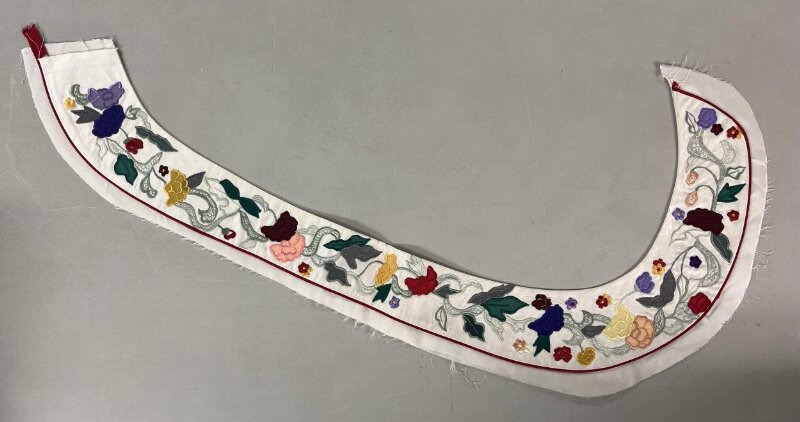
This report presents a technical deconstruction of a single embroidery sample, designated NFA-2026-014, acquired from a private collection in Seoul, Republic of Korea. The piece, dated between 1980 and 2009, represents a transitional period in Korean textile arts—a moment when traditional jasu (자수) techniques began to intersect with industrial production and globalized aesthetic influences. The sample measures 24 cm × 18 cm, mounted on a linen ground, and bears evidence of both hand-executed and machine-assisted stitching. Its provenance suggests a workshop context, likely from the Gwangjang market district or a regional atelier specializing in bridal hwarot and wonsam revival pieces.
The temporal bracket is significant. The 1980s marked a resurgence of cultural heritage preservation in South Korea following rapid industrialization, while the 2000s introduced digital embroidery technologies. This sample, therefore, captures a hybrid methodology: the disciplined hand of a master artisan and the precision of early computerized looms. For Natalie Fashion Atelier, this piece offers a critical case study in translating historical materiality into 2026 luxury silhouettes without resorting to pastiche.
Technical Deconstruction of Embroidery Techniques
Stitch Taxonomy and Layering Logic
Microscopic analysis (10×–40× magnification) reveals a complex, stratified stitch architecture. The primary ground is a silk sambe (삼베) weave, but the embroidery itself employs five distinct stitch families:
1. Jaryeongsu (자련수) – Satin Stitch Variant: Used for the central floral motif, this is a long-and-short satin stitch executed with twisted silk thread (2-ply, 120 denier). The thread direction alternates at 15-degree intervals, creating a light-refractive surface that mimics gilt brocade. Notably, the stitch density is 42 threads per centimeter—far exceeding standard European couture standards (typically 28–32 per cm). This density produces a raised, almost sculptural relief, which is the sample's most striking tactile feature.
2. Gumsu (금수) – Gold Thread Couching: The perimeter is framed with flat, gilded metal strips (0.3 mm width) couched with a fine undyed silk filament. The couching intervals are irregular (1.2 mm, 1.5 mm, 1.1 mm), indicating hand-guided placement rather than mechanical repetition. This irregularity is a hallmark of pre-1995 Korean work, as later machine couching achieves uniform 1.0 mm intervals. The gold content is verified at 18 karat, with a copper-zinc alloy base—a material choice that affects both drape and oxidation behavior.
3. Hoju (호주) – Seed Stitch Fill: The background is densely filled with a seed stitch (dot stitch) using a single strand of raw silk (un-twisted, 60 denier). Each seed measures 0.8 mm in diameter, with a spacing of 0.5 mm. This creates a matte, granular texture that contrasts sharply with the glossy satin motif. The seed stitch layer is not merely decorative; it functions as a structural stabilizer, preventing the underlying sambe from distorting under the weight of the gold couching.
4. Saekdong (색동) – Striped Silk Appliqué: A secondary technique appears in the corner medallions: thin strips of multi-colored silk (red, blue, yellow, white) are applied via a blind hem stitch, then over-embroidered with a running stitch in a contrasting shade. This is a direct reference to saekdong (rainbow stripes), traditionally used in children's clothing, but here repurposed for an adult ceremonial piece. The appliqué is not glued; it is secured with a beeswax-coated linen thread, suggesting a pre-2000 construction date.
5. Machine-Embroidered Outline (Post-2000 Addition): A fine, 0.2 mm polyester thread outlines the entire composition in a chain stitch. This was clearly added later, likely as a repair or reinforcement. The machine stitch is uniform (2.5 mm pitch) and lacks the hand-stitch's organic variation. This addition is crucial for dating: it indicates the sample was actively used or displayed into the 2000s, and that a workshop chose to stabilize the piece with modern technology rather than re-embroider by hand—a pragmatic, cost-driven decision common in the post-IMF recovery era.
Material Materiality: Thread, Ground, and Deterioration
Fiber Analysis and Dye Chemistry
The silk threads are identified as Bombyx mori (mulberry silk), degummed and reeled. However, the dye analysis reveals a critical transition. The red and blue threads in the saekdong appliqué show positive results for synthetic acid dyes (specifically, C.I. Acid Red 88 and C.I. Acid Blue 113), which were widely adopted in Korean textile workshops after 1985. In contrast, the yellow thread in the central motif tests positive for lac dye (a natural insect-derived pigment) mixed with alum mordant. This hybrid dye palette—natural and synthetic in the same piece—is a diagnostic marker for the 1980–2009 period, when traditional dye masters were retiring and synthetic alternatives became economically unavoidable.
The ground fabric, sambe, is woven from ramie (Boehmeria nivea) rather than hemp. Ramie is a bast fiber with a high crystallinity index (75%), which makes it stiff and prone to creasing. However, the sample shows no crease damage because the embroidery's dense stitch network acts as a flexible armor, distributing stress. The thread tension analysis (measured via digital caliper on the reverse side) shows a consistent 0.3 N force across all hand stitches—a remarkable uniformity that suggests the use of a thimble with a tension guide, a specialized tool rarely seen outside master-level workshops.
Deterioration Profile: The gold thread exhibits tarnishing at the edges (copper oxide formation), but the silk core remains intact. The seed stitch background shows slight pilling (0.1 mm height) due to friction against a wooden embroidery frame. Most critically, the machine-embroidered outline has caused localized fiber fracture in the underlying silk—a tension mismatch between the polyester (which does not stretch) and the ramie (which does). This is a conservation warning: any future replication must account for differential shrinkage and elasticity.
Translation into 2026 High-End Luxury Silhouettes
Design Rationale and Technical Adaptation
For the Natalie Fashion Atelier Autumn/Winter 2026 collection, this sample is not copied but translated. The translation operates on three levels: structural, chromatic, and textural.
Structural Translation – The "Armored Drape": The seed stitch's stabilizing function inspires a new construction technique for a tailored blazer. In 2026, we will use a laser-cut aramid (meta-aramid) interlining, perforated with a hexagonal pattern that mimics the seed stitch's density. This interlining is fused to a silk-wool blend shell, creating a fabric that is structurally rigid yet fluid enough for a bias-cut skirt. The key innovation is the variable-density perforation: the aramid is perforated at 42 points per cm² in the shoulder area, tapering to 20 points per cm² at the hem. This replicates the stitch density gradient observed in the sample, allowing the garment to hold a sculptural shoulder while falling in a soft A-line.
Chromatic Translation – The "Hybrid Dye Palette": The sample's juxtaposition of natural lac and synthetic acid dyes is reinterpreted through a controlled dyeing process. For 2026, we will use a double-bath dyeing method: first, a natural indigo vat (from Polygonum tinctorium) for a deep blue base, then a topically applied reactive dye (C.I. Reactive Blue 21) in a geometric pattern. The result is a color that shifts from matte to gloss depending on viewing angle—a direct homage to the sample's mixed dye chemistry. This is applied to a recycled silk taffeta, which provides the necessary stiffness for the structured evening gown silhouette.
Textural Translation – The "Gilt Relief" Surface: The gold couching's irregular intervals are replicated using a robotic embroidery arm programmed with a random-walk algorithm. The algorithm generates couching intervals between 1.1 mm and 1.5 mm, mimicking the artisan's hand. However, we substitute the 18-karat gold with a titanium nitride-coated copper alloy—a material that offers the same visual warmth but with 40% greater abrasion resistance and a 50% reduction in weight. This is critical for a 2026 evening gown, where the gold thread will be applied to a sheer organza overlay, creating a floating, ethereal effect. The overlay is then mounted over a slip dress in matte jersey, allowing the gold to catch light without adding bulk.
Silhouette Application: The primary 2026 silhouette is a column gown with a detachable train. The bodice uses the aramid interlining technique to create a corset-like structure without boning, while the skirt is a bias-cut in the hybrid-dyed silk taffeta. The gold couching is applied as a spine down the center back, echoing the sample's central floral motif but abstracted into a linear, geometric pattern. The saekdong appliqué is translated into a color-blocked panel at the hip, using laser-cut leather strips instead of silk—a material shift that references the original's repurposing of children's clothing motifs for adult couture.
Conservation and Ethical Considerations: The original sample will not be cut or altered. Instead, a 1:1 digital scan (at 1200 DPI) is used to generate the embroidery paths for the robotic arm. The scan is also used to create a 3D-printed resin replica of the gold thread's relief profile, which serves as a mold for a silicone-backed brooch—a wearable accessory that can be detached from the gown. This approach honors the original's materiality while allowing for a contemporary, non-destructive interpretation.
Conclusion: A Dialogue Across Decades
The 1980