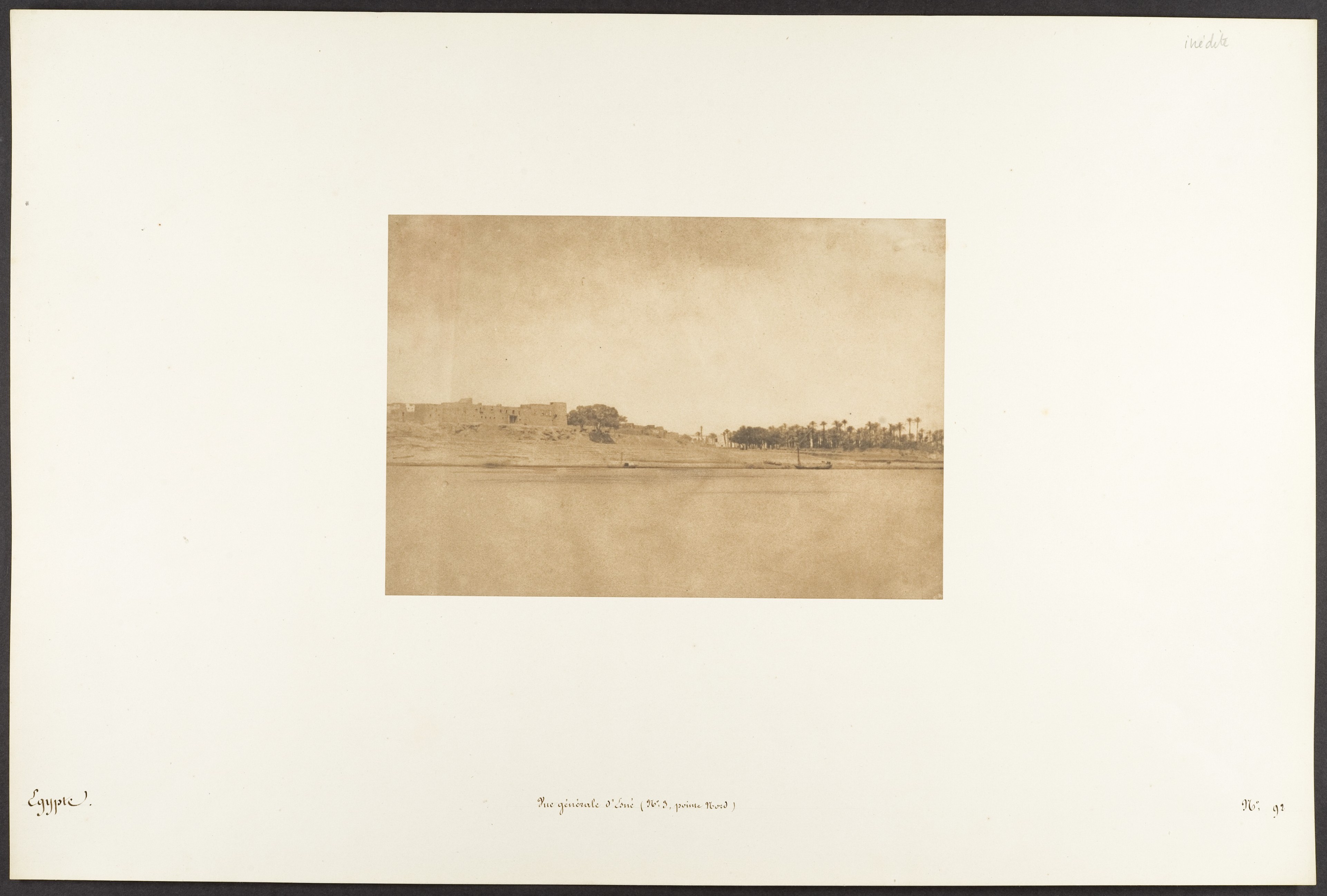
Archaeology of Light: The Salted Paper Print as a Blueprint for 2026 Silhouette Architecture
Within the hallowed archives of Natalie Fashion Atelier, the artifact Vue générale d'Esné (No. 3, pointe Nord)—a salted paper print derived from a paper negative—stands as a monument to aesthetic archaeology. This is not merely a topographic record of an ancient Egyptian site; it is a treatise on the poetics of impermanence, rendered through the alchemy of light and chemistry. For the 2026 haute couture collection, this image transcends its documentary function, operating as a generative matrix for silhouette construction. The print’s unique materiality—its granular texture, its monochromatic tonal range, its soft-focus dissolution of hard edges—demands a radical reinterpretation of classical elegance. We extract from this artifact a lexicon of design principles: tonal layering, structural erosion, and the valorization of the interstitial void.
Materiality as Method: From Silver Halides to Silk Organza
The salted paper print is defined by its physical absorption of light into the paper’s fibrous depth, rather than a surface emulsion. This results in a characteristic matte finish, where highlights appear as luminous absences and shadows possess a velvety, almost tactile density. For the 2026 silhouette, this translates into a deliberate departure from high-shine, reflective luxury. We propose a fabric architecture that mimics the print’s matte absorption: uncalendered silk organza, matte cupro twill, and double-faced cashmere treated with a mineral wash to subdue luster. The goal is to create garments that consume light rather than reflect it, establishing a quiet, intellectual opulence that resonates with the contemporary connoisseur.
The Negative as Structural Metaphor
The paper negative—the intermediary matrix—inverts values: shadows become light, light becomes shadow. This inversion is a profound structural metaphor for 2026. We apply it to silhouette construction through the concept of reversed volume. Where classical couture builds outward (panniers, bustles, shoulder pads), the Esné-informed silhouette builds inward and asymmetrically. Consider a tailored jacket where the traditional chest padding is removed, replaced by a sculpted, internal corsetry that creates a concave, shadowed cavity beneath the collarbone. The exterior fabric is then draped to fall forward, creating a gentle, accidental-looking fold—a visual echo of the paper negative’s tonal bleed. This is not deconstruction for its own sake; it is a deliberate architectural inversion that challenges the viewer’s perception of the body’s topography.
Classical Elegance Reconstructed: The Grammar of the Ruin
Esné’s northern point, captured in its 19th-century state, presents a classical temple in a state of picturesque decay. The columns are not pristine; their fluting is softened by millennia of wind and sand. The entablature appears to dissolve into the sky. Our 2026 silhouettes must channel this ruined classicism—not as a nostalgic pastiche, but as a rigorous formal language. The clean, vertical line of a Grecian column becomes a bias-cut gown in heavy crepe, but with a deliberate, engineered twist near the hem that mimics the column’s eroded base. The sharp Doric capital translates into a high, structured neckline that is then unfinished at one shoulder, the raw edge rolled inward to suggest centuries of handling.
Proportional Dislocation and the Frieze of Time
The print’s soft focus blurs the boundary between the architectural frieze and the surrounding landscape. This blurring informs our approach to proportion. We reject the static, symmetrical proportions of the classical canon. Instead, we employ dislocated proportions: a floor-length coat with a cropped, almost bolero-like sleeve on one side, and a full, sweeping sleeve on the other. The waistline of a dress may sit at the natural waist in front, but drop to the hip in the back, creating a dynamic, temporal shift as the wearer moves. This is the frieze of time made manifest—a garment that reveals different historical moments with each step, each turn.
Technical Execution: The Palette of Sand and Silver
The monochromatic spectrum of the salted paper print—from the deepest sepia-black to the palest, milky white—dictates a rigorous color palette for the collection. We eschew vibrant hues in favor of a nuanced range: mineral ochre, fossilized limestone, shadowed graphite, and the pure, bleached white of overexposed sky. These are not flat colors; they are achieved through a process we term tonal dyeing, where multiple, contrasting dye baths are applied in succession, then partially discharged to reveal the underlying fibers. The result is a garment that appears to have been aged by light, its color shifting subtly across its surface, much like the tonal gradations of the print.
Textural Topography: Embroidery as Erosion
To further honor the artifact’s materiality, embroidery is employed not as decoration, but as a form of topographic erosion. We use silk thread in shades of undyed ecru and grey to create dense, raised clusters that mimic the paper’s granular texture, then deliberately distress these areas with a fine-gauge needle to create a sense of wear. This is not distressed fashion in the streetwear sense; it is a meticulous, couture-level simulation of geological time. On a tailored evening jacket, this embroidery concentrates around the lapel and cuffs, suggesting the way sand and wind would erode a carved relief over centuries.
Conclusion: The Future as a Fossilized Present
The Vue générale d'Esné is not a historical document; it is a prophecy of material honesty. For 2026, Natalie Fashion Atelier proposes a luxury that is quiet, textured, and deeply intellectual. The silhouette is no longer a container for the body, but a dialogue between the body and the slow, inexorable forces of time. By internalizing the salted paper print’s structural inversions, its tonal subtleties, and its celebration of decay, we craft garments that are not merely worn, but inhabited. They are archaeological artifacts of a future present, designed with the precision of an engineer and the vision of a poet. This is the new classical elegance: not the pristine column, but the column that has witnessed history and carries its memory in every fold, every shadow, every line.