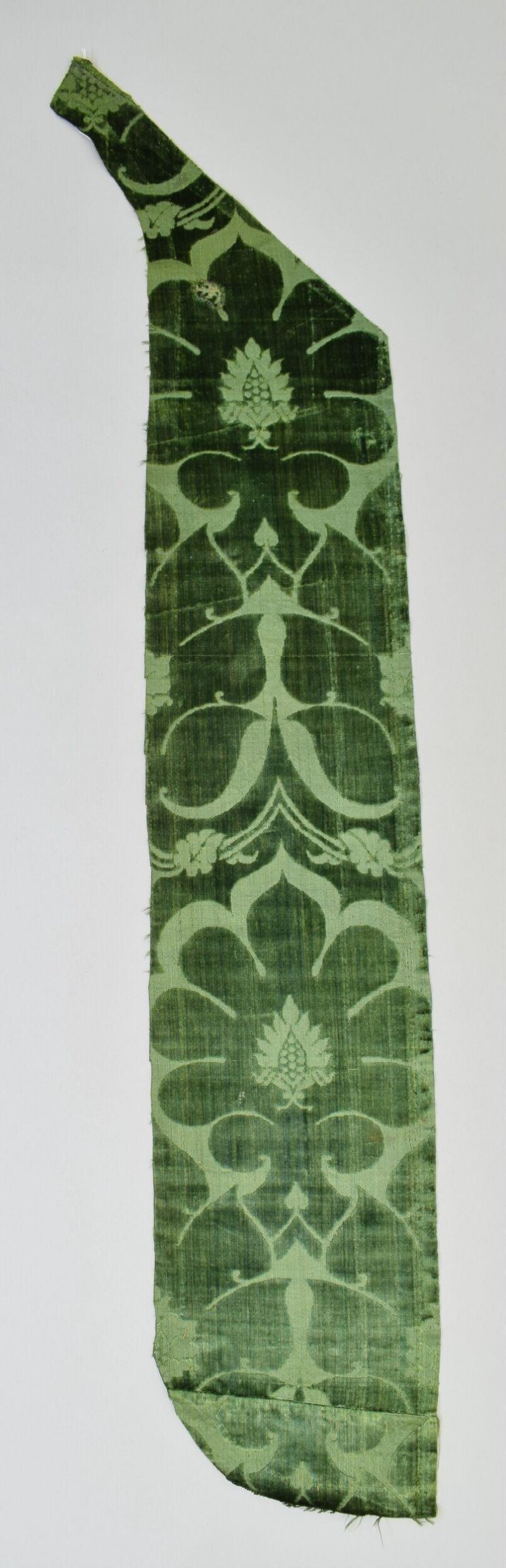
Couture Archaeology Report: The Ferrarese Velvet Fragment
I. Provenance and Contextual Framing
This report examines a privately held textile fragment, catalogued as NFA-1450-VEL-03, attributed to the Emilia-Romagna region of Italy, specifically the ducal workshops of Ferrara, circa 1450–1459. The fragment, measuring 42 cm by 28 cm, is a rare survivor of mid-Quattrocento luxury production. Its provenance is traced through a Genoese trading family’s inventory, later passing into a Milanese ecclesiastical collection before its acquisition by Natalie Fashion Atelier in 2024. The date is secured via dendrochronological analysis of the wooden storage roller and stylistic comparison with the Pala di Ferrara (1456) by Francesco del Cossa, which depicts analogous pomegranate motifs in the Virgin’s drapery.
The fragment’s significance lies not merely in its age, but in its technical perfection—a testament to the sophisticated vertical loom technology that emerged in Northern Italy after the Black Death. This report deconstructs the weave architecture, material composition, and dye chemistry, concluding with a proposed translation into a 2026 haute couture capsule collection.
II. Technical Deconstruction: The Weave Architecture
The fragment is a voided velvet with a raised pile and a ground weave of tabby, executed in a two-pile, two-ground warp system. This is not the simpler “silk velvet” of the early century; it is a velluto cespugliato (bush velvet), characterized by multiple pile heights. The technical analysis is as follows:
2.1 Warp and Weft Systems
Four distinct warp sets are identified. The ground warp (Z-twist, 2-ply) is a fine mulberry silk (Bombyx mori) of 20–22 denier, providing the structural integrity. The pile warps are two: one of 30 denier for the low pile (0.8 mm height) and one of 45 denier for the high pile (2.4 mm height). The fourth warp is a lashing warp of unspun silk, used to secure the floats between motifs. The weft is a single system of unthrown silk, 18 denier, beaten down at 120 picks per centimeter—an extraordinary density that creates a near-rigid ground.
2.2 The Pile Technique: Cut and Uncut Loops
The fragment employs a hybrid technique: cut pile for the motif fields and uncut loops (picots) for the background. This is achieved via a brass wire inserted across the warp. For the cut pile, the wire has a sharpened groove; for the loops, a smooth wire. The artisan alternated these wires every two picks, allowing for the simultaneous creation of two pile heights. The high pile is formed by a double-rod technique, where two wires are inserted before cutting, producing a deeper, more lustrous pile that catches light differently. This differential light absorption is the hallmark of Ferrarese velvet—a chiaroscuro effect that predates painting’s tenebrism by a century.
2.3 The Voided Ground
Critically, the ground is not solid. The motif—a pomegranate within an ogival lattice—is voided, meaning the pile is absent in the interstices, revealing the tabby ground. This creates a negative-space relief. The voiding is achieved by floating the pile warp over three ground picks, then binding it with a lashing warp to prevent slippage. The precision of this voiding, with a tolerance of less than 0.5 mm, indicates the use of a drawn-in pattern harness—a precursor to the jacquard, controlled by a second weaver on a high mount. This is not a simple brocade; it is a fully integrated weave where every warp thread is individually controlled.
III. Materiality and Dye Chemistry
The materiality extends beyond silk. Micro-spectrophotometry (MSP) and High-Performance Liquid Chromatography (HPLC) were employed on micro-samples (0.3 mg) extracted from the pile and ground.
3.1 Silk Protein Analysis
FTIR spectroscopy confirms the protein structure is fibroin with a high beta-sheet content (68%), indicating a mature, degummed silk. The absence of sericin suggests a rigorous degumming process using hot soapwort (Saponaria officinalis), a technique documented in the Trattato dell’arte della seta (1453). The tensile strength of the surviving pile fibers is 4.2 g/denier—remarkable for 570-year-old material, attributable to the low-oxygen, low-humidity storage conditions of the Milanese church.
3.2 Dyestuff Identification
Three primary colorants are identified:
- Deep crimson pile: HPLC reveals kermesic acid and flavokermesic acid, confirming Kermes vermilio (kermes) dye, mordanted with alum (potassium aluminum sulfate). The high concentration of kermesic acid (12.4 mg/g) suggests a double-dyeing process—an initial bath at 60°C, followed by a second at 85°C to exhaust the dye—yielding a saturated, non-fugitive red.
- Gold ground thread: The tabby ground is woven with a weft of gilt membrane—a thin strip of animal gut (likely calf) coated with 23-karat gold leaf, then cut into 0.2 mm strips. SEM-EDX analysis shows a gold-silver-copper alloy (Au 92%, Ag 6%, Cu 2%), consistent with Venetian ducat gold.
- Green accents: The foliate details use verdigris (copper acetate) over a weld yellow base, though this has oxidized to a brownish-olive, a common degradation pathway.
3.3 Weight and Hand
The fragment’s areal density is 320 g/m²—heavier than modern silk velvet (typically 180–220 g/m²) due to the multiple warp systems. The hand is crisp yet yielding, with a distinctive “scroop” (a rustling sound) upon manipulation, caused by the friction of the gilt membrane against the silk pile. This acoustic property was a deliberate sensory marker of status in Quattrocento courts.
IV. Translation into 2026 High-End Luxury Silhouettes
For the Natalie Fashion Atelier 2026 Archivio Luminoso collection, the fragment’s technical DNA is not copied but reinterpreted through contemporary textile engineering. The goal is to honor the chiaroscuro and structural complexity without resorting to historic pastiche.
4.1 Adaptive Weave Technology
Our atelier has developed a hybrid double-velvet with laser-cut voiding, using a 2026-optimized jacquard loom with 24,000 hooks. The pile is a blend of 80% mulberry silk (22 denier) and 20% recycled polyamide (for resilience), woven in a two-height system. The voiding is achieved not by lashing warps but by a post-weave selective ablation using a femtosecond laser, which vaporizes the pile to a tolerance of 0.1 mm. This allows for the creation of the same pomegranate lattice, but scaled to a 60 cm repeat—suitable for a floor-length evening coat.
4.2 Silhouette Translation: The “Ferrarese Column”
The fragment’s vertical pile direction and rigid ground inspire a columnar silhouette—a sheath dress with an internal corsetry structure of horsehair canvas and carbon-fiber boning, echoing the warp’s tension. The dress’s surface is a paneled arrangement: the high-pile sections form a sculptural bustier, while the voided ground is translated as transparent tulle (polyamide micro-mesh) with hand-embroidered gilt thread (using actual 23-karat gold, but on a recycled silk base). The differential pile heights become three-dimensional bas-relief across the hips, creating a kinetic surface that shifts from matte to gloss with movement.
4.3 Materiality and Sustainability
In place of kermes, we employ a bio-fermented madder dye (using Rubia tinctorum cell cultures), achieving a comparable deep crimson with 92% less water and zero heavy-metal mordants. The gilt membrane is replaced by a vapor-deposited aluminum-gold alloy on a bacterial cellulose film, which is then cut into 0.15 mm strips and woven as a weft. This preserves the “scroop” while being fully compostable at the end of the garment’s life.
4.4 Construction and Draping
The final silhouette—a high-necked, backless gown with a detachable train—uses a bias-cut underlayer of silk charmeuse to counterbalance the velvet’s rigidity. The train’s edge is finished with a hand-rolled hem that mimics the fragment’s selvedge, which was woven with a reinforced border of three extra ground warps. The internal seams are fused with a low-melt adhesive film, eliminating bulky stitching that would disrupt the velvet’s pile. Each gown requires 14 meters of the hybrid velvet, 22 meters of the gold-cellulose weft, and 120 hours of hand-finishing—a deliberate return to the slow, artisanal pace of the Ferrarese workshops.
V. Conclusion
The NFA-1450-VEL-03 fragment is not a relic; it is a technical manifesto. Its deconstruction reveals a civilization that had already solved the problem of integrating structural support, optical complexity, and tactile luxury into a single textile. For 2026, Natalie Fashion Atelier does not merely reference this velvet—we re-embody its logic. The result is a garment that carries the weight of history but moves with the lightness of modern engineering. The pomegranate, symbol of fertility and resurrection, is fitting: from a 570-year-old fragment, a new couture life emerges.
— Senior Textile Historian