From Bombazeen to Bum-be-seen: An Aesthetic Archaeology of Temporal Duality in Couture Silhouette
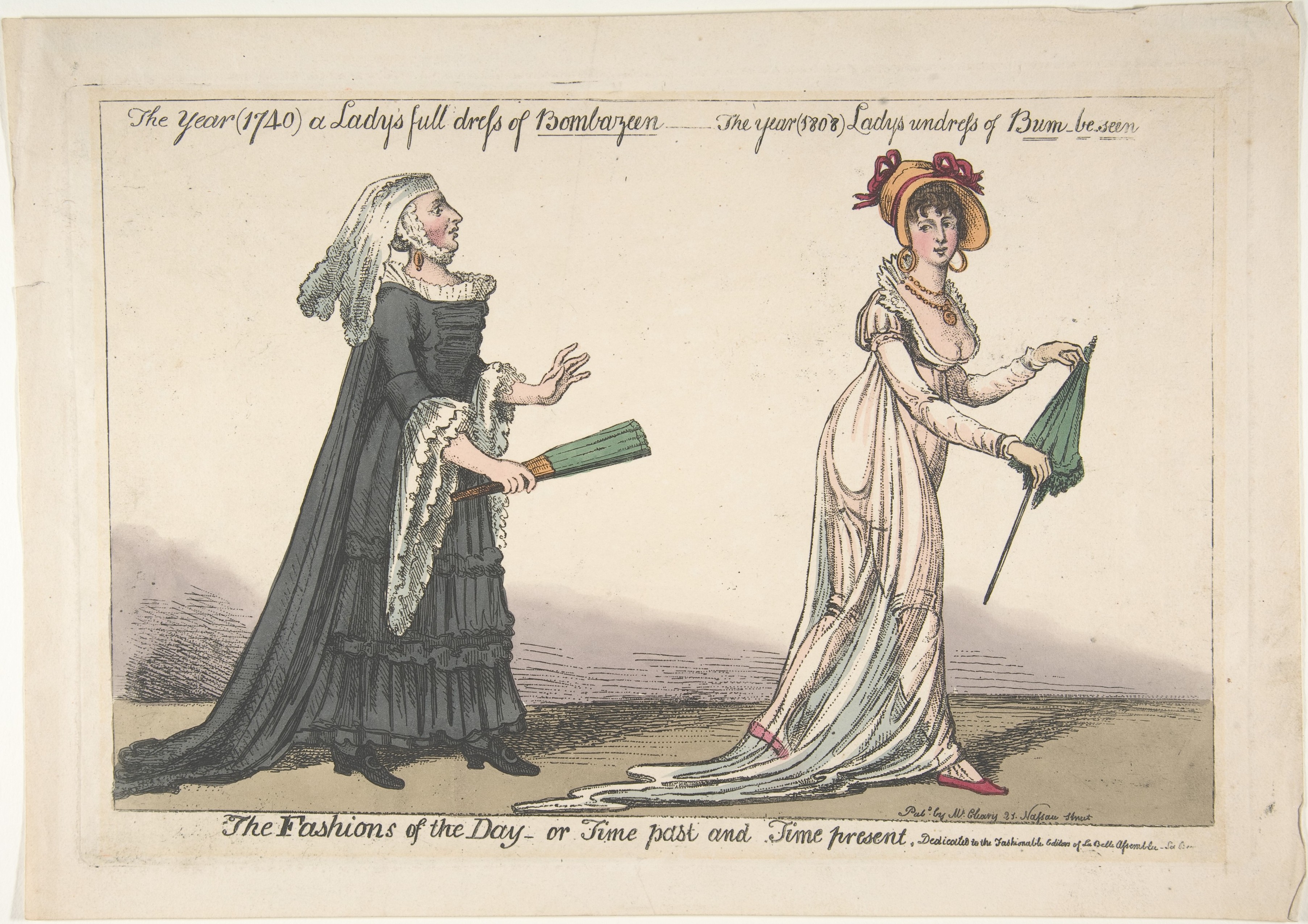
The hand-colored etching, *The Year 1740: A Lady's Full Dress of Bombazeen* and *The Year 1808: Lady's Undress of Bum-be-seen*, presents a singular artifact of aesthetic archaeology—a diptych of temporal dissonance rendered in pigment and line. For the contemporary atelier, this isolated print is not merely a historical record but a generative matrix. It encodes a profound dialogue between structural opulence and minimalist restraint, between the public performance of fabric and the private whisper of the body. As we project toward 2026, this artifact offers a critical lexicon for redefining luxury silhouettes, moving beyond nostalgic revival toward a dialectical synthesis of time past and time present.
I. Materiality as Narrative: Decoding the Bombazeen Paradox
The etching’s materiality—the hand-colored line—immediately foregrounds a tension central to haute couture. Bombazeen, a worsted wool-and-silk blend, historically signified mourning and sobriety, yet its depiction in 1740 is one of lavish architectural volume. The full dress, with its wide panniers and rigid stomacher, transforms a somber textile into a monument of social presence. Conversely, the 1808 "undress" of bum-be-seen (a phonetic corruption of bombazine) signals a radical shift: a high-waisted, columnar silhouette that clings to the natural form, prioritizing ease and intimacy over courtly display.
For the 2026 silhouette, this material paradox—the same yarn, two opposing philosophies—instructs a nuanced approach to fabric manipulation. The modern couturier must treat materiality as a temporal agent, capable of oscillating between armor and atmosphere. The 1740 dress demands a revival of structural engineering: internal boning, interlinings of horsehair, and the precise distribution of volume to create a silhouette that occupies space with deliberate authority. The 1808 undress, however, advocates for a technical mastery of drape and bias, where the fabric’s own weight and memory create a fluid, second-skin effect. The 2026 luxury silhouette, therefore, must not choose between these poles but rather engineer a fabric that can perform both—a textile that is simultaneously rigid and liquid, capable of collapsing time within a single garment.
II. Silhouette Dialectics: The Pannier and the Column
The etching’s core contribution to future design lies in its articulation of silhouette as a philosophical statement. The 1740 pannier is an explicit rejection of the body’s natural geography, projecting a geometric, almost architectural, frontality. It is a silhouette of externalized grandeur, where the garment dictates posture, movement, and social interaction. The 1808 column, in contrast, is a silhouette of internalized sensibility, a quiet acknowledgment of the body’s verticality and mobility. This is not a mere shift in fashion; it is a shift in ontology.
Translating this dialectic to 2026, we propose a new hybrid: the "Temporal Pannier." This silhouette does not resurrect the wide hip structure but reinterprets its logic through negative space and asymmetrical construction. Imagine a gown where a single, sculpted hip panel—reminiscent of the 1740 pannier—is constructed from a rigid, bio-resin-infused silk, while the opposing side flows in a fluid, 1808-inspired column of sheer, unlined crepe. The result is a silhouette that embodies both past and present simultaneously, a garment that offers a profile of monumental structure and a frontage of minimalist grace. This is not costume; it is aesthetic archaeology made wearable, a literal embodiment of the etching’s dual timeline.
III. The Grammar of Decoration: From Applied Ornament to Embedded Narrative
In the 1740 full dress, decoration is applied and abundant—lace, ribbon, and embroidery serve as markers of status, layered upon the bombazeen’s sober ground. The 1808 undress, by contrast, is almost austere, its decoration found in the subtle play of light on the fabric’s surface and the precision of its seaming. The etching’s hand-coloring further complicates this: the pigment is applied with a certain freedom, suggesting that even in the 18th century, the *perception* of decoration was subjective, a matter of the viewer’s eye.
For 2026, this dictates a move away from literal embellishment toward embedded narrative decoration. The luxury silhouette will not be adorned with external brooches or passementerie but will feature surface treatments that are integral to the fabric’s construction. This could manifest as a jacquard woven with a micro-pattern derived from the etching’s own brushstrokes, or a laser-cut leather appliqué that mimics the pannier’s structural lines but is fused invisibly into the garment’s interior. The decoration becomes a secret, a layer of meaning visible only upon close inspection—a nod to the 1808 ethos of intimacy, yet carrying the 1740’s weight of intention.
IV. The 2026 Silhouette: A Proposed Lexicon of Temporal Couture
Synthesizing these archaeological findings, the Natalie Fashion Atelier proposes a three-part framework for the 2026 collection, directly informed by this etching:
- The "Monumental Undress": A day dress in a double-faced bombazeen, one side polished to a dull sheen, the other brushed to a matte nap. The silhouette is an 1808 column, but with a structural underlay that creates a subtle, inverted pannier at the back—a ghost of 1740 volume that disappears in profile. The garment’s power lies in its restraint, its decoration a single, hand-painted line that traces the etching’s original pigment.
- The "Archival Pannier": An evening gown that deconstructs the 1740 full dress. The bodice is a rigid, corseted shell of black bombazeen, but the skirt is detached, a series of floating, engineered panels that move independently, echoing the etching’s hand-colored strokes. Each panel is weighted differently, creating a kinetic sculpture that references the past’s grandeur while performing the present’s dynamism.
- The "Temporal Shift" Gown: A transformative piece, constructed with a hidden internal mechanism (a series of delicate, magnetic clasps) that allows the wearer to convert a full, 1740-inspired skirt into a sleek, 1808 column in a single gesture. This is the ultimate expression of the etching’s duality—a garment that contains both time past and time present, and cedes control of its narrative to the wearer.
V. Conclusion: The Archive as a Living Methodology
The hand-colored etching of 1740 and 1808 is not an artifact to be preserved under glass but a methodology to be practiced. It teaches that luxury is not the accumulation of ornament but the mastery of temporal tension. The 2026 silhouette, informed by this isolated aesthetic archaeology, must be a vessel for this tension—a garment that holds the memory of bombazeen’s mourning weight and the liberation of bum-be-seen’s unbound ease. By embracing this dialectic, Natalie Fashion Atelier does not simply reference history; it operationalizes history, transforming a two-century-old etching into a blueprint for a future where elegance is defined by the confident negotiation of time itself. The result is a couture that is not nostalgic but prophetic, a material discourse on the eternal present of the body in motion.