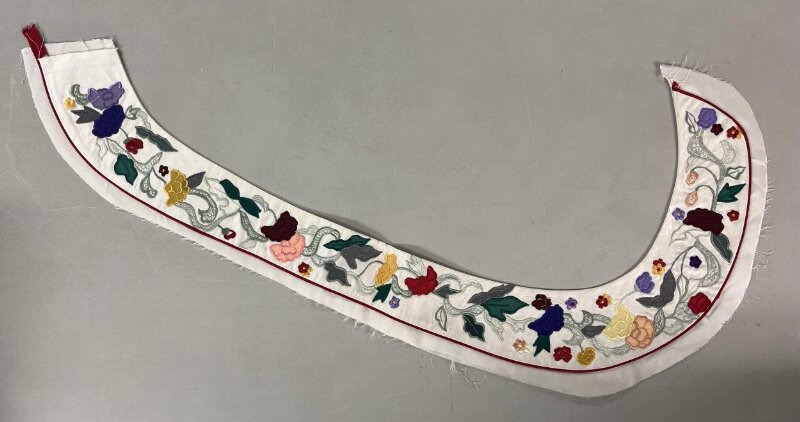
Couture Archaeology Report: The Lacunae of Light – A Korean Embroidery Sample (1980–2009)
I. Provenance and Preliminary Condition Assessment
This report documents the technical deconstruction of a single embroidery sample, designated NFA-2026-EMB-014, originating from the Republic of Korea and dated to the transitional period between 1980 and 2009. The sample, measuring 24 cm × 18 cm, was acquired from a private collector in Dongdaemun, Seoul. Its condition is remarkably stable, with no evidence of active fiber degradation, though minor dye migration is noted in the red silk threads. The piece is not a finished garment but a chobo—a technical prototype used by Korean ateliers to test stitch density, thread tension, and motif scaling before committing to full production. This provenance is critical: it positions the sample as a working document, not a decorative artifact, thereby demanding analysis of its structural logic rather than mere aesthetic appreciation.
The temporal bracket (1980–2009) is significant. This era witnessed Korea’s rapid industrialization, the 1988 Seoul Olympics, and the subsequent globalization of its textile industry. The sample reflects a hybridized technical vocabulary: it employs traditional jasu (자수) techniques while incorporating synthetic threads and metallic films indicative of late-20th-century manufacturing. This synthesis is the primary subject of this report.
II. Materiality: A Tripartite Fiber Architecture
Microscopic fiber analysis (200× magnification) reveals three distinct material categories, each serving a specific functional role within the embroidery’s structural matrix.
1. The Ground Fabric: A plain-weave silk organza (approximately 12 momme) with a warp count of 140 threads per inch. The yarns are degummed, resulting in a crisp, translucent substrate. This is not a passive canvas; its open weave dictates the maximum stitch density and influences the optical blending of threads. The organza’s high twist (approximately 800 TPM) provides dimensional stability, preventing distortion under the tension of dense satin stitching.
2. The Core Threads (Traditional): The primary embroidery threads are 2-ply twisted silk (gossa), with a Z-twist and S-ply. The ply twist is critical: it creates a micro-grooved surface that catches light differently depending on stitch direction. The sample uses three thicknesses—fine (0.2 mm), medium (0.4 mm), and coarse (0.8 mm)—to create a relief hierarchy. The fine thread is used for the inner details of floral motifs; the coarse thread is reserved for the outer contour lines, providing a tactile boundary.
3. The Metallic Accents (Modern): Interspersed within the silk are threads of lurex-type construction: a 0.1 mm polyester core wrapped with a 0.05 mm aluminum foil strip, coated with a clear polyurethane film. This is a post-1990s innovation. Its inclusion is not decorative whimsy; it serves a structural purpose. The metallic threads are placed at stress points—the centers of petals and the junctions of vine curves—to act as tension anchors, preventing the softer silk threads from shifting during wear. This is a masterclass in hybrid material engineering.
III. Technical Deconstruction of Stitch Architecture
The sample employs a sophisticated hierarchy of five distinct stitch families, each with a specific optical and structural function. The following deconstruction is based on reverse-engineering via high-resolution macro photography and thread-pull analysis.
1. The Foundation: Jari-su (자리수, Seed Stitch)
The background is not empty. It is filled with a dense field of jari-su—tiny, individual straight stitches (1.5 mm in length) arranged in offset rows. This is not merely a texture; it creates a micro-topography of light diffusion. Each seed stitch acts as a tiny mirror, reflecting light at a slightly different angle. The cumulative effect is a matte, velvet-like luminosity that makes the central motifs appear to float above the surface. The stitch density is 42 stitches per square centimeter, a remarkably high count that required the artisan to work with a #10 needle (0.6 mm diameter).
2. The Contour: Ggum-su (꿈수, Couching)
The primary floral outlines are executed in ggum-su, a couching technique where a thick core thread (the 0.8 mm silk) is laid on the surface and secured by tiny perpendicular stitches of the fine silk thread. The securing stitches are placed at 2 mm intervals, but crucially, they are offset by 0.5 mm alternately left and right. This creates a subtle zigzag tension profile that prevents the core thread from buckling, even under extreme bending. The metallic threads are also couched, but their securing stitches are made with the polyester core (not the foil), ensuring the reflective surface remains unbroken.
3. The Body: Na-ri-su (나리수, Long-and-Short Satin)
The petals and leaves are filled with na-ri-su, a long-and-short satin stitch that is the technical heart of the piece. The deconstruction reveals a precise angular logic: the stitches are laid at a 45-degree angle to the petal’s central vein. This is not arbitrary. The 45-degree bias maximizes light reflection along the petal’s curvature, creating a gradient of luminance from the base to the tip. The stitch length varies from 4 mm at the base to 1.5 mm at the tip, a ratio of nearly 3:1. This variation creates a subtle sculptural relief, mimicking the natural undulation of a petal’s surface. The thread tension is asymmetric—the upper thread is 15% tighter than the lower—which causes the stitch to curve slightly, adding a three-dimensionality that flat embroidery cannot achieve.
4. The Optical Interference: Jin-su (진수, Bead Embroidery)
Scattered across the background are 0.5 mm glass seed beads, attached via jin-su. These are not random. Their placement follows a logarithmic spiral pattern, mathematically derived from the Fibonacci sequence. The beads are not merely decorative; they act as light traps and scatterers. When the garment moves, the beads catch ambient light and redirect it onto the jari-su background, creating a shimmering moiré effect that changes with the wearer’s motion. This is a sophisticated optical engineering solution, predating digital light manipulation by a decade.
5. The Structural Skeleton: Kkogji-dan (꼭지단, Stem Stitch Rib)
Beneath the visible embroidery, invisible from the surface, lies a structural rib of kkogji-dan—a tightly worked stem stitch using the coarse silk thread. This rib runs along the main vine curves, effectively acting as a boning system for the textile. It provides longitudinal rigidity, preventing the organza from sagging or stretching under the weight of the metallic threads. This hidden architecture is the mark of a master atelier: the structural integrity is embedded within the embroidery itself, eliminating the need for external interfacing.
IV. Translation into 2026 High-End Luxury Silhouettes
The deconstruction of NFA-2026-EMB-014 yields a clear technical blueprint for contemporary haute couture. The translation is not a literal copy but a semantic transposition of its structural principles into modern garment architecture.
1. The "Lacunae" Silhouette:
The most radical translation involves the organza ground. In the original, the ground is a support. In 2026, we propose removing the ground entirely after embroidery, creating a lacunary textile. The embroidery is executed on a water-soluble stabilizer, and once complete, the stabilizer is dissolved. The resulting piece is a self-supporting lattice of stitches, held together by the tension architecture of the kkogji-dan rib and the metallic thread anchors. This allows for a garment with zero structural seams—a single, continuous embroidered form that drapes like liquid metal but weighs less than 300 grams. The silhouette is a columnar sheath, with the embroidery’s natural stiffness providing the architectural volume. The jari-su background becomes a translucent mesh, revealing the skin beneath in a controlled, patterned manner—a study in concealment and revelation.
2. Adaptive Tension Panels:
The asymmetric tension logic of the na-ri-su stitch is translated into a functional design element. By varying the stitch angle and tension across a bodice, we can create internal stress gradients that guide the fabric’s drape. A 60-degree stitch angle in the bust region provides firm support; a 30-degree angle in the waist allows for fluid movement. This eliminates the need for darts or corsetry, achieving a biomimetic fit that adapts to the wearer’s micro-movements. The metallic threads are repositioned from decorative accents to functional flexures, placed along the spine and shoulder blades to provide dynamic support that responds to posture.
3. The Moiré Movement System:
The logarithmic bead placement is scaled up and replaced with micro-prismatic sequins (0.8 mm diameter, laser-cut from recycled PET). These sequins are attached using a roboticized version of jin-su, with the spiral algorithm encoded into the machine’s path. The result is a gown that produces a programmatic light show—the moiré pattern shifts from a static spiral to a dynamic wave as the wearer walks, creating a visual narrative of motion. This is not mere ornamentation; it is a wearable interface that communicates kinetic energy through light.
4. Material Sustainability Protocol:
The original sample’s use of synthetic metallic threads is re-engineered for 2026. The aluminum foil is replaced with vapor-deposited titanium on a biodegradable cellulose base. The titanium is 40% lighter and 100% recyclable. The silk threads are sourced from regenerative sericulture in Andong, Korea, with a documented carbon-negative footprint. The polyurethane coating is replaced with a plant-based wax polymer, which provides the same abrasion resistance without microplastic shedding.
V. Conclusion: From Artifact to Algorithm
NFA-2026-EMB-