The Gilded Frame: Deconstructing Sacred Geometry for the 2026 Silhouette
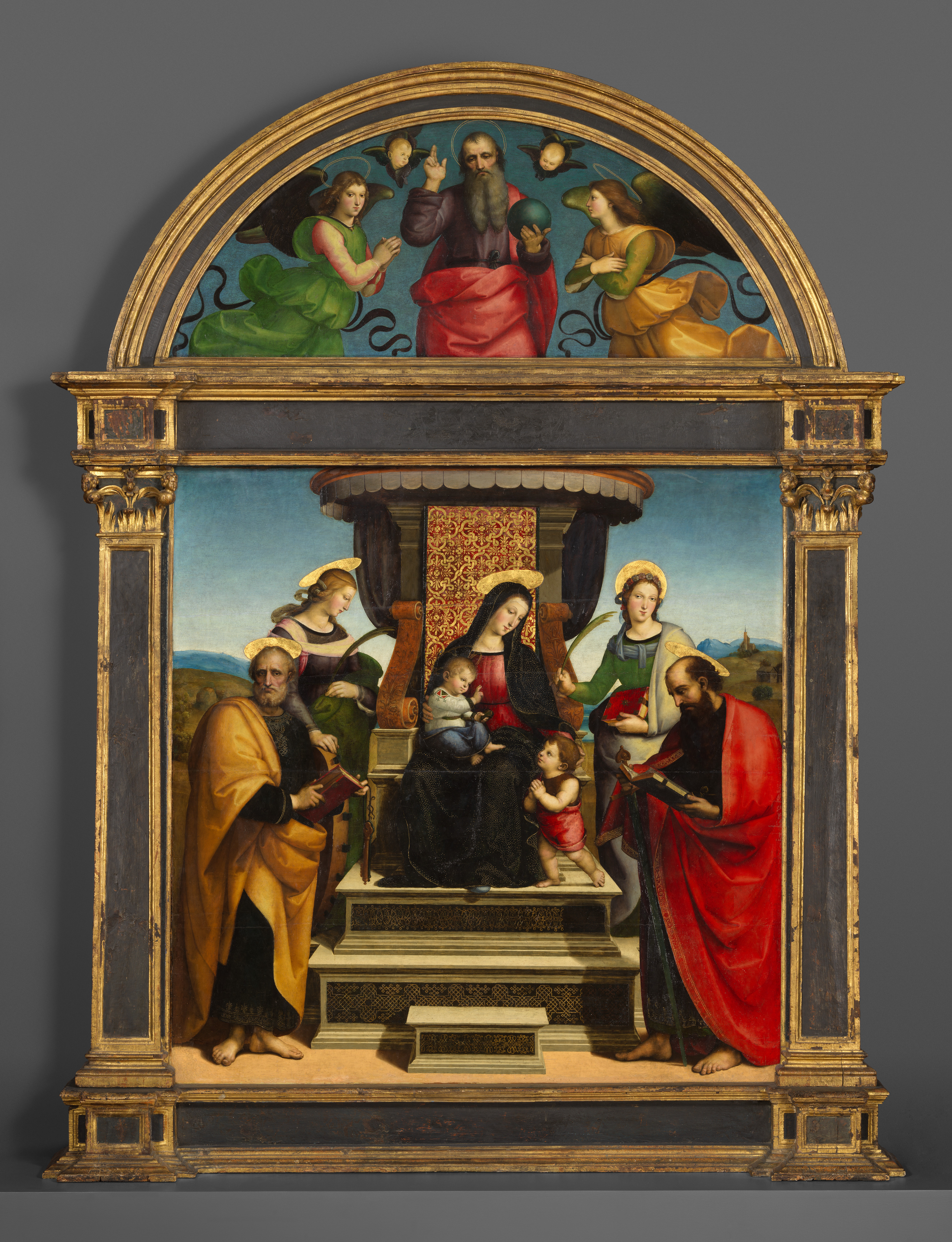
Within the hushed archives of Natalie Fashion Atelier, we engage in a practice we term aesthetic archaeology—the excavation of visual truth from historical masterpieces to inform the architecture of contemporary luxury. Our present subject, the Madonna and Child Enthroned with Saints, rendered in oil and gold on wood, presents a paradox of immobility that yields extraordinary kinetic potential. This work, steeped in Byzantine and early Renaissance tradition, is not a relic but a blueprint. It dictates a 2026 silhouette defined by hieratic verticality, gilded luminosity, and the structural logic of the mandorla. For the modern atelier, this altarpiece translates into garments that do not merely clothe the body but frame it, transforming the wearer into a living icon of composed power.
I. The Architectural Carcass: From Panel to Pannier
The altarpiece’s wooden support—rigid, unyielding, and geometrically precise—finds its direct couture analogue in the internal structure of the 2026 collection. We reject the fluid drapery of the past decade in favor of a return to controllée construction. The panel’s vertical thrust is mirrored in elongated, corseted torsos that extend the waistline by four centimeters, creating a lengthened, devotional proportion. This is not a Victorian wasp waist; it is a Renaissance stile—a rigid, conical shell that supports the upper body like a reliquary.
The technical execution relies on horsehair canvas and bias-cut silk gazar, layered over a base of sculpted boning that traces the exact curvature of the panel’s inner frame. The shoulder line is deliberately sharpened, echoing the architectural brackets that support the throne’s canopy. This creates a “gothic shoulder”—a precise, almost severe horizontal line that contrasts with the softened, inward-tapering waist. The result is a silhouette that reads as immovable yet paradoxically dynamic, as if the wearer has stepped directly from the gilded panel into the contemporary arena.
II. Gold Leaf as Second Skin: The Metallurgy of Light
The gold ground is not mere decoration; it is the painting’s theological core, a field of divine light that erases terrestrial shadow. In our 2026 haute couture, we translate this via metallic micro-lamé—a fabric woven from 24-karat gold-plated nylon filaments, so fine it moves like liquid mercury yet holds its architectural shape. This is not a shimmer; it is a luminous field. The fabric is applied in panels, not draped, to replicate the flat, unmodulated surface of the gold leaf.
Critically, we introduce the technique of craquelure appliqué. Just as the original panel exhibits fine, age-induced cracks in its gold surface, we deliberately fracture our metallic layers using a heat-pressed laser-etched lattice. This creates a micro-topography of light and shadow that catches the eye at varying angles, mimicking the devotional flicker of candlelight on the original. The 2026 silhouette, therefore, is not static. It is a living altarpiece that shifts between opulence and austerity depending on the viewer’s vantage—a sophisticated play on the sacred and the secular.
III. The Mandorla and the Mantle: Reimagining the Halo
Central to the composition is the mandorla—the almond-shaped aureole enclosing the sacred figures. This geometry is the most potent source for our outerwear. We propose a sculptural cape that, when viewed from the front, appears as a severe, closed column. Yet, upon movement, it opens into a full, elliptical arc, tracing the mandorla’s contour around the wearer’s body. The technical challenge lies in the cantilevered seam—a hidden internal frame of carbon fiber and molded buckram that holds the cape’s edge aloft, creating a permanent, three-dimensional halo.
The mantle of the Virgin, typically a deep lapis or crimson, is reimagined as a double-faced wool crepe—midnight blue on one side, oxblood on the other. The wearer can flip the mantle, altering the silhouette’s emotional temperature. This dualism references the painting’s own tension between the earthly (the saints’ tactile presence) and the celestial (the abstract gold). The mantle’s hem is weighted with internal lead-cored piping, ensuring it falls with the same deliberate, gravity-bound stillness as the painted folds, which never flutter but exist in a state of eternal, frozen drape.
IV. The Saints’ Vestments: Textural Hierarchy and Embroidery
The attendant saints in the panel are distinguished by their vestments—brocades, damasks, and orphrey bands—each with a distinct tactile signature. For 2026, we create a hierarchical textile system. The primary fabric is a silk duchesse satin, woven with a subtle, raised gaufrage pattern that replicates the painted folds’ three-dimensionality. Secondary accents employ cut-velvet appliqué in the exact hue of the panel’s verdaccio under-painting—a greenish-grey that, when glimpsed at the cuff or collar, suggests the process of creation, the raw pigment beneath the gold.
Embroidery is not ornamental but structural. We deploy orfèvrerie brodée—a technique using gold thread, seed pearls, and cabochon-cut glass—to trace the exact outlines of the saints’ halos. These embroidered circles are placed at the shoulder blades, sternum, and lower spine, acting as acupressure points of light. When the garment moves, these halos detach from the body’s plane, creating a kinetic trompe-l’œil that echoes the painting’s spiritual hierarchy. The wearer becomes the central figure, the saints demoted to mere spectators of her procession.
V. Chromatic Restraint: The Palette of Devotion
Our color story is derived from the panel’s pigment inventory, not its visual impression. We extract the raw umber of the shadowed flesh, the lead-tin yellow of the throne’s finials, and the azurite of the Virgin’s robe—but we mute them by 40% through a process of optical blending with grey undertones. The result is a palette of muted devotion: poussière d’or (gold dust), sang de bœuf (oxblood), bleu nuit (night blue), and terre verte (green earth). This is not a costume; it is a chromatic abstraction that allows the silhouette’s architecture to dominate. We deliberately avoid the panel’s bright cinnabar red, deeming it too literal. Instead, we introduce a burnt sienna that appears only as a hairline piping on the internal seams—a secret, hidden color revealed only during movement, like the underdrawing of the master’s hand.
VI. The 2026 Wearer: An Icon in Motion
The final silhouette is a paradox: monumental yet intimate. The extended shoulder line and rigid torso communicate authority, while the mandorla cape and halo embroidery invite contemplation. The garment’s weight—approximately 3.2 kilograms—is engineered to be felt, grounding the wearer in the same physical reality as the painted saints. This is couture as devotional performance.
In conclusion, the Madonna and Child Enthroned with Saints offers 2026 not a nostalgic pastiche but a system of proportions and light. By isolating its gold ground, its architectural frame, and its hieratic geometry, we construct a silhouette that is both timeless and radically contemporary. The wearer does not simply wear a garment; she inhabits a gilded architecture, a moving chapel of self-possession. This is the ultimate luxury: the ability to carry a sacred space within one’s own outline, rendered in oil, gold, and the finest silk that Paris can weave.