Archaeology of the Fold: The Kosode Fragment as a Blueprint for 2026 Silhouette Architecture
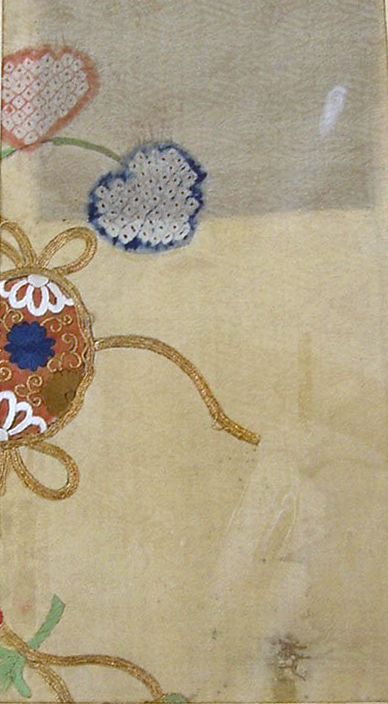
The study of historical dress is rarely a linear narrative; it is, more accurately, a process of aesthetic archaeology—excavating layers of material culture to retrieve principles that transcend their temporal origin. Within the hallowed archives of Natalie Fashion Atelier, the fragment of a Japanese kosode, specifically a section bearing a partial decorative ball (kusudama), presents a masterclass in restrained opulence. Constructed from resist-dyed silk satin damask (rinzu) and embellished with silk and metallic thread, this artifact is not merely a relic. It is a technical treatise on luminosity, structure, and the art of the invisible. For the 2026 haute couture season, this fragment offers a profound departure from transient trends, proposing a silhouette language predicated on tactile depth, architectural drape, and the strategic deployment of micro-ornamentation.
I. Material Dialectics: Rinzu and the Physics of Light
The foundation of this kosode’s power lies in its substrate: rinzu, a silk satin damask. Unlike flat, opaque textiles, rinzu operates on a principle of specular reflection. The satin weave’s floating yarns create a mirror-like surface, while the damask’s contrasting weave structures—satin against twill or plain weave—produce a subtle, chameleonic play of light. The resist-dye technique (shibori or itajime) further disrupts the surface, introducing a tonal gradient that mimics the soft diffusion of light through paper screens.
For 2026, this translates into a deliberate rejection of flat, digital-printed fabrics in favor of three-dimensional textile engineering. The atelier’s forthcoming silhouettes will utilize a modernized rinzu, woven with a higher twist in the warp to enhance body and resilience. The 2026 silhouette will not be draped to cling, but rather structured to catch and hold light in deliberate pockets. We propose a columnar gown where the front panel is woven in a high-contrast damask pattern—a geometric kusudama motif—while the back panel is left in a matte, resist-dyed finish. This creates a bi-luminous garment: a piece that changes its architectural reading as the wearer moves, shifting from reflective monumentality to absorptive subtlety.
II. The Kusudama Motif: From Amulet to Structural Node
The kusudama, historically a folded paper ball used for incense or medicinal herbs, is a symbol of protection and healing. In this textile fragment, the motif is partially visible, suggesting a larger, perhaps repeating, pattern. This partiality is crucial. It is not a literal representation but an abstracted geometry—a series of concentric diamonds and radiating lines that speak to the tension between the spherical and the planar.
In the 2026 haute couture collection, the kusudama is deconstructed from a two-dimensional print to a three-dimensional structural node. We will employ it as a functional bustle or a sculptural shoulder pad, constructed from folded silk organza and metallic thread piping. This is not ornamentation for its own sake; it is structural engineering. The node acts as a counterweight, allowing the fabric to fall in precise, controlled cascades. The silhouette for 2026 will therefore feature a pronounced asymmetry—a single, prominent kusudama-inspired structure at the hip or the scapula, which balances a fluid, unadorned expanse of rinzu. This creates a dialogue between tension and release, a visual metaphor for the modern woman’s equilibrium between public presence and private self.
III. Embroidered Cartography: Metallic Thread as a Line of Force
The embroidery on this kosode fragment is not merely decorative; it is cartographic. The silk and metallic threads trace the contours of the resist-dyed areas, effectively drawing a map of the dyeing process. The metallic thread—likely a flat, gilt strip—serves as a line of force, delineating the edges of the kusudama and adding a rigid, luminous boundary to the soft, dyed interior.
For 2026, we will translate this principle into a technique we term “embroidery as tailoring.” Instead of using thread solely for embellishment, we will use it as a structural stay. High-tensile metallic threads will be couched along the seams and darts of the garment, effectively creating an exoskeleton that allows the silk to hold a sharp, architectural edge without the need for heavy interfacing. This results in a silhouette that is paradoxically rigid and fluid: the outer lines are crisp and defined, while the interior fabric moves with organic freedom. The 2026 evening wear will feature this technique prominently, with metallic thread tracing the armhole, the princess seams, and the hemline, creating a glowing, topographical outline of the body’s form.
IV. The Principle of Ma: Negative Space in Silhouette
The most profound lesson from this kosode fragment is the concept of Ma—the intentional use of empty space. The resist-dye technique leaves areas of the silk untouched, allowing the damask’s own pattern to breathe. The embroidery does not cover the entire surface; it selectively punctuates. This is a lesson in restraint that is critical for the 2026 luxury market, which is increasingly moving away from logo-saturation towards quiet, knowledgeable luxury.
The 2026 silhouette will therefore incorporate negative space as a design element. This manifests as strategic cut-outs—not in a vulgar, skin-baring manner, but as architectural voids. A gown might feature a single, sweeping arc cut from the side seam, revealing a panel of plain, matte silk underneath. The eye is drawn to the void, allowing the mind to complete the form. This is the ultimate luxury: the confidence to leave things unsaid. The silhouette becomes a meditation on absence, where the garment’s power is amplified by what it does not show.
V. Synthesis: The 2026 Natalie Fashion Atelier Silhouette
The synthesis of these elements yields a distinct 2026 couture archetype: the “Rinzu Kusudama” silhouette. It is characterized by a high, structured neckline reminiscent of the kosode’s collar, flowing into a bi-luminous bodice of rinzu. The waist is not cinched but defined by a floating metallic thread panel, creating a visual corset. From the hip, a single, exaggerated kusudama node of folded silk organza projects, serving as a counterbalance to a train of resist-dyed silk that pools on the floor like liquid shadow.
This is not a costume. It is a philosophical garment. It speaks to a clientele that values provenance, technique, and the quiet power of material intelligence. By excavating the principles of this Japanese fragment, we do not copy the past; we re-architect its logic for a new era. The 2026 collection will not be about silhouette as shape, but silhouette as a sequence of light, void, and structure—a wearable thesis on the enduring relevance of classical elegance.