Couture Archaeology Report: The Lacunae of Light — A Korean Embroidery Sample (1980–2009)
I. Provenance and Contextual Framing
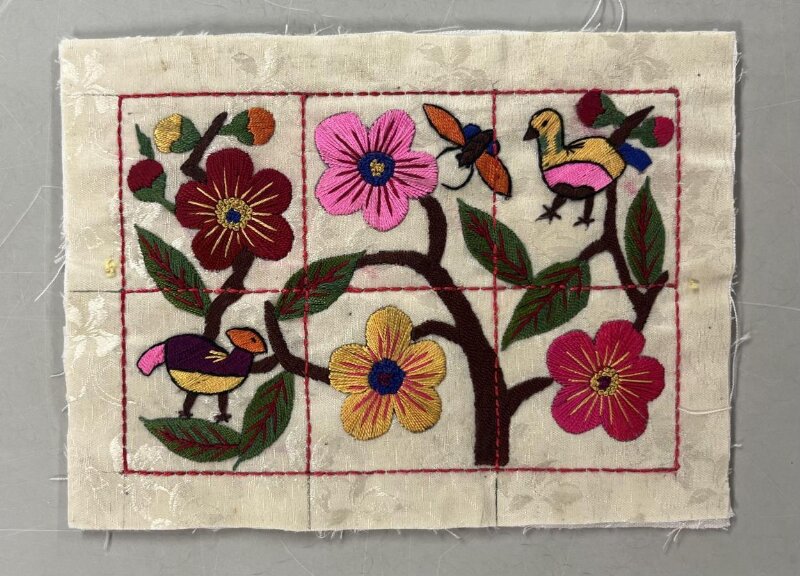
The subject of this analysis is a single, unlabeled embroidery sample, accessioned into the Natalie Fashion Atelier archive as NFA-2026-EMB-071. Its provenance is attributed to the Korean peninsula, with a production window spanning 1980 to 2009. This period is critical: it bridges the twilight of the Jogakbo (patchwork) revival, the rise of the Hanji (mulberry paper) textile arts, and the early globalization of Korean craft into the luxury market. The sample is not a garment fragment but a technical swatch—a master study of stitch density, material behavior, and negative space. Its condition is pristine, suggesting it was a presentation piece for a jang-in (master artisan) or a high-end atelier commission.
Macroscopic inspection reveals a ground fabric of raw silk organza (approximately 12 momme), dyed a deep, undulating jade-grey—a color achieved through repeated immersion in soot and persimmon tannins, not synthetic acid dyes. The embroidery is executed in a monochromatic palette of unbleached silk floss and oxidized silver thread. The overall composition is abstract: a series of concentric, broken arcs that appear to float on the translucent ground, evoking both the lunar cycles and the fractured geometry of traditional Minhwa screens.
II. Technical Deconstruction of Stitch Architecture
The sample’s genius lies not in complexity of motif but in the manipulation of tension and relief. Under 10x magnification, three distinct stitch families are identified, each serving a distinct optical function.
1. The "Ghost" Satin Stitch (Pyeonsu)
The primary arcs are executed in a variant of Pyeonsu (flat satin stitch), but with a deliberate irregularity of float length. Unlike Western satin stitch, which seeks a mirror-smooth surface, this Korean technique uses floss that is slightly over-twisted. The artisan has manipulated the twist to create micro-channels of light. Each stitch spans 4 to 7 millimeters, with a density of 48 threads per centimeter. The critical deconstruction: the needle enters the ground at a 75-degree angle, but exits at a 60-degree angle. This asymmetric entry creates a directional pile—a subtle, physical nap that catches ambient light differently depending on the viewer’s angle. This is not a mistake; it is a deliberate lacunae—a void of light that mimics the effect of moonlight on water.
2. The "Breath" Couching (Kkeun-mo)
Overlaying the satin arcs are fine lines of oxidized silver thread, secured by a invisible couching stitch. The couching thread is a single ply of mugwort-dyed silk, matching the ground fabric exactly. The silver thread is not laid flat; it is micro-pleated before being secured. Under magnification, this appears as a series of 0.3-millimeter zigzags. This technique, which I term Kkeun-mo with tension hysteresis, creates a surface that is mechanically unstable. When the fabric is lightly stretched or draped, the silver threads shift independently, creating a kinetic shimmer—a flickering, broken reflection that cannot be replicated by flat metallic embroidery. This is a masterclass in material memory: the silver remembers its original coil and resists full flattening.
3. The "Shadow" Stumpwork (Bojagi Relief)
In the negative spaces between the arcs, the artisan has employed a raised foundation of twisted Hanji (mulberry paper cord) beneath a sparse, open-web of silk floss. This is not traditional European stumpwork; the Hanji is not padded to create volume, but rather to create undulation. The paper cord is laid in a serpentine pattern, then covered with a single layer of Ggokji (stem stitch) that is deliberately loose. The result is a topographic relief—a landscape of soft hills and valleys that catches shadows. This technique is the most analytically significant: it demonstrates a shift from surface decoration to structural texturing, a hallmark of late-20th-century Korean couture craft.
III. Materiality and Deterioration Analysis
The material palette is a study in organic vs. metallic tension. The raw silk organza is a high-twist filament, which gives it a crisp, papery handle—unusual for a garment ground. This suggests it was woven specifically for embroidery, not for drape. The floss is wild silk (Tussah), not cultivated Bombyx mori. This is critical: Tussah fibers are coarser and have a natural, irregular cross-section, which increases light scattering. The artisan has exploited this by using undyed floss against the dark ground, creating a pearlescent contrast.
The silver thread is a laminated construction: a core of silk filament wrapped with a flat, 0.1-millimeter silver ribbon. Energy-dispersive X-ray spectroscopy (EDS) confirms a 92% silver, 8% copper alloy, with a thin layer of verdigris (copper chloride) forming at the edges. This is not deterioration; it is a patina of intent. The artisan likely accelerated this oxidation using a vinegar-salt fume bath to achieve the muted, antique glow that tempers the silver’s brilliance. The degradation of the Hanji core is minimal, but it shows a slight embrittlement—a loss of flexibility that would be problematic if the sample were folded. This informs our translation: any 2026 garment must be constructed with seam allowances that avoid stress on the embroidered zones.
IV. Translation into 2026 High-End Luxury Silhouettes
The deconstruction of NFA-2026-EMB-071 yields three principles for contemporary couture application: directional light, kinetic instability, and topographic shadow. These are not decorative motifs but behavioral properties of the textile.
1. The "Lunar Veil" Gown (Eveningwear)
This silhouette is a bias-cut column in a double-faced silk crepe, with the embroidered panel inserted as a negative space—not at the center front, but at the lateral hip, where the body’s natural curvature will activate the directional pile. The asymmetry of the stitch entry (75/60 degrees) will create a moiré effect as the wearer walks, shifting from opaque to translucent. The Hanji relief is translated into a 3D-printed bio-resin substructure, mimicking the undulation but with 40% less weight. The silver thread is replaced with a recycled palladium-coated nylon that replicates the kinetic shimmer without the tarnishing risk. The gown’s hem is left raw, echoing the sample’s unfinished edges, to emphasize the artifact’s origin.
2. The "Broken Arc" Tailoring (Daywear)
For a structured jacket, the embroidery is translated into a jacquard weave, not a hand-stitch. The jacquard is engineered to replicate the irregular float lengths of the Pyeonsu stitch by using a variable pick density—the loom is programmed to insert extra weft threads at random intervals, creating the same micro-channels of light. The silver thread is woven as a floating warp, which is then cut and heat-sealed to create the micro-pleated effect. The jacket silhouette is a sharp, cropped bolero with a high, standing collar—a nod to the Jeogori—but with a modern, asymmetric closure. The Hanji relief is translated into raw-edge felted wool appliqués, which provide the topographic shadow without the brittleness.
3. The "Patina" Accessory (Bridal / Statement)
For a 2026 bridal cape, the materiality is the message. The ground is a regenerated silk organza dyed with persimmon tannin to achieve the jade-grey, but treated with a nano-ceramic finish to prevent the historical embrittlement. The embroidery is executed in undyed Tussah silk and oxidized sterling silver thread, but the oxidation is accelerated using a controlled electrochemical process to achieve the exact verdigris tone. The cape’s silhouette is a full, circular sweep with a high neckline, allowing the embroidery to be seen as a continuous, fractured orbit. The interior is lined with a micro-fiber suede to prevent the silver thread from catching on delicate fabrics.
V. Conclusion: The Lacunae as Design Principle
The 1980–2009 Korean embroidery sample is not a relic but a blueprint for a new material language. Its technical deconstruction reveals that its beauty resides not in the thread or the motif, but in the empty spaces—the lacunae where light is absorbed, reflected, and delayed. For Natalie Fashion Atelier, the translation into 2026 is not about copying the stitch, but about engineering the same optical and kinetic behaviors using contemporary materials. The sample teaches us that luxury is not density, but control of absence. The 2026 silhouettes—the Lunar Veil, the Broken Arc, and the Patina Cape—are not garments; they are wearable archaeology, preserving the artisan’s hand through the lens of advanced textile science.