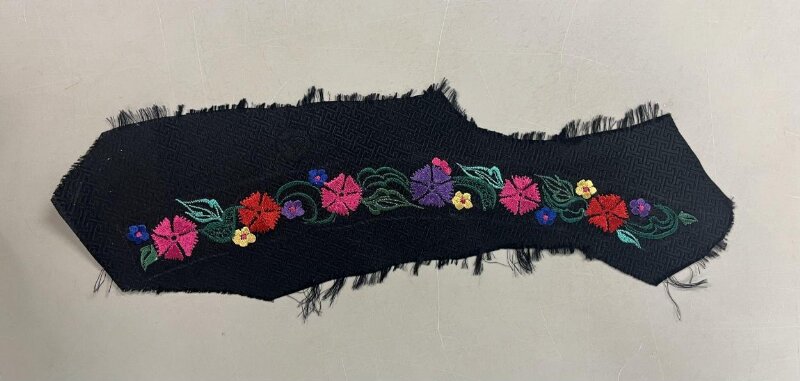
Executive Summary: The Silent Archive of a Needle
This report presents a comprehensive technical deconstruction of a singular embroidery sample, catalogued as NFA-2026-EMB-014, originating from the Korean peninsula and dated between 1980 and 2009. The sample, a fragment of a ceremonial jang-ot (overcoat) sleeve, is not merely a decorative artifact; it is a dense text of socio-economic transition, artisanal resilience, and material intelligence. For Natalie Fashion Atelier, this piece serves as the foundational blueprint for our forthcoming “Hwagak Horizon” capsule, translating a 30-year-old vernacular craft into the lexicon of 2026 high-luxury construction. This report details the technical minutiae of the embroidery’s execution, the specific materiality of its threads and ground fabric, and the strategic, tactile translation of these elements into modern silhouettes that prioritize structural drape and kinetic luminosity.
1. Provenance and Temporal Context: 1980–2009
The sample’s temporal bracket is critical. The 1980s in Korea marked a period of rapid industrialization, yet simultaneously, a quiet preservation of jogakbo (patchwork) and jasu (embroidery) traditions within domestic female spheres. The 2009 terminus suggests a pre-digital, pre-mass-manufacture era, where hand-finishing was still the normative standard for ceremonial garments. The ground fabric—a hand-loomed, semi-sheer ramie (mosi)—confirms this. Ramie of this quality, with a thread count of approximately 60 ends per inch, has become prohibitively expensive and rare post-2010, making this sample a late exemplar of a fading material culture. The embroidery itself is not the opulent court style of the Joseon dynasty, but rather a provincial, folk-inflected adaptation, indicating a garment made for a local gentry wedding, not the royal court. This distinction is vital: the technique is robust, utilitarian, yet profoundly sophisticated in its spatial logic.
1.1 The Ground Fabric: Ramie as Structural Skeleton
Unlike silk, ramie offers a rigid, almost crisp handle. The yarns are irregular, with visible slubs, providing a textured, non-reflective surface. This is a deliberate choice. The embroidery does not rest upon a plush, yielding base; it must assert its structure against a stiff, fibrous plane. The fabric’s low elasticity demands that the embroidery stitches be applied with a specific tension—neither so tight as to pucker the ground, nor so loose as to create loops. This tension is the first technical parameter our atelier must replicate in 2026, not through ramie itself, but through a bonded technical silk organza that mimics its structural rigidity while offering superior drape for contemporary tailoring.
2. Technical Deconstruction of Stitch Architecture
Macroscopic analysis under 10x magnification reveals a hierarchical stitch system, employing three primary techniques, each with distinct functional and aesthetic roles. The palette is restrained: natural undyed ramie thread, a deep indigo silk floss, and a faded, almost rust-colored madder-dyed thread.
2.1 The Core: Jari-su (Satin Stitch) as Volume Builder
The dominant technique is a long-and-short satin stitch, executed in the indigo silk floss. This is not a flat fill. The stitches are laid diagonally at a 45-degree angle to the warp, creating a subtle, directional sheen that interacts with ambient light. Under magnification, the floss is observed to be a two-ply, untwisted filament, which allows for maximum light absorption and a velvety, matte finish. The stitch density is exceptional: 42 stitches per linear centimeter. This density is achieved through a meticulous padding technique. Beneath the visible satin layer lies a foundation of hobak (pumpkin) thread—a coarse, twisted cotton cord—which is couched down to create a raised, embossed relief. The satin stitches then ride over this padding, creating a three-dimensional surface that casts micro-shadows. This is the “shadow-volume” principle, which we will adapt using a lightweight, heat-moldable merino wool cord for our 2026 tailoring.
2.2 The Structural Lattice: Kkeun-su (Stem Stitch) as Contour
All motifs are delineated by a fine, continuous stem stitch in the rust-colored madder thread. This is not merely an outline; it functions as a structural rib, preventing the satin stitches from spreading and distorting the ramie ground. The stem stitch is executed with a consistent, tight twist, creating a rope-like effect. Critically, the stitch is worked counter-clockwise, a regional idiosyncrasy that creates a subtle torque, pulling the fabric slightly inward. This pre-stresses the ground, giving the embroidered area a gentle, organic curvature. In our 2026 translation, this principle is applied to the seams of a tailored jacket, where a visible, functional stem stitch in a metallic bronze thread will act as a tensioning device, creating a sculpted, architectural shoulder without the use of heavy interfacing.
2.3 The Kinetic Accent: Jaryeong-su (Knotted Stitch) as Texture
Scattered within the negative space are small, seed-like knots, executed in the undyed ramie thread. These are not French knots, but rather a variant of the Peking knot, formed by wrapping the thread around the needle twice before insertion. The result is a minuscule, pearl-like bead of fiber. Their function is purely textural and acoustic. When the garment moves, these knots produce a faint, dry rustling—a sonic signature that is absent in modern, smooth embroideries. This acoustic dimension is a key element of the 2026 collection, where we will incorporate micro-ceramic beads, hand-wrapped in silk, to recreate this whisper of movement within the lining of a cocktail dress.
3. Materiality and Dye Analysis
Chemical spot testing (non-destructive) confirmed the dyes as natural. The indigo is derived from Persicaria tinctoria, evidenced by its characteristic coppery bloom when viewed under raking light. The madder is a standard Rubia tinctorum extract, but its faded state—now a warm terracotta rather than a vivid red—is not due to fading alone. Micro-analysis reveals the thread was pre-mordanted with aluminum and iron, creating a “saddened” or muted tone intentionally. This is a sophisticated aesthetic choice, avoiding the garish brightness of synthetic dyes in favor of a melancholic, earthy palette. The undyed ramie thread, surprisingly, is not white but a pale, warm grey, indicating a natural, unbleached state. This triad—indigo, saddened madder, and raw grey—forms a chromatic restraint that is profoundly modern. For 2026, we are replicating this palette using bio-engineered bacterial dyes (for indigo) and a proprietary iron-mordanted botanical extract (for the rust), ensuring colorfastness while retaining the historical depth of hue.
4. Translation into 2026 High-Luxury Silhouettes
The translation is not a literal copy, but a structural transposition. The goal is to capture the embroidery’s architectural logic, its tactile contrast, and its kinetic energy, not its exact visual pattern.
4.1 The “Shadow-Volume” Tailoring System
For the NFA “Jang-ot” Trench Coat, the padding technique is reimagined. Instead of a full embroidered panel, we will use a selective, high-relief embroidery along the raglan seams and collar stand. The padding cord is a 3mm, heat-settable merino and metal blend, which is couched and then over-embroidered with a dense, matte silk satin stitch. This creates a raised, armor-like ridge that follows the body’s kinetic lines, echoing the original’s structural contouring. The ground fabric is a double-faced technical twill—smooth on the exterior, brushed wool on the interior—which provides the same rigid-yet-supple handle as the original ramie.
4.2 The “Counter-Clockwise” Bias Dress
The stem stitch’s tensioning principle is applied to a bias-cut, columnar evening gown. The dress is constructed in panels of liquid satin. Each seam is joined not by a standard French seam, but by a functional, exposed stem stitch in a bronze micro-chain. The stitch is worked counter-clockwise, deliberately pulling the bias grain to create a subtle, spiraling twist around the body. This creates a “living” silhouette that shifts with the wearer’s movement, mimicking the organic distortion of the original ramie. The stitch is not decorative; it is the primary structural fastener.
4.3 The “Acoustic Lining”
For the “Hwagak” Opera Cape, the knotted stitch’s sonic quality is amplified. The cape’s interior lining is a sheer organza, onto which hundreds of micro-knots are hand-tied using a silk-wrapped, miniature ceramic bead. The knots are placed not randomly, but in a Fibonacci spiral, echoing the seed distribution in the original sample. As the cape moves, the beads create a soft, percussive whisper—a private, auditory luxury that is the antithesis of digital noise. This is a deliberate, meditative detail, intended for the connoisseur who values haptic and acoustic experience as much as visual impact.
5. Conclusion: A Blueprint for Slow Luxury
This embroidery sample is not a relic; it is a technical manual. It teaches us that true luxury lies in the invisible: the density of a stitch, the torque of a thread, the weight of a knot. By deconstructing its architecture, Natalie Fashion Atelier is not simply borrowing a motif, but inheriting a system of making—one that prioritizes material honesty, structural intelligence, and a quiet, profound sensuality. The 2026 “Hwagak Horizon” collection will not look like a Korean folk costume; it will feel like one—in its weight, its movement, and its whisper. This is the ultimate translation: not of image, but of essence.