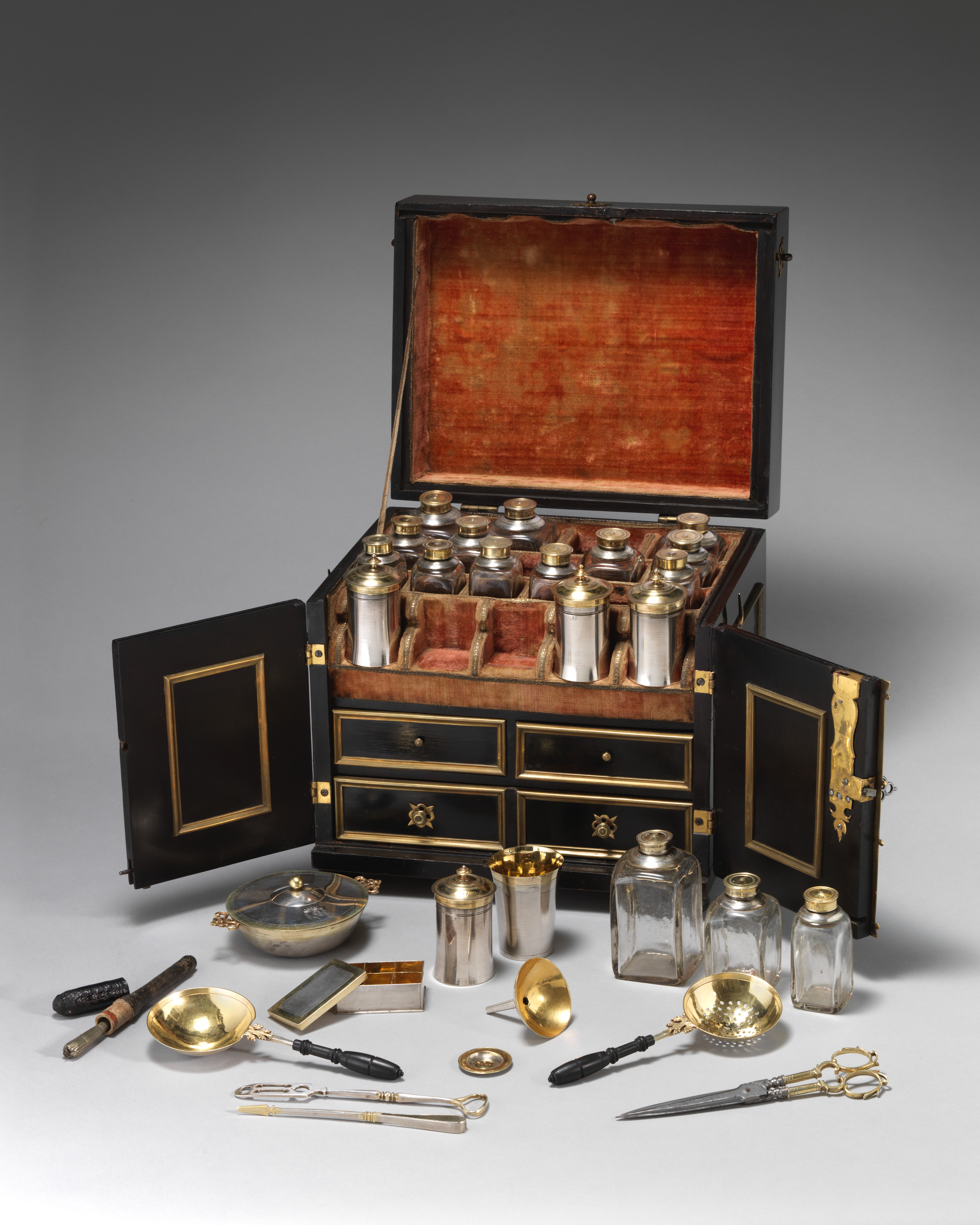
I. The Apothecary Cabinet as a Morphological Blueprint
The apothecary cabinet, in its most refined iteration—ebonized pearwood (Pyrus communis) veneer over a conifer carcass, accented with partially gilded silver and brass—is not merely a storage object. It is a treatise on disciplined opulence. For the 2026 silhouette, this artifact demands a departure from overt display toward a structural intimacy. The cabinet’s exterior presents a monolithic, darkly polished surface; its interior, a revelation of red silk velvet and precisely ordered glass. This dichotomy—austere shell, luxurious core—translates directly into tailoring. The forthcoming collections must adopt a dual-skin construction: an outer layer of matte, compressed technical wool or ebonized leather that absorbs light, paired with an inner flash of saturated crimson or vermilion silk lining, revealed only through engineered movement or deliberate deconstruction.
The material hierarchy of the cabinet is instructive. Pearwood, ebonized to mimic the density of true ebony, speaks to sustainable artifice. In 2026, this informs a preference for treated, dark-stained natural fibers—lyocell, modal, and densely woven hemp—finished with a semi-gloss, almost metallic patina. The partially gilded silver elements are not applied liberally but reserved for structural junctures: the hinges, the locks, the delicate pulls. In silhouette terms, this translates to strategic hardware placement—a gilded zipper track tracing the spine of a coat, or silver-toned grommets articulating a shoulder seam, functioning as both fastening and jewelry.
II. The Geometry of the Thirty-Two Vessels
The thirty-two glass and steel vessels housed within the cabinet are not random. They are a study in modular repetition—each container a variation on a cylindrical or ovoid theme, yet each with a distinct neck, lip, or base. This serial variation is the key to 2026’s high-end outerwear and separates. We move away from the single, monolithic garment toward the component wardrobe: a coat that is, in fact, a system of thirty-two interchangeable panels or pouches. Each module, though visually similar, serves a distinct function—a thermal pocket, a ventilation duct, a magnetic closure point—mirroring the apothecary’s need for differentiated containment within a unified aesthetic.
The low-carbon steel instruments, with their unadorned, functionalist profiles, introduce a necessary counterpoint to the gilt and velvet. They represent the utilitarian axis of luxury. For 2026, this justifies the inclusion of exposed, raw-edged seams, visible topstitching in contrasting steel-gray thread, and the use of unpolished, oxidized metal hardware. The silhouette becomes a dialogue between the précieux (the gilded, the silken) and the brut (the steel, the unrefined). A jacket’s silhouette may be sharply defined by a steel-boned corset structure, yet its surface is entirely covered in the softest, most tactile ebonized suede.
A. The Quilted Cushion and the Architecture of the Back
The interior’s protective quilted cushion, covered in red silk, is a masterclass in volumetric restraint. The quilting is not puffy or exaggerated; it is a low-relief, diamond-stitched pattern that adds structural integrity without compromising the object’s profile. This is the direct progenitor for the 2026 back panel. We reject the oversized, balloon-like padding of previous seasons. Instead, the silhouette’s posterior volume will be achieved through precision channeling—a technique where the padding is enclosed within stitched channels, creating a firm, sculptural shell that follows the natural curvature of the spine. The red silk is not merely a color; it is a thermal and tactile regulator. In garment terms, this suggests the use of a temperature-regulating, silk-blend wadding in the lining of outerwear, visible only at the nape or the cuff, a secret indulgence.
III. The Dialectic of Ebony and Gilt
The ebonized pearwood surface is a study in negative luxury. It does not shout; it absorbs. The 2026 haute couture silhouette must embrace this chromatic and textural darkness—not as goth, but as a sophisticated void. Fabrics should be developed with a light-absorption coefficient in mind: matte-finished, micro-sanded surfaces that feel dry to the touch, like the wood itself. The silhouette becomes a shadow play, where the garment’s form is read through its highlights and folds rather than its color.
Conversely, the partially gilded silver provides the point of light. The gilding is deliberately worn, partial, suggesting age and ritual use. This is translated into 2026 via abrasion techniques on metallic threads or lamé—not a uniform shine, but a distressed, historical glimmer that appears only when the wearer moves. The silhouette’s edges—the collar points, the cuff openings, the hemline—are the “gilded” areas, where a fine line of metallic embroidery or a delicate chain-stitch in silver thread delineates the garment’s boundary, echoing the cabinet’s gold trimming.
B. The Red Silk Velvet Lining: The Interior Gaze
The drawers lined with red silk velvet introduce the concept of the interior spectacle. In 2026, the garment’s inside becomes as important as its outside. This is not merely about a pretty lining; it is about the archaeology of the garment. Seams are bound in bias-cut red velvet. Pockets are constructed as miniature velvet-lined cases. The silhouette’s construction is left partially accessible—a hidden placket, a detachable sleeve—inviting the wearer to explore the garment’s internal architecture. This is a direct response to the cabinet’s design, where the most precious materials are reserved for the unseen.
IV. Synthesis: The 2026 Silhouette Defined
The apothecary cabinet, in its isolated aesthetic archaeology, does not offer a single silhouette but a system of silhouettes. The first is the Armoire Silhouette: a long, columnar coat with a rigid, straight front and a softly quilted back, closed with a single, large, gilded clasp at the throat. The second is the Vessel Silhouette: a cropped, high-collared jacket with multiple, asymmetric flap pockets, each proportioned to hold a specific tool—a phone, a card case, a vial of scent—mirroring the cabinet’s modular storage. The third is the Gilt-Line Silhouette: a fluid, bias-cut gown in black crepe, where the only ornamentation is a fine, tarnished silver thread tracing the collarbone and the hip, evoking the cabinet’s metal mounts.
Ultimately, the 2026 couture collection informed by this artifact is not about nostalgia. It is about the transfer of structural principles: the discipline of the dark exterior, the luxury of the hidden interior, the precision of modular components, and the strategic placement of precious metal. It is a silhouette that demands a second glance, a closer inspection, and a reverence for the craft that lies beneath the surface. The wearer becomes the curator, the garment a cabinet of wonders.