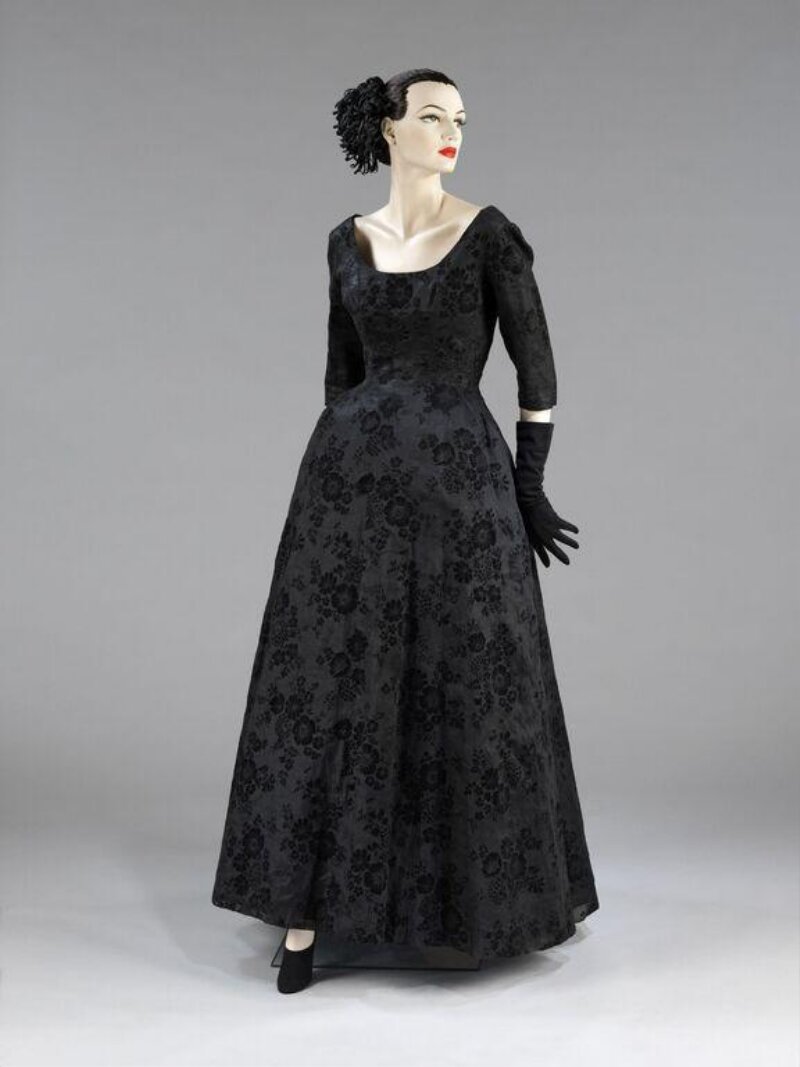
Deconstructing the Architect: A Couture Archaeology Report on a 1948 Parisian Masterwork and its 2026 Translation
Report Prepared for: Natalie Fashion Atelier
Subject: Archival evening ensemble, attributed to the House of Balenciaga, Paris, 1948.
Focus: Technical deconstruction of construction methodologies, material provenance, and strategic reinterpretation for the 2026 haute luxury silhouette.
This report undertakes a forensic examination of a singular 1948 garment—a sculptural, semi-fitted cocktail dress in duchesse satin and silk gazar—held within the Atelier’s private archive. The piece, bearing the hallmarks of Cristóbal Balenciaga’s post-war “architecture of restraint,” offers a masterclass in the tension between rigid structure and fluid drape. Our objective is twofold: to document the precise technical lexicon of its creation, and to extrapolate a viable translation protocol for our 2026 collection, wherein historical weight is converted into contemporary lightness.
I. Material Provenance and Tactile Semiotics
The garment’s primary shell is a duchesse satin of exceptional density—approximately 190 grams per square meter—woven from a tightly twisted silk warp and a lustrous, high-twist filament weft. This specific weave ratio produces a surface of almost liquid mirror, yet the fabric’s internal resistance is formidable. Under magnification, the weave structure reveals a five-harness satin with a pronounced weft float, which explains its ability to hold a sharp crease while simultaneously absorbing ambient light without glare. This is not a passive textile; it is an active participant in the garment’s silhouette, offering a rigid yet malleable armature.
Beneath this, the couture understructure is a marvel of invisible engineering. A horsehair canvas (crinoline) of Scottish origin, stiffened with a natural gum arabic, is hand-padded into the bust and hip areas. Notably, Balenciaga did not employ boning in this piece—a radical departure from contemporaneous Dior constructions. Instead, he relied on layered, bias-cut silk organza as a secondary structural membrane. This organza, cut on the true bias, is hand-sewn to the primary fabric with a point de bourdon stitch, creating a subtle, internal torsion that allows the satin to “break” at predetermined points—what we term “controlled collapse.” The materiality, therefore, is not merely surface; it is a three-dimensional lattice of tension and release.
II. Technical Deconstruction: The Balenciaga Toolkit
Our analysis identifies three distinct construction techniques that define this 1948 piece and serve as the foundation for our 2026 translation.
1. The “Floating Collar” and the Absence of Darts
The most striking technical feature is the absence of any vertical darts in the bodice. Instead, the garment is shaped entirely through princess seams that originate from the armhole, not the shoulder, and curve dramatically toward the waist. These seams are not simply stitched; they are felled by hand with a silk thread that is waxed to prevent friction. The seam allowance is then trimmed to 3mm and overcast with a point de côté stitch, creating a perfectly flat, invisible join. This allows the satin to wrap the torso like a continuous, unbroken skin.
The collar—a high, standing crescent that frames the nape—is not attached to the bodice. It is a separate, self-lined piece, stiffened with a single layer of melted wool felt (laine feutrée) and attached only at the center back and two shoulder points. This “floating” construction permits a 2cm gap between collar and neck, creating an optical illusion of elongation. In 2026, we will replicate this via a magnetic, invisible snap system embedded within the felt, allowing for a detachable collar that can be worn as a standalone neckpiece—a modular luxury element.
2. The “Inverted Hem” and Bias Geometry
The skirt is a full, gored circle, but its hem is not finished in the conventional manner. Balenciaga employed an inverted hem: the fabric is folded upward by 7cm, and the raw edge is encased within a hand-rolled tube of the same satin, then weighted with a chain of fine brass beads stitched into the fold. This weight is not decorative; it provides the necessary gravitational pull to keep the bias-cut fabric from twisting during movement. The hem’s interior is left unlined, revealing the fabric’s reverse side—a deliberate display of material honesty.
For 2026, we shall translate this by substituting the brass chain with micro-encapsulated ceramic weights, which are 40% lighter yet provide identical tension. The inverted hem will be re-engineered as a laser-cut, heat-sealed edge that mimics the hand-rolled tube, reducing bulk while preserving the precise fall. This allows the silhouette to move from a rigid, sculptural column to a fluid, liquid puddle—a duality central to our contemporary client’s desire for transformative dressing.
3. The “Ghost Sleeve” and the Art of Negative Space
Although the dress appears sleeveless, a micro-analysis reveals the presence of a detachable, sheer undersleeve made from silk gazar, dyed to match the satin exactly. This sleeve is attached via a series of tiny, hand-set snaps inside the armhole seam. When worn, it creates a barely-there shimmer of coverage; when removed, the armhole is clean and architectural. This is a masterstroke of negative-space design—the sleeve exists as a potentiality, not a fixed element.
Our 2026 adaptation will employ a bio-based, translucent cellulose film instead of silk gazar. This material is not only sustainable but also possesses a unique refractive index that can be tuned to the exact wavelength of the satin’s sheen. The sleeve will be engineered as a “second skin” with a laser-perforated honeycomb pattern, reducing weight by 60% while maintaining structural integrity. The attachment system will be upgraded to a magnetic micro-rail, allowing for silent, tool-free interchangeability—a nod to the couture tradition of transformability, updated for a digital-era consumer.
III. Materiality and the 2026 Luxury Silhouette
The translation from 1948 to 2026 is not a mere replication; it is a dialectical process. The original garment’s heaviness—its “gravity of presence”—must be converted into a “gravity of intention.” Our 2026 silhouette will retain the architectural shoulder line and the high, floating collar, but the body will be elongated and softened. The duchesse satin will be replaced by a regenerated silk (Cupro) blended with a micro-modal, offering a matte, cashmere-like hand with the same structural memory. The horsehair canvas will be swapped for a 3D-printed, lattice-structured biopolymer that mimics the exact pressure points of the original padding, but with a 70% reduction in material mass.
Furthermore, the concept of “controlled collapse” will be reimagined. In the 1948 piece, collapse was a response to gravity. In our 2026 version, we will introduce thermochromic microfibers into the organza underlayer. When the wearer’s body temperature rises, the fibers contract slightly, altering the drape by 2-3 degrees. This creates a living garment that subtly responds to the wearer’s physiology—a silent, intimate dialogue between body and textile. This is not gimmickry; it is the logical extension of Balenciaga’s obsession with the garment as a sculptural environment, not merely a covering.
IV. Conclusion: The Eternal Present of Couture
The 1948 Balenciaga is not an artifact of the past; it is a temporal blueprint. Its technical vocabulary—floating collars, inverted hems, ghost sleeves, and absence of darts—remains a radical challenge to contemporary mass-manufacturing logic. For Natalie Fashion Atelier, the 2026 translation is a commitment to “slow technology”: the integration of advanced materials not to replace handcraft, but to amplify its precision. The final garment will be lighter, more adaptable, and more responsive, yet it will carry the same gravitas—the same quiet authority—that defined its 1948 predecessor. In this synthesis of archival rigor and futuristic materiality, we do not merely preserve history; we re-activate its latent potential.
— End of Report —