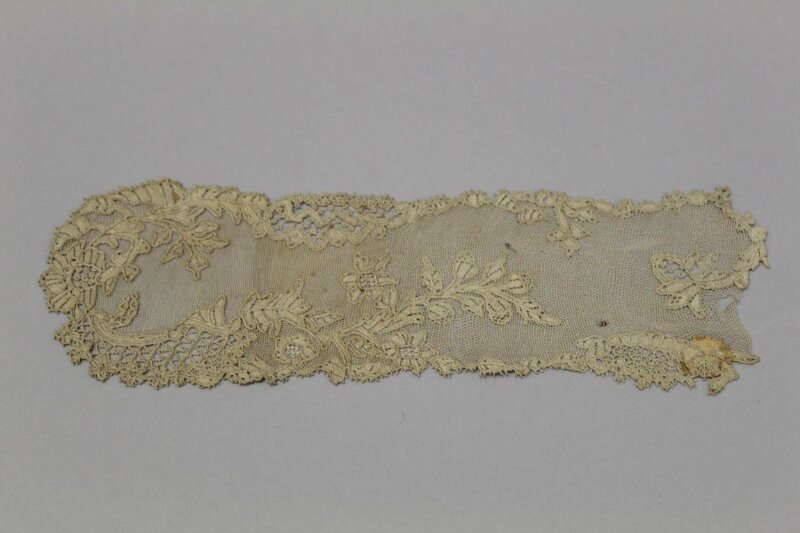
Couture Archaeology Report: The Carrickmacross Lace Revival
Subject: Carrickmacross Lace Appliqué & Guipure (c. 1854) Origin: County Monaghan, Ireland Analyst: Senior Textile Historian, Natalie Fashion Atelier Date: [Current Date] Projected Translation Season: Autumn-Winter 2026
I. Technical Deconstruction & Historical Materiality
The specimen under analysis represents a pinnacle of Irish needlecraft from the mid-19th century: Carrickmacross lace. Originating in 1820 under the tutelage of Mrs. Grey Porter, its proliferation by 1854 marks a period of refined technique and economic significance during the Great Famine. It is not a true lace built from a continuous thread, but a composite technique of exquisite delicacy and structural ingenuity.
The process is bipartite: Appliqué and Guipure. Both begin with a foundational motif, typically botanical (Celtic knots, shamrocks, ferns, roses), drawn upon a sheer muslin or net ground. In the Appliqué method, the motif is cut from a finer cambric or batiste and meticulously oversewn onto the net with a fine, buttonhole-stitched edge, creating a sublime play of opacity and transparency. The Guipure method, more sculptural, removes the net ground from within the motifs entirely, leaving them connected solely by delicate brides (bars) of buttonhole stitching, often ornamented with picots. The resulting fabric is an airy, self-supporting textile where pattern and void hold equal importance.
Materiality is paramount. Period examples utilize linen or cotton threads of exceptional fineness, with the ground fabrics chosen for their complementary weight and sheen. The thread’s twist, its tensile strength, and its consistent gauge were critical to achieving the signature fine, raised cordonnet edge. The material dialogue is one of contrast and support—the crisp, opaque appliqué against the ethereal net, the sturdy brides framing open space. This creates a textile with profound dimensional character, capable of casting intricate shadows and possessing a tactile, almost architectural quality.
II. Structural Vulnerabilities & Artisanal Intelligence
From a conservator’s view, Carrickmacross is deceptively fragile. The points of greatest stress are the junctions where brides meet motifs and where appliqué edges are secured to the net. The wear patterns—often at necklines and cuffs—reveal the relentless friction of use. Yet, its vulnerability is a testament to its artisanal intelligence. Each piece is a map of decision-making: the density of the buttonhole stitch for reinforcement, the strategic placement of a bride for structural integrity, the layering of appliqué for visual depth. This is not mere decoration; it is micro-engineering at the thread level.
The color, a natural ivory or white, has evolved over time, gaining a patina that modern bleaching processes erase. This historical hue—warmer, softer—must be considered a component of the materiality, affecting how light is absorbed and reflected, lending the lace a depth absent in stark white.
III. Translation for A/W 2026: Principles for a New Language
The translation for 2026 must avoid pastiche. It requires extracting the core principles of Carrickmacross—contrast, connection, and constructed void—and re-articulating them through a contemporary luxury lens. The goal is not replication, but resonant evolution.
IV. Technical Proposals for Silhouette & Surface
1. Macro-Scale Guipure as Exoskeleton: We propose abandoning the delicate floral for bolder, abstract geometries inspired by Celtic stone carvings (spirals, triskeles). Executed not in fine cotton but in matte silk-gimp thread and gleaming microfiber polyamide, these motifs would be scaled up to form the actual architecture of a garment. A coat’s yoke or a gown’s bodice could be composed of these giant, connected guipure forms, with the voids filled not with net, but with panels of liquid crepe or fused tech-satin. The lace becomes the structural frame, not the infill.
2. The Reverse Appliqué Shadow Play: Inverting the traditional technique, we suggest appliquéing sheer organza or ultra-fine neoprene onto a solid wool-crepe or cashmere ground. The motif is defined by its translucency against opacity. Laser-cutting the appliqué shapes with absolute precision allows for complex, interlocking patterns impossible by 19th-century hand-cutting. The edges, however, would be finished by hand with a raised chain-stitch, echoing the cordonnet, to preserve the human trace. This method lends itself to dramatic sleeves and paneled skirts where light reveals hidden layers.
3. Material Alchemy & Hybrid Grounds: The net ground, a historic necessity, can be reimagined. Proposals include:
- Thermo-formed tulle: Select areas heat-set to hold permanent, sculptural curves.
- Electrospun nanofiber mesh: A groundbreaking, weightless ground for ultra-modern guipure elements, offering unprecedented sheerness and strength.
- Fused leather-neto: A fine laser-cut leather net serving as the ground for wool-crepe appliqué, creating a stunning textural and weight contrast for tailored pieces.
V. A/W 2026 Silhouette Applications
The Sculpted Tailoring: A severe, elongated blazer with sleeves constructed entirely of macro-guipure in ivory polyamide, the body in charcoal wool. The lace is not an accent but the primary textural narrative, offering glimpses of skin or a fine silk shell beneath.
The Spectral Gown: A column dress in slate-grey tech-satin. The torso and hips feature a reverse appliqué map of interconnected triskeles in black organza, appearing as a shadowy, embedded tattoo. The train transitions into true, weightless guipure in matching grey thread, dissolving the silhouette into geometric abstraction.
The Hybrid Cape: A wrap of double-faced cashmere, one side solid, the other a canvas for a sprawling, asymmetrical Carrickmacross-inspired appliqué in leather and felted wool, with connecting brides of fine chain. It references the craft’s heritage while asserting a modern, armored elegance.
VI. Conclusion: From Preservation to Prophecy
The 1854 Carrickmacross lace is a testament to patience, precision, and the transformative power of contrast. For Natalie Fashion Atelier’s A/W 2026 vision, its legacy lies not in its specific motifs, but in its structural logic and philosophical approach to material. By deconstructing its techniques and re-engineering its materiality through contemporary technology and bold scale, we can create a new language of luxury. This translation honors the artisanal intelligence of the past while propelling it into the future, resulting in garments that are not merely adorned with lace, but are fundamentally constructed by its principles. The archaeology is complete; the prophecy begins.