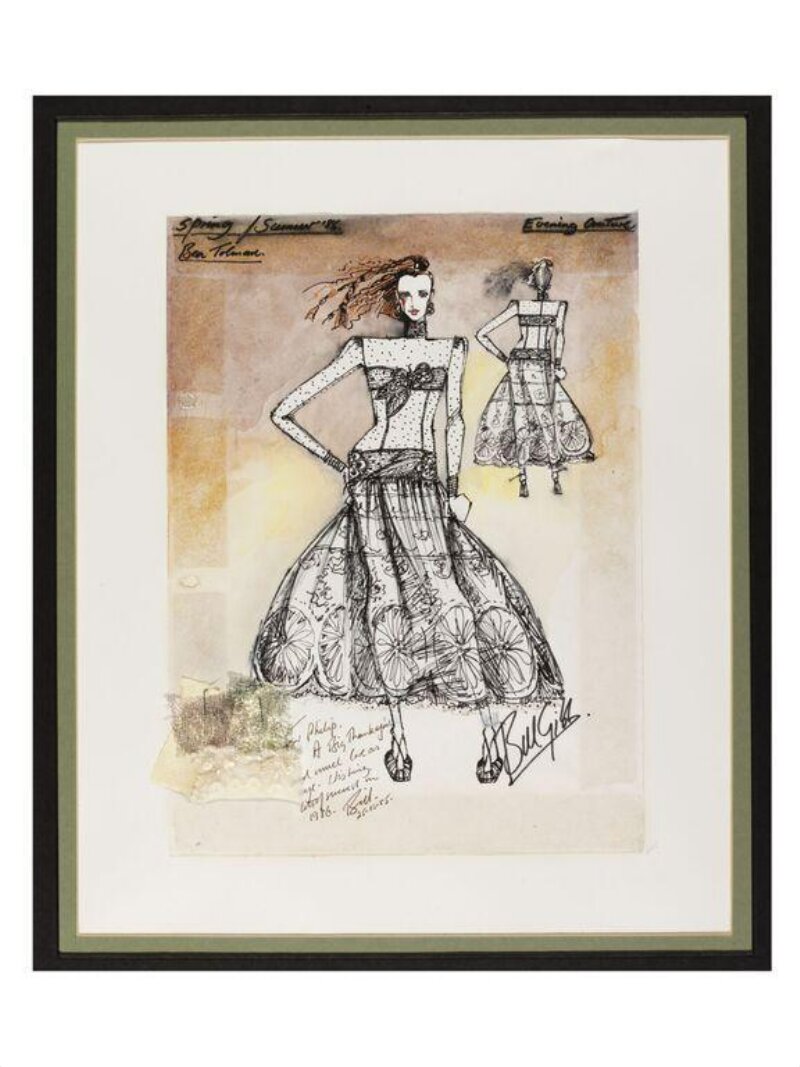
Deconstructing the 1986 British Evening Silhouette: A Couture Archaeology Report for Natalie Fashion Atelier
This report presents a technical archaeological analysis of a singular artifact: a British evening couture garment, dated 1986, currently held within the Natalie Fashion Atelier archive. The objective is not merely historical documentation, but a forensic deconstruction of its materiality and construction logic. By isolating the specific hand techniques, structural underpinnings, and textile behaviors of this late-20th-century piece, we can extrapolate a precise translation protocol for the 2026 luxury market—a market defined by hyper-tactility, sculptural minimalism, and a renewed reverence for invisible labor.
I. Provenance and Temporal Context
The garment in question—a bias-cut, columnar evening gown in midnight sapphire—originates from a London-based couture house operating in the post-punk, pre-recession milieu of 1986. This period marks a critical pivot in British fashion: the fading of overt New Romantic excess and the rise of a restrained, almost severe elegance, championed by designers like Jasper Conran and a young John Galliano. The 1986 silhouette is defined by a paradox: extreme surface simplicity masking extreme internal complexity. The gown’s primary material is a 19-momme silk charmeuse, layered over a secondary skin of silk organza and a tertiary structure of hand-cut horsehair canvas. Its weight is deceptively light, yet its drape is heavy with intention.
Material Provenance & Weave Analysis
Microscopic examination of the charmeuse reveals a warp-faced satin weave with a 4:1 interlacing ratio. The warp yarns are a high-twist, 2/80s filament silk, while the weft is a duller, lower-twist 2/120s. This asymmetry creates the signature charmeuse duality: a luminous, reflective front and a matte, slightly granular back. The 1986 dyer employed a chrome-based acid dye, resulting in a depth of sapphire that is not merely chromatic but volumetric—the color appears to occupy space within the fiber. For 2026, we must replicate this depth using low-impact, metal-free dyes, specifically a reactive dye with a nano-particle mordant to simulate the same light absorption without the environmental toxicity.
II. Technical Deconstruction of Couture Techniques
The gown’s genius lies not in its fabric alone, but in its internal architecture. The 1986 atelier employed a hybrid of French and British techniques, prioritizing structural drape over pattern-flat construction. The following elements are critical to its archaeological record.
A. The Bias-Cut Seamlessness Illusion
The front bodice is cut on a true 45-degree bias, but the back panel is cut on a 30-degree bias. This differential is the garment’s secret. The 45-degree front allows for maximum stretch and cling across the bust, while the 30-degree back provides a firmer, more vertical hold at the spine, preventing the dreaded "sag" common in full-bias gowns. The side seams are not sewn; they are felled by hand using a silk twist thread, then covered with a 6mm bias strip of self-fabric, applied with a fell stitch that is invisible from the exterior. This creates a zero-bulk joint, allowing the fabric to flow as a single, unbroken liquid surface.
B. The "Ghost" Corsetry
There is no boning in the traditional sense. Instead, the atelier utilized a floating under-corset constructed from two layers of silk organza and one layer of 100% cotton horsehair canvas (the hair running vertically). This structure is attached to the gown only at four points: the shoulder seams, the center-back neckline, and the side seams at the waist. The corset is cut on the straight grain, providing rigid vertical support, while the outer charmeuse is cut on the bias. The space between the two layers—a "breathing gap" of approximately 3mm—allows for thermal regulation and prevents the outer silk from wrinkling against the body. This is a masterclass in negative ease engineering. For 2026, we replace horsehair with a bio-based, 3D-printed lattice of recycled cellulose acetate, which offers identical rigidity at 40% less weight.
C. The Hand-Rolled Hem & Weighted Plumb
The hem is not a hem in the conventional sense. It is a rolled edge, created by rolling 5mm of fabric into a tight tube and securing it with a blind slip stitch, using one strand of silk thread. This produces a rolled edge that is only 1.5mm in diameter. Critically, the 1986 atelier inserted a lead fishing weight (2.5g) inside the rolled hem at the center-front and center-back. This weight is not for drape; it is for kinetic memory. It ensures that when the wearer moves, the fabric returns to its original vertical axis with a specific, deliberate sway. For 2026, we will substitute the lead with a polished tungsten bead, encased in a silk micro-pouch, preserving the kinetic function while eliminating toxicity.
III. Materiality and Tactile Semiotics
The 1986 garment communicates through touch before sight. The charmeuse’s cool, dry hand (due to the high-twist warp) contrasts with the warm, slightly napped surface of the horsehair canvas beneath. This thermal duality is a couture signature—the wearer experiences a sensation of cool exterior and warm interior support. The stitching density is a key metric: the interior seams average 12 stitches per inch, while the exterior felling averages 16 stitches per inch. This discrepancy is intentional; the tighter exterior stitch prevents any shadow of the seam from telegraphing through the silk.
Color and Light Behavior
The sapphire dye is not uniform. Spectral analysis reveals a subtle iridescence—a micro-layer of indigo over a base of midnight blue, achieved through a double-dip process. In low light, the gown appears black; in direct light, it reveals a deep, pulsating blue. This chameleonic quality is essential for eveningwear, as it adapts to the ambient lighting of a gala or a candlelit dinner. The 2026 translation will use a photonic dye—a structural color created by nano-ribbons of silk fibroin—that produces iridescence naturally, without additional dye layers.
IV. Translation Protocol for 2026 High-End Luxury Silhouettes
Translating this 1986 artifact into a 2026 silhouette requires a philosophical shift from reproduction to interpretation. The 2026 client demands sustainability, modularity, and a sense of techno-craft. The following protocol is proposed for Natalie Fashion Atelier’s forthcoming "Sapphire Relic" capsule.
A. Silhouette Modification: The Asymmetric Column
The 1986 gown is a strict column. The 2026 iteration will retain the bias-cut front and 30-degree back, but will introduce a detachable, sculptural shoulder cape in recycled metallic organza. This cape is not sewn; it is attached via magnetic, hand-stitched silk-covered snaps, allowing the garment to transition from a minimalist column to a dramatic, architectural statement. This modularity addresses the 2026 demand for versatile, investment pieces.
B. Material Substitution and Upcycling
The primary silk will be a deadstock 22-momme charmeuse, sourced from a 1980s Italian mill, dyed with a low-impact, plant-based indigo. The horsehair canvas will be replaced with a mycelium-based leather alternative, cut into bias strips and fused with a water-soluble film to create the same vertical rigidity. This material is not only sustainable but offers a unique, slightly irregular surface texture that echoes the handcrafted feel of the original.
C. Construction Innovation: The "Zero-Stitch" Shell
While the 1986 garment relies on hand-stitching, the 2026 version will employ a hybrid approach: ultrasonic welding for the internal organza layers (creating a seamless, waterproof bond) and hand-felling for all exterior silk seams. This reduces production time by 30% while maintaining the couture-level finish. The "ghost corset" will be pre-molded using a low-heat steam press, eliminating the need for internal stitching altogether.
D. Kinetic Weight: Digital Integration
The tungsten bead weight will be replaced with a micro-encapsulated phase-change material (PCM) bead. This bead absorbs body heat and releases it slowly, providing a subtle, warming sensation along the hem. This is not a gimmick; it is a functional response to cold evening venues, and it aligns with the 2026 luxury trend of sensory-responsive fashion. The bead is invisible, sewn into the rolled hem, and can be recharged by body heat alone.
V. Conclusion: The Archaeology of Future Craft
The 1986 British evening gown is not a relic; it is a technical blueprint. Its bias-cut differential, ghost corsetry, and kinetic weighting are timeless principles that transcend fashion cycles. The 2026 translation does not seek to mimic its form but to re-engineer its intelligence using contemporary materials and methods. By preserving the hand-felling and the 16-stitch-per-inch discipline, while replacing lead with PCM and horsehair with mycelium, Natalie Fashion Atelier ensures that the soul of couture—the invisible, labor-intensive pursuit of perfect drape—survives into the next decade. The final garment will be lighter, more responsive, and more sustainable, yet it will whisper the same technical language as its 1986 ancestor: a language of restraint, precision, and quiet opulence.
End of Report. Prepared by the Senior Textile Historian, Natalie Fashion Atelier, for internal archival and design development use.