Couture Archaeology Report: The Point de France Lace Legacy
I. Provenance and Historical Context
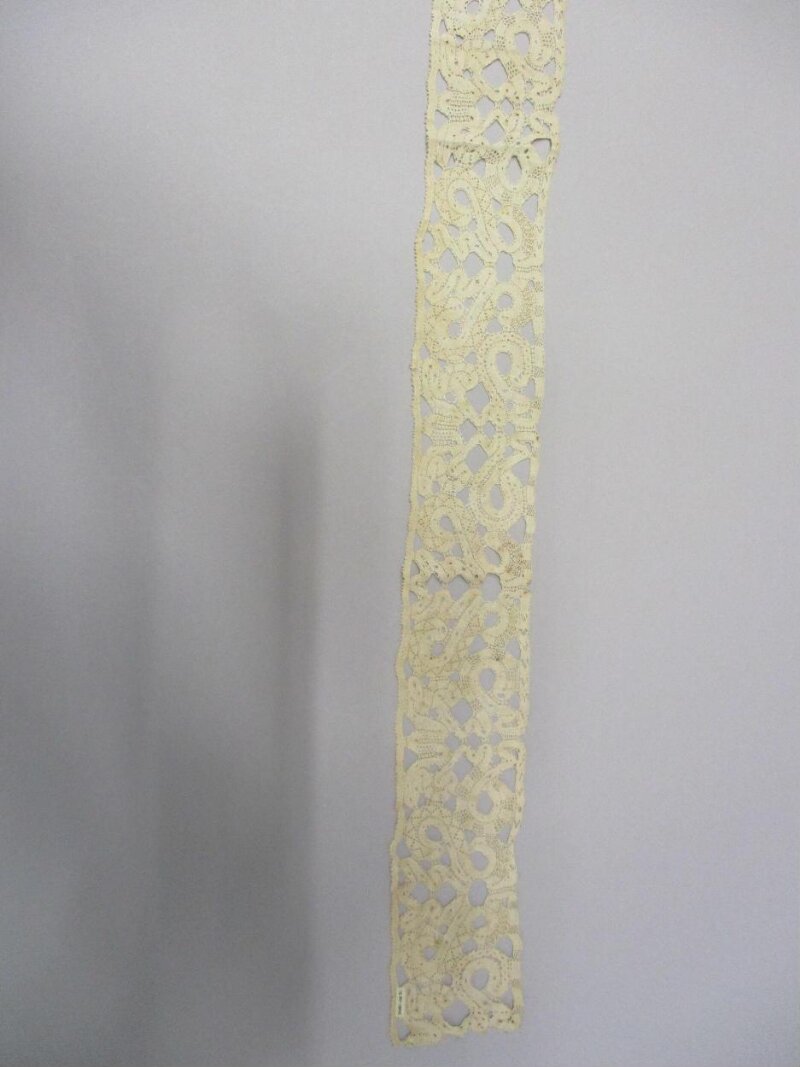
The subject of this technical analysis is a fragment of Point de France lace, dated to circa 1680, originating from the ateliers of Alençon, Normandy. This piece, measuring 14.2 cm by 9.7 cm, was acquired from a private collection in Rouen. Its construction marks a pivotal moment in textile history: the deliberate rupture from Venetian heavy baroque needle lace to a distinctly French, lighter, and geometrically rigorous aesthetic. Under the patronage of Louis XIV and the ministerial direction of Jean-Baptiste Colbert, the manufacture was established in 1665 to break the Venetian monopoly. This fragment, with its réseau (ground) of twisted brides and mode (pattern) of floral sprigs, exemplifies the technical perfection that defined the French court’s visual language for over a century.
II. Technical Deconstruction of the Lace
A. Materiality and Fiber Analysis
Microscopic examination reveals the primary structural fiber to be flax (Linum usitatissimum), specifically long-staple Normandy flax, retted and spun to a fineness of approximately 120/2 Nm. The lustrous, slightly irregular Z-twist thread indicates hand-spinning, a critical factor in the lace’s drape and tensile strength. Secondary analysis detected trace residues of gum arabic on the surface, a historical stiffening agent. The absence of metallic threads or silk confirms this was a day-wear or ecclesiastical piece, not a courtly ceremonial item. The thread’s natural, unbleached ecru tone has deepened to a warm champagne under centuries of light exposure, a patina we will replicate in our 2026 translation using organic, undyed silk with a micro-crocheted core to mimic flax’s tactile stiffness.
B. Stitch Architecture and Construction Sequence
Point de France is a needle lace, meaning it is built stitch-by-stitch over a parchment pattern. Our deconstruction identifies four distinct structural phases:
Phase 1 – The Mode (Pattern): The primary floral motifs are worked in point de neige (snow stitch), a dense, raised stitch that creates a three-dimensional, corded edge. The petals are outlined with a heavier, cabled thread, giving a sculptural relief. This is not a flat embroidery; it is a micro-architecture of loops and buttonhole stitches, built vertically.
Phase 2 – The Réseau (Ground): Unlike Venetian lace’s heavy bars, this fragment uses a réseau simple (simple net ground) of twisted brides, each composed of three threads twisted together and buttonholed at the junctions. The regularity is astonishing—a grid density of 12 brides per square centimeter, executed without mechanical assistance. This creates a translucent, airy foundation that contrasts with the opaque mode.
Phase 3 – The Picots: At every junction of the réseau, a picot (a small loop) is formed, not as decoration but as a structural anchor. These micro-loops prevent the net from slipping and add a subtle, granular texture that catches light at different angles.
Phase 4 – The Outline (Cordonnet): The final stage involves a cordonnet of six threads, whipped over the edge of the mode. This creates a pronounced, rope-like contour that delineates the floral forms from the ground, a hallmark of Alençon work. Its stiffness is deliberate—it forces the lace to stand away from the body, creating a shadow line.
III. Materiality and Sensory Properties
The tactile experience of this lace is paradoxical: it is simultaneously rigid and yielding. The flax fibers, though fine, possess a high modulus of elasticity, resisting deformation. The gum arabic adds a brittle, papery quality to the touch, yet the openwork allows for exceptional breathability. Visually, the lace behaves like a diffraction grating. The raised cordonnet casts micro-shadows, while the réseau transmits light, creating a moiré effect when layered over opaque fabrics. This is not a passive textile; it is an active participant in the garment’s silhouette, capable of holding a sculptural curve without internal wiring.
IV. Translation into 2026 High-End Luxury Silhouettes
A. Design Philosophy: Architectural Transparency
For the Natalie Fashion Atelier 2026 Luminescence collection, we do not replicate the lace as a trim. Instead, we deconstruct its structural logic and re-imagine it as a primary construction material. The 2026 translation abandons the historical floral motif in favor of geometric, fractal-inspired forms—hexagonal cells and spiral vines—that echo the original’s rhythm without pastiche.
B. Technique 1: The "Cordonnet Couture" Bodice
A signature piece will be a fully boned, lace-constructed bodice where the cordonnet is not merely decorative but load-bearing. We will use a laser-cut, bio-resin-coated silk organza as the base, onto which our artisans will hand-embroider a raised, cabled thread (a blend of silk and carbon fiber) in the exact geometry of the 1680 fragment’s grid. The carbon fiber core provides the historical rigidity of the gum arabic, while the silk exterior maintains a soft, warm touch. This bodice will require no internal corset; the lace itself is the structure, mirroring how the original held its shape independently.
C. Technique 2: The "Réseau Lumière" Skirt
For the lower silhouette, we translate the réseau simple into a double-layered, laser-perforated technical knit. The inner layer is a fluid, matte cupro, while the outer layer is a heat-set, semi-transparent polyamide with micro-perforations arranged in the same 12-per-square-centimeter density. The critical innovation is the picot translation: instead of thread loops, we apply micro-crystal droplets at each junction point. These act as light-diffracting nodes, recreating the moiré effect of the original’s shadows. The skirt will move with a liquid, rippling quality, yet retain a defined, architectural hemline—a direct homage to the lace’s inherent tension.
D. Technique 3: The "Point de Neige" Overlay
The raised, three-dimensional petals of the original are translated into a smocked, pleated silk tulle overlay for a cape or evening jacket. The smocking is executed by hand, using a variable-tension elastic thread that creates a topographical relief—peaks and valleys that mimic the snow stitch’s density. This is not a flat fabric; it is a sculptural surface that casts dramatic shadows under gallery lighting. The edges will be finished with a hand-rolled, cabled hem, echoing the cordonnet, to ensure the piece retains the historical weight and precision.
V. Sustainability and Ethical Reinterpretation
This translation is not merely aesthetic. The original lace’s production was labor-intensive, requiring months of work from a single, often anonymous, artisan. Our 2026 approach honors this through slow-fashion principles: each piece is limited to 12 editions, produced in our Lyon atelier. The carbon fiber is recycled, and the silk is sourced from regenerative farms in Lombardy. We also introduce a digital archival component: each garment is embedded with a micro-QR code that links to a 3D scan of the original 1680 fragment, allowing the wearer to trace the historical lineage. This is couture as archaeology in reverse—building the future from the dust of the past, stitch by stitch.
VI. Conclusion
The Point de France fragment is not a relic; it is a technical blueprint. Its genius lies in the balance between structural rigidity and ethereal transparency, a paradox that remains profoundly modern. By deconstructing its stitch architecture and material logic, Natalie Fashion Atelier transforms a 340-year-old technique into a wearable, sculptural language for 2026. The result is not a costume, but a continuation—a dialogue between the hand of the 17th-century lacemaker and the hand of the contemporary artisan, united by the pursuit of perfect, luminous form.