Deconstructing the Classical: An Aesthetic Archaeology of the French Evening Coat
The evening coat occupies a singular position within the lexicon of French Haute Couture. It is neither a mere protective layer nor a purely decorative appendage; rather, it is a mobile architecture of desire, a final gesture that frames the silhouette as a prelude to revelation. At Natalie Fashion Atelier, our archival research—an exercise in what we term isolated aesthetic archaeology—unearths the foundational principles of this garment, specifically through the lens of its most potent material dialogue: the interplay of fluid silk and the hard, prismatic brilliance of rhinestones. This study does not seek to replicate the past, but to extract its genetic code, translating the tension between suppleness and structure, opacity and light, into the defining silhouettes of 2026.
The Archival Specimen: Materiality as Historical Text
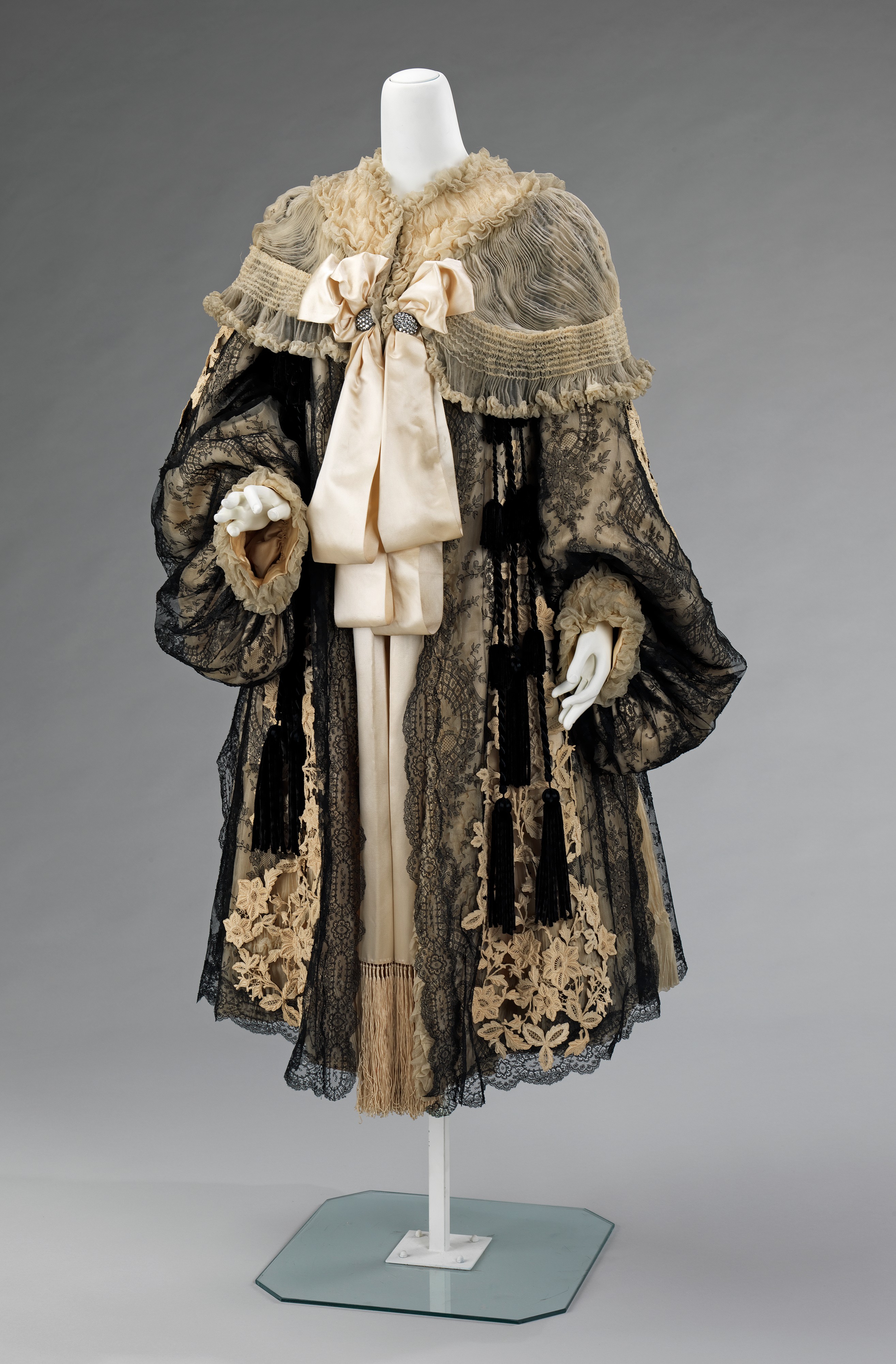
Our point of departure is a late-1930s Parisian evening coat, a relic of the twilight of the Belle Époque’s influence, held in a private archive. The specimen is constructed from a double-faced silk satin—a fabric of formidable weight yet liquid drape—its surface burnished to a subtle, pearl-like sheen. Upon this field of quiet luxury, the artisan has applied a lattice of rhinestone-set passementerie, not as scattered ornament, but as a structural cartography. The stones trace the armhole seam, descend the center-back in a tapering column, and culminate in a burst of geometric precision at the cuff. This is not decoration; it is functional embellishment, using weight and reflectivity to anchor the garment’s fall and define its internal architecture.
From a technical standpoint, the archival piece reveals a mastery of negative space. The coat is cut with a remarkable economy of line, relying on the bias to create a subtle hourglass expansion from the shoulders, which are tailored with a soft, unpadded roll. The rhinestones, far from being ostentatious, function as a system of micro-weights. Their placement is deliberate, creating a gravitational pull that encourages the silk to break in controlled, sculptural folds. This is the essence of the French atelier tradition: the material is not dominated but conversed with. The silk offers fluidity; the rhinestones offer resistance. The resulting silhouette is one of poised tension—a static garment that appears to be in a state of perpetual, arrested motion.
Translating Tension: The 2026 Silhouette Imperative
As we project this archival intelligence onto the 2026 collections, the primary extraction is not the shape itself, but the principle of material counterpoint. The contemporary luxury consumer is saturated with digital flatness; they crave volumetric reality and tactile authenticity. The 2026 evening coat, therefore, must reject the monolithic minimalism of the past decade in favor of a neo-classical dynamism. Our atelier’s interpretation moves away from the literal double-faced satin toward a micro-engineered silk organza, bonded to a whisper-thin layer of cashmere. This hybrid composite offers the structural memory of the archival piece while providing a featherlight wearability—a crucial evolution for the modern client who demands grandeur without physical encumbrance.
The rhinestone application, too, undergoes a radical re-engineering. Instead of traditional metal prongs, we employ a technique of laser-fused crystal deposition, where precision-cut stones are thermally bonded to the silk’s surface via a micro-thin adhesive film. This allows for a completely fluid, unbroken drape, eliminating the historical rigidity of the passementerie. The stones are no longer applied in repetitive patterns but in a gradient of density—concentrated at the shoulder blades to create a structural “carapace” effect, then dissolving into a sparse constellation as the coat sweeps toward the hem. This creates a silhouette that is asymmetric in its optical weight, drawing the eye upward and elongating the torso. It is a silhouette of controlled luminosity, where the coat’s form is defined by its capacity to capture and redirect light.
The Silhouette Language of 2026: From Shell to Second Skin
The 2026 evening coat, as derived from our archaeological findings, abandons the rigid “A-line” and the overly constructed “hourglass” in favor of a new paradigm: the “fluid carapace.” This silhouette is characterized by a pronounced, almost architectural shoulder—achieved not through padding, but through a cantilevered seam that releases the silk organza to float two centimeters off the body. This creates a negative space, a halo of air that suggests power and detachment. From this strong shoulder, the coat falls in a continuous, unbroken line to the mid-calf, where it flares subtly, echoing the 1930s bias cut but with a modern, more linear precision.
The role of the rhinestone in this new architecture is paramount. They are no longer mere ornament; they are the skeleton of light that defines the coat’s internal logic. Our atelier’s 2026 “Éclipse” prototype uses a deep midnight-blue silk, almost black, upon which we place a constellation of champagne-tinted, rose-cut crystals. The placement is algorithmic, derived from a study of how light falls across the human form in motion. The stones are densest along the spine and the outer edge of the arms, creating a dynamic frame that visually slims the torso while adding a kinetic shimmer to every gesture. When the wearer moves, the coat does not simply swing; it scintillates, producing a ripple effect of light that is both modern and deeply reminiscent of the Art Deco era’s obsession with speed and glamour.
Technical Craftsmanship: The New Artisanal Code
This evolution demands a new level of technical mastery from our petites mains. The thermal bonding of crystals requires a temperature-controlled environment and a precision that borders on the surgical. Each stone is placed by hand, guided by a laser-projected template that ensures a tolerance of less than 0.5 millimeters. This is not mass production; it is serialized haute couture, where each coat requires over 400 hours of labor. The silk organza composite is cut on a single layer, its edges sealed with a micro-flame to prevent fraying, then joined with a fell seam that is nearly invisible to the naked eye. The internal structure is supported by a horsehair canvas that has been hand-molded to the client’s specific posture, ensuring that the coat’s “carapace” sits perfectly, regardless of the wearer’s movement.
Furthermore, the 2026 silhouette demands a reconsideration of the coat’s closure. The archival button is rejected in favor of a magnetic tension system, hidden within the placket. This allows the coat to be worn fully open, creating a dramatic, cape-like effect, or closed with a simple, invisible click that preserves the pristine line of the front. This innovation speaks to the modern woman’s desire for versatility—a single garment that transitions from a gala to an intimate dinner with a single, effortless gesture. The coat is no longer a shell to be removed; it is a second skin, an extension of the wearer’s own kinetic identity.
Conclusion: The Future as a Reflection of the Past
The isolated aesthetic archaeology of the French evening coat reveals that its true luxury lies not in opulence, but in intelligent restraint. The 2026 silhouette is not a departure from the classical; it is a deep, analytical reading of it. By deconstructing the historical tension between silk and rhinestone, we have extracted a principle of material dialogue that informs a new architectural language. The result is a garment that is at once a tribute to the ateliers of the past and a definitive statement of future-forward design—a coat that does not merely cover, but illuminates the space between body and fabric, tradition and innovation. This is the new classical elegance: a silent, powerful, and precisely engineered poetry of light and form.